Get Full Government Meeting Transcripts, Videos, & Alerts Forever!
Get email alerts on the Capital Improvement Program topic
No spam. Unsubscribe anytime.
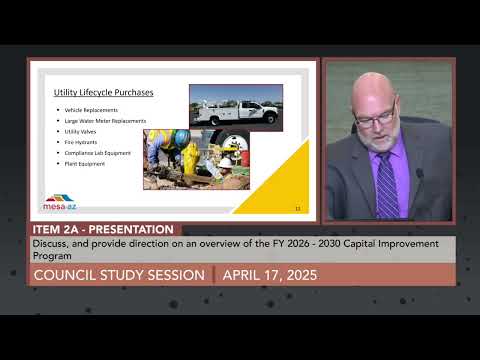
Mesa council reviews five-year capital improvement plan and bond project prioritization
Summary
Mesa City Council study session reviewed the FY2026–2030 capital improvement program, discussed how voter-authorized bond authorizations are allocated to projects, and raised questions about funding shortfalls and project prioritization including the public safety training campus and the Center Street active-transportation project.
Mesa City Council members met in a study session April 17 to review the city's proposed five-year Capital Improvement Program (CIP) for fiscal years 2026 through 2030 and to discuss how voter-approved bond authorizations are allocated and prioritized.
City staff said the CIP is a planning document used to schedule and allocate financial resources to address infrastructure needs and noted the five-year plan that comes to council is the city's funding plan; only the first year is appropriated as part of the annual budget. Brian Richel, director of the Office of Management and Budget, told the council, "The program is really a planning document. It allows the city to schedule and allocate financial resources to address infrastructure needs."
The presentation highlighted how projects are funded: utility projects primarily with utility revenues and obligations, and general-government projects with local revenues, regional awards and grants, voter-authorized general-obligation bonds and other debt types such as excise-tax obligations. Staff emphasized they also consider operations and maintenance costs when programming new buildings such as libraries and fire stations so the city can both build and sustain services.
Council members pressed staff on how bonds and allocated funds are tracked and whether projects listed in bond brochures are guarantees. City attorneys and finance staff explained the city typically bonds by category rather than by specific project; the ballot and voter materials show intended projects but the authorizing language and later council approvals allow staff to prioritize within the category, then return to council for allocations as design and costs are confirmed. A city attorney said projects are changed publicly and with council approval when necessary.
Council members raised project-specific concerns. The public-safety training campus remains a complex, multi-use campus still in master planning; staff said the original authorization will likely be insufficient and that additional funding or phasing will be necessary. The Center Street connector (often discussed in the Mesa Moves program) was described as having had a feasibility study funded but not construction funding; staff said it remains on the active transportation priority list but is currently unfunded for construction due to escalating costs on higher-priority projects.
Council requested more detail on which bond-authorized projects are completed versus allocated versus still waiting design or funding. Staff said they will provide the council the lists showing the status of allocations, percent complete on projects and the longer list of unfunded projects. Several council members urged that future bond outreach continue to make clear the distinction between example projects shown to voters and the category-based nature of bond authorizations.
The study session closed with staff offering to return with additional lists and clarifications on allocations and on financial forecasting for planned and unfunded projects, and to brief council committees on large multi-year items before ballot proposals are prepared.