Get Full Government Meeting Transcripts, Videos, & Alerts Forever!
Get email alerts on the Pre K topic
No spam. Unsubscribe anytime.
Sumner County proposes consolidated Gallatin pre-K campus to focus early intervention and relieve principals' workload
Summary
District staff proposed consolidating eight Gallatin pre-K classes at EB Wilson to centralize special‑education services and create operational efficiencies; proposal discussed student counts, transportation for special‑education students and space/occupancy constraints.
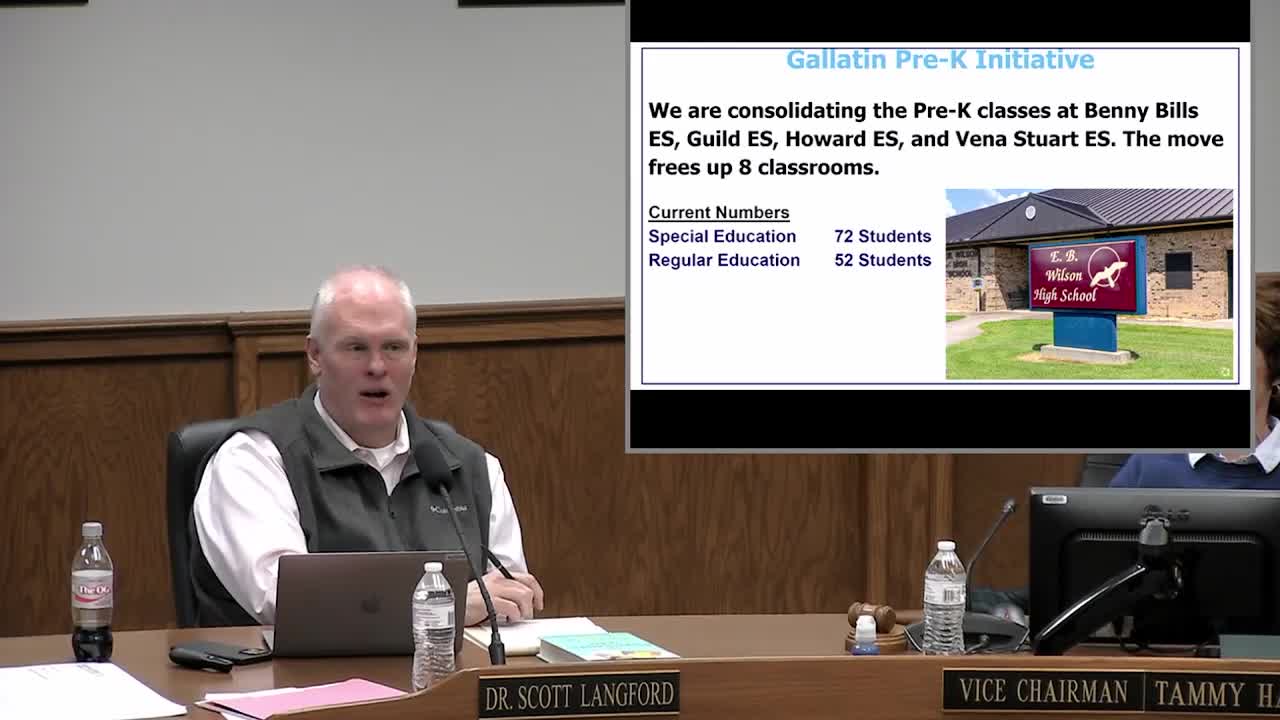
GALATIN, Tenn. — Sumner County Schools presented a plan April 8 to consolidate eight Gallatin pre‑K classrooms onto an EB Wilson campus, a move officials said would centralize services for students with disabilities and ease principals’ administrative loads.
Superintendent Dr. Becker said the consolidation would “provide two classrooms of space for Howard” and help principals who currently spend day‑and‑a‑half each week on IEP and 504 meetings. She said the district currently serves about 72 special‑education preschool students and 52 regular‑education preschool students across the Gallatin cluster and that consolidating would make scheduling, therapy, and staffing more efficient.
Norma (special education director) and other staff said the model would allow the district to tailor timing for three‑year‑old special‑education students (often morning or afternoon sessions) while keeping four‑year‑old voluntary pre‑K (VPK) peers in full‑day placements. Dr. Becker said the district would need to follow day‑care and pre‑K square‑footage rules and obtain the appropriate certificate of occupancy; space constraints may limit the number of additional slots the consolidation can create.
Staff described program design details: centralized clinics and therapy, shared teacher support, and better peer modeling. Dr. Becker and principals said centralization makes it easier to coordinate IEP meetings and frees school principals to be more student‑facing. The district also plans a language‑model class pilot for three‑year‑olds in partnership with a local church that will meet twice weekly to evaluate students’ needs before broader placement.
Board members asked about transportation. Staff said the district is required by federal law to provide transportation for special‑education students when necessary to access services; transportation for voluntary pre‑K peer slots would generally remain the parents’ responsibility. Officials also raised potential benefits for staff childcare access and noted the district is evaluating whether the model could be replicated in other communities.
Dr. Becker said the district expects the Gallatin consolidated pre‑K to be a model that could be used elsewhere and asked staff to continue planning details, including scheduling patterns, occupancy constraints, and service delivery. No formal vote was taken in the study session; staff will return with implementation details and any required facility or licensing approvals.