Get Full Government Meeting Transcripts, Videos, & Alerts Forever!
Get email alerts on the Education Schools topic
No spam. Unsubscribe anytime.
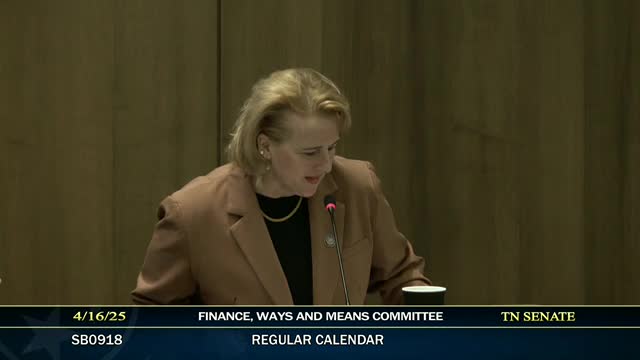
Senate advances Shelby County "challenged school district" bill after hours of debate
Summary
The Senate Finance, Ways and Means Committee voted to recommend Senate Bill 7/14 as amended, creating an oversight/advisory framework for districts that meet poverty and performance triggers; the measure drew extended debate over local control, constitutional concerns and costs.
The Senate Finance, Ways and Means Committee on April 16 recommended passage to the calendar of Senate Bill 7/14 as amended, a measure that defines a "challenged school district" and creates a nine-member oversight or advisory board and other interventions for districts that meet specified poverty and academic-performance criteria.
Sponsor Senator Jon Taylor, explaining the amended bill to the committee, said the legislation "is not a takeover bill" but rather "an advisory bill to help them get the school district back in shape." He told the committee the measure is aimed at districts with sustained low performance and significant economic disadvantage and would give the commissioner of education and the State Board of Education a set of limited intervention tools.
Under the bill as explained in committee, a district qualifies as a challenged district if at least 50% of students are economically disadvantaged, the district fails to meet expectations in math and English, and the district has at least one school placed on the state's priority list in each of the last five priority lists issued by the Department of Education. Once a district meets those criteria the commissioner of education may, with the consent of the State Board of Education, remove the superintendent. The bill also authorizes the commissioner to recommend removal of school board members with State Board consent, and to expand charter opportunities, lift income caps on Education Savings Account eligibility for students in the affected district, and expedite charter conversions.
The bill establishes a nine-member oversight/advisory board to help craft a transformation plan. The appointments would include three from the governor, two from the lieutenant governor, two from the speaker of the House, and seats for the county mayor and the city mayor (or their designees). The board would be paid at the same rate as the elected Shelby County school board (discussed in committee as approximately $20,000–$30,000 annually), serve a minimum four-year term with an option to extend two more years, and be provided up to three staff members paid by the county commission. The board must produce a comprehensive needs assessment within 90 days of its first meeting and then a transformation (business) plan based on that assessment.
Sponsor Taylor described the oversight board's duties in detail, including compiling teacher counts and effectiveness categories, reviewing class-size compliance, evaluating instructional materials and mentoring and professional development programs, auditing finance statements and facility usage, and reviewing discipline records. The oversight board would also review school board agendas and contracts over $50,000 and submit comments that the elected board must read into their public meeting minutes. Taylor said the committee has included a $3,000,000 appropriation in the budget for a forensic audit of the district and told members Shelby County's annual education budget is approximately $1,800,000,000.
Opponents — including a senator who identified themselves as a representative of Shelby County — objected that the measure effectively replaces local, elected authority with unelected appointees and questioned whether that approach has produced better outcomes elsewhere. The senator representing Shelby County urged more community investment (housing, safety, jobs) as the route to better school performance and argued the bill "supersedes" voters by creating an unelected board paid with local taxpayer dollars.
Senator Lamar and other supporters countered that the bill is intended to partner with the elected school board and to provide accountability and resources, not to permanently usurp local control. Lamar said the advisory board is a "carrot and stick" approach designed to encourage cooperation and to provide expertise, and he noted that the bill's interventions require State Board of Education involvement. Senator Wally said the bill could apply statewide to other districts that meet the triggers and said some counties might welcome similar oversight.
Committee discussion also included constitutional concerns. One senator asked how State Board approval for county-appointed replacements would align with the Tennessee Constitution's provision on county office vacancies; sponsor Taylor responded that the State Board has historically removed and replaced school board members in prior decades and that the bill requires State Board consent for local appointments in the intervention process.
After extended debate and amendment votes that adopted two finance amendments (which clarified compensation and other items), the committee moved the bill as amended. On the final committee vote, the bill was recommended for passage to the calendar with two recorded "no" votes.
The committee record shows members asked for additional oversight language and debated funding and constitutional questions; the bill will next proceed toward the full Senate calendar for further consideration.