Get Full Government Meeting Transcripts, Videos, & Alerts Forever!
Get email alerts on the Emergency Management topic
No spam. Unsubscribe anytime.
Grimes County outlines hurricane readiness plan; approves use of damage‑documentation software
Summary
Grimes County officials, emergency managers and community partners met to update hurricane-season plans, clarify shelter and animal‑sheltering roles, and approve a new field documentation app to speed post‑storm reimbursement.
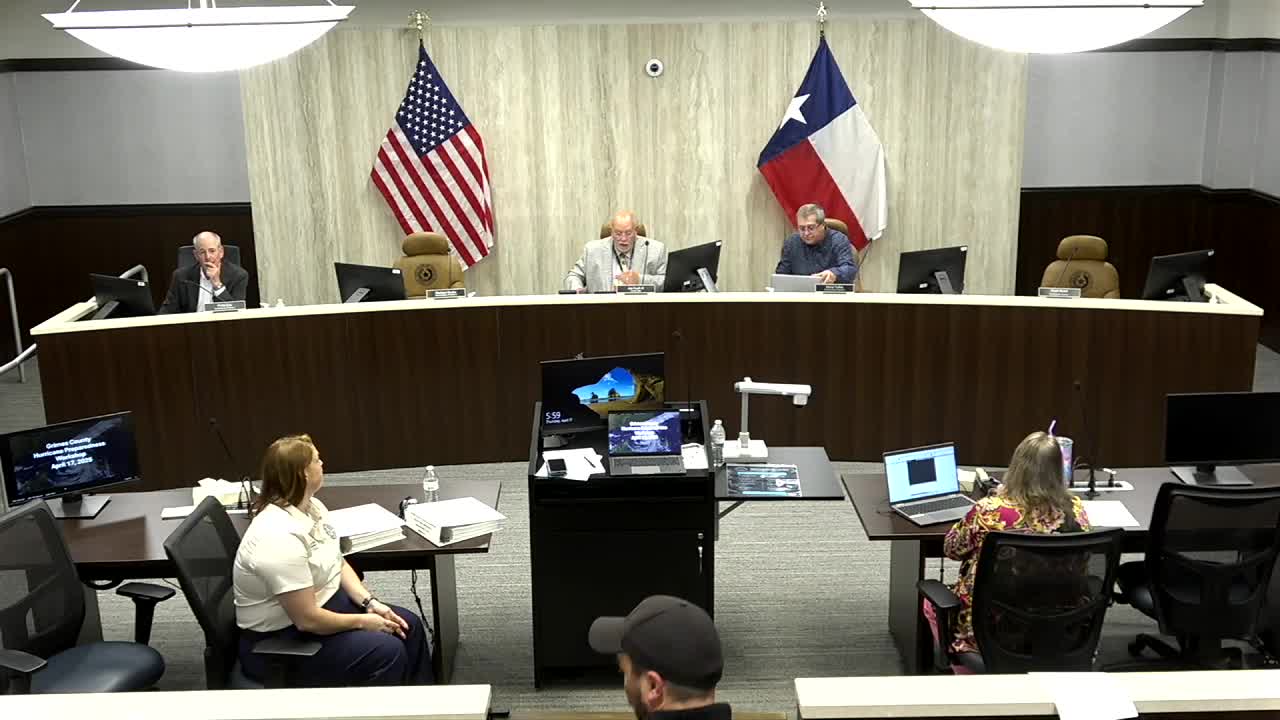
Grimes County Judge (name not specified) convened a public planning session April 17 to review hurricane preparedness with county emergency staff, AgriLife extension agents, law‑enforcement and utility partners and volunteer organizations, and the court approved use of a mobile disaster‑assessment application to document damage.
The county framed the meeting as a working planning session to bring agencies and volunteer groups into alignment before the 2025 Atlantic hurricane season. Dionne Bumpus, Grimes County emergency management services coordinator, said this meeting and follow‑up exercises are intended to move planning earlier than in prior years. "This is gonna be a working, planning session," Bumpus said.
Why it matters: County officials stressed the limits of local capacity and the importance of early documentation to secure federal and state reimbursement after a storm. Panch Gonzales, district chief for Texas Division of Emergency Management (TDEM) District 13, urged residents and county officials to use the state's rapid reporting tools so the state and federal partners understand how "big is big and how bad is bad" and can prioritize aid.
Most important actions and decisions
- Commissioners approved adopting a field documentation app to replace paper forms for disaster assessment and FEMA reporting. The court's action was described during the meeting as intended to improve the speed and accuracy of damage records.
- County staff and partners agreed to continue coordinating sheltering, animal care, road clearance and communications plans and to finalize memoranda of understanding (MOUs) with school districts and local vendors where possible.
Key details from the meeting
Storm outlook and preparedness guidance: A National Weather Service video shown to the group and presenters from AgriLife emphasized that water hazards—storm surge and inland flooding—cause most hurricane fatalities and that the season typically peaks in August and September. Bumpus and partners urged households to maintain at least a half tank of fuel, keep cash and paper copies of important documents, and prepare an evacuation and pet plan.
Shelters and mass care: The American Red Cross currently has three registered shelters in Grimes County—the Navasota VFW, the B. Dye Civic Center and the Iola Community Center—and can mobilize mass feeding and mobile units. Red Cross representatives and Bumpus said it may take up to 72 hours for outside Red Cross volunteers to arrive if the impact is regional, so residents should be self‑sufficient for at least 72 hours.
Animal sheltering: Texas A&M AgriLife representatives and the county extension agent said they will help develop an animal issues plan that includes both livestock and pets, animal supply points and coordination with the A&M Veterinary Emergency Team. Elora Alexander, director of Grimes County Animal Rescue, said, "We will have a cap on how many we can help," and that the rescue is developing backup plans and working with AgriLife to expand short‑term capacity.
Evacuation routes and traffic concerns: Officials noted that Grimes County sits inland along major evacuation corridors (U.S. 290 and Texas 6) that could become heavily congested. Commissioners and staff warned planners to expect spillover traffic from feeder roads such as State Highway 249 and stressed the need to factor congestion into evacuation and sheltering plans.
Communications and public information: County staff said they will use the Grimes County Emergency Management Facebook page and coordinate with the sheriff's office, local media (Navasota Examiner, KHOU, KAGS, KBTX) and the county website for public messaging. Bumpus said the county will push tropical weather watch/warning messages likely about five days ahead of potential impacts. Officials encouraged residents to register cell numbers for reverse‑911 alerts.
Roads, debris and reimbursement: Road and Bridge Director John Stiver described prepositioning fuel and crews, chainsaw capability and stockpiled materials for rebuilding washouts. The county has added about 120 projects to a state flood plan and has a debris contract (TFR Enterprises) and monitor (Thompson Consultants) in place to support large post‑storm cleanups. Officials repeatedly urged volunteers and staff to take before‑and‑after photos to support FEMA and state reimbursement claims.
Utilities and generator safety: Mid South Electric representative Darren Dean described damage assessment teams, mutual‑aid crew networks, and the company's ability to isolate small taps using fiber‑linked reclosers to reduce outages in life‑threatening situations. Mid South warned homeowners not to backfeed household generators into the grid because that can energize lines and endanger repair crews.
Health, EMS and hospital preparedness: Grimes County EMS supervisor Joseph Hicks said EMS will stage resources, use generator‑equipped facilities and make case‑by‑case decisions on response if roads are impassable. The Texas A&M Mobile Health team offered a mobile health RV for first‑response care and support for responders.
State support and documentation: Panch Gonzales (TDEM) explained the escalation path—local to county to state to EMAC/FEMA—and reiterated the importance of P‑STAT/I‑STAT and other rapid reporting tools to document damage so state and federal resources can be allocated appropriately. He said the state will assist once county documentation shows threshold levels of damage.
Next steps and outstanding issues: Staff will continue drafting MOUs with school districts and transportation vendors for evacuation buses, refine sheltering and animal plans, finalize the disaster‑assessment app deployment and train additional PIOs. Facilities and maintenance staff offered generator and facilities support. Court members emphasized that chiefs and supervisors must balance responder safety with urgency to respond during events.
Quotes from meeting participants
"This is gonna be a working, planning session," Dionne Bumpus, Grimes County emergency management services coordinator.
"Our job is to protect life and property," Sheriff’s Office representative (name not specified).
"We will have a cap on how many we can help," Elora Alexander, director, Grimes County Animal Rescue.
"Once we know how big is big and how bad is bad, that's where we kinda start helping bring those resources," Panch Gonzales, TDEM District 13 district chief.
Ending: County officials urged residents to prepare now—know evacuation zones, secure important documents, plan for pets and neighbors—and to follow official county and media channels for updates. The court scheduled additional planning work and training to be completed before the peak of hurricane season.