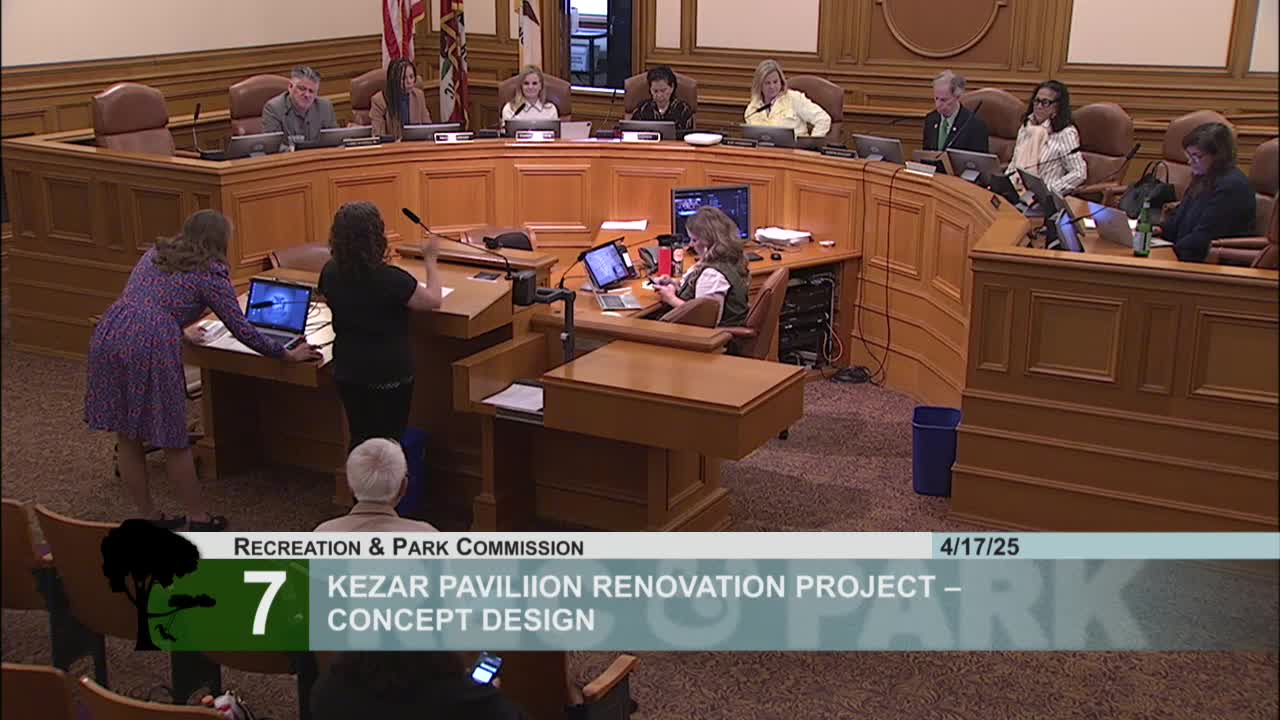
Commission approves concept plan to renovate Kezar Pavilion in Golden Gate Park
Loading...
Summary
The San Francisco Recreation and Park Commission on April 17 unanimously approved a conceptual design to renovate Kezar Pavilion in Golden Gate Park, preserving the building's historic exterior while modernizing interiors for recreation, accessibility and emergency use.
The San Francisco Recreation and Park Commission on April 17 unanimously approved a conceptual design to renovate Kezar Pavilion in Golden Gate Park, a 1926 facility used for basketball, community programming and large events.
The design preserves the pavilion's historic exterior walls while demolishing and rebuilding the adjoining annex, adding elevators, modern mechanical systems, accessible entries, retractable bleachers and new multipurpose rooms. Staff told commissioners the project is funded primarily through the 2020 Earthquake Safety and Emergency Response (ESER) bond; the project team estimates about $70 million in funding is currently available and said additional public and private grants will complete the budget before full construction begins.
Why it matters: Kezar Pavilion is a contributing resource in the Golden Gate Park historic district and serves schools, youth sports and community programs. Renovation aims to keep the building usable after a major earthquake, to restore public access to balcony-level space and to add neighborhood-serving programming, including rooms suitable for children and seniors.
Project details provided to the commission say the renovation will keep the pavilion's exterior appearance intact while excavating and rebuilding underlying foundations, lowering the court level to align the annex and pavilion floors, and replacing the roof and gym floor to match the building's historic character. The plan converts the closed balconies into multipurpose rooms, installs elevators and accessible routes, and creates a new west plaza framed by seating and native plantings. Staff said retractable bleachers will permit dual-court configurations for basketball, volleyball and badminton.
During the presentation Alexis Ward, project manager with the department's Capital Division, described the project's public-safety role: staff said Kezar could be used as a shelter or emergency staging area under a memorandum of understanding with the Department of Emergency Management because of its large floor and restroom/showers. Ward told the commission that approval of the concept design constitutes the approval action under San Francisco Administrative Code Chapter 31.
Commissioner Hallasey asked about seating capacity; Ward replied, "It's gonna be 1,400," explaining that modern code requirements, elevators and safer balcony access reduce capacity compared with historic figures. The updated capacity reflects the project's trade-off between preserving historic fabric and meeting modern accessibility and life-safety standards.
Public commenters and alumni groups urged swift action to preserve the pavilion. Cynthia (ProSAC chair) and several alumni representing Polytechnic High School stressed Kezar's historical and cultural importance. The department presented letters of support from community groups and said local stakeholders had asked that the exterior appearance be retained.
The commission voted to approve the concept design. Staff said the department will pursue a construction-manager/general-contractor delivery model; the next steps are contractor preconstruction input, design-development, construction documents and permitting. Construction is estimated to take 24 to 30 months once remaining funds are secured.
Votes at a glance: The commission approved the concept design by a unanimous vote; the transcript records the motion, second and a vote with no opposition.
Next steps: Staff will move to preconstruction contracting, refine cost estimates with contractor input, advance design development and return with further approvals and funding specifics before construction begins.