Get Full Government Meeting Transcripts, Videos, & Alerts Forever!
Get email alerts on the Public Health Capital topic
No spam. Unsubscribe anytime.
Department of Public Health asks for $500,000 in bond bill to refresh Capitol office; officials outline other unallocated public-health bond items
Summary
The Department of Public Health told the General Obligation Bonding Subcommittee it seeks $500,000 in the governor’s bond package to replace carpets, cubicles and other interior items in its long‑occupied office building and described several other public‑health related bond amounts that are not yet available for use.
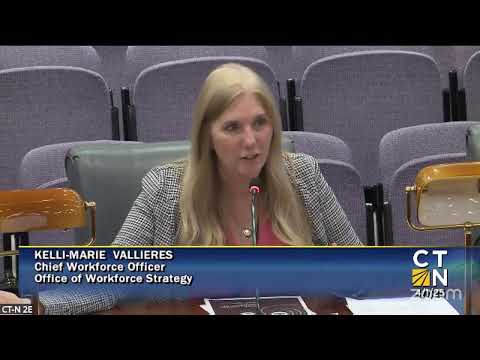
The Department of Public Health asked the General Obligation Bonding Subcommittee on Tuesday for $500,000 in the governor’s bond proposal to support a “Refresh and Renew” renovation of the department’s office building.
The request, described to the subcommittee by the department’s commissioner, would fund replacement of outdated carpets, cubicles and furniture and support concurrent HVAC repairs. “We need a contractor to help reorganize the space and provide for new furniture equipment, carpets to be able to make the space up to standard for working, staff to be in the office,” the commissioner said.
The department said the building is an older structure that previously served as an insurance company office and that staff have been decluttering and archiving records in advance of renovations. The commissioner told the committee the $500,000 is included in a Senate bill referenced during the presentation (Senate Bill 1247) and thanked members “for your consideration of this request.”
Nut graf: The presentation also made clear several previously authorized bond dollars tied to public‑health priorities remain unspent or are not yet on the bonding agenda, leaving the department unable to obligate or operate programs without further administrative steps.
Key other items discussed
- Lead remediation in schools: Committee members asked about a previously-discussed $5,000,000 bond allocation for lead in schools. The commissioner said the department has started work funded by the Bipartisan Infrastructure Law and has been developing a program, but “we have not specifically been working with the $5,000,000 that has been previously discussed as part of a bond package, but has not come specifically to us to use yet.”
- Drinking‑water projects and public water grants: The commissioner said numerous drinking‑water projects are underway using federal Drinking Water State Revolving Fund money and bipartisan infrastructure funds. She noted a prior bond authorization of $25,000,000 for water systems has “not been added to the bond agenda” and therefore is not available for the department to spend. On another question, the department confirmed there remains approximately $50,000,000 (fifty million) in previously authorized public water system bond funds that have not been fully allocated to projects.
- Water stations in public schools: A $3,500,000 line item for water stations in schools appears in a bond bill, but the commissioner said the department has no existing program to operationalize water‑bottle or bottle‑filling station installations and would need to build a program from scratch. The department has consulted with the Department of Administrative Services (DAS) on HVAC and air‑quality work, but not specifically on a school water‑station program.
- Gun violence prevention capital funds: The commissioner described work by the Office of Firearm Injury Prevention and the Commission on Community Gun Violence, and said that $12,000,000 authorized for capital improvements intended to reduce environmental risk factors (for example, lighting and green‑space improvements) is set aside for a next stage of work and has not yet been spent. The office released a request for applications aimed at municipalities, public health, police and community‑based organizations for programming; the $12,000,000 on capital projects will follow that programmatic phase.
Committee reaction and process notes
Committee members pressed for clarity on which of the previously authorized bond dollars were available to the department now and which remain on a bond agenda or require further action by the executive branch. The commissioner repeatedly explained that several bond authorizations exist but “have not been added to the bond agenda” and therefore are not at the department’s disposal, and that new programs (for example, water stations in schools) would require both executive branch prioritization and time to stand up staffing and processes.
Ending: Committee chairs thanked the commissioner and moved on to other agency presentations. The department said it would follow up with committee members on remaining questions about the public‑water balance and the status of the programs discussed.