Get email alerts on the Construction Procurement topic
No spam. Unsubscribe anytime.
Willis ISD holds construction procurement workshop outlining hiring rules, wage requirements and delivery methods
Summary
Construction counsel Blake Henshaw led a workshop for the Willis ISD board and staff covering procurement methods (CMAR, design-bid, design-build), mandatory use of architects/engineers in many projects, prevailing wage rules and common contract pitfalls including bonds and change orders.
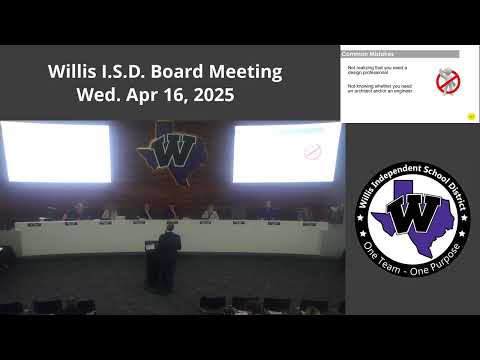
Blake Henshaw, a construction law practitioner working with Willis ISD, reviewed procurement and contracting practices for the district’s ongoing building program during an April 6 workshop, outlining when design professionals are mandatory, how delivery methods differ, and recurring legal and cost traps to avoid.
Henshaw said the district must hire an architect or engineer for most new school buildings and for alterations that meet statutory thresholds, and described how design professionals function as the district’s on-site decisionmakers and pay certifiers throughout a project. “They’re the ones that go and make sure…they will certify the owner to you. Okay. We can pay that,” Henshaw said, summarizing the design professional’s role in certifying completed work before payments are released.
Why this matters: Willis ISD is managing multiple concurrent projects — renovations, a new ninth-grade campus, and transportation facilities — so procurement choices affect schedule, cost, oversight and potential legal exposure.
Most important takeaways
- When design professionals are required: Henshaw advised that school districts must engage an architect for a new educational building when construction exceeds $100,000, or when an alteration exceeds $50,000 and involves relocation or removal of walls, partitions or exits. He said an engineer is required when electrical or mechanical work is involved and the job cost exceeds $8,000, or when student safety concerns make professional oversight required. Henshaw recommended taking a conservative view on “student safety” triggers and hiring professionals where there is doubt.
- Prevailing wage and wage surveys: Henshaw warned trustees that Texas prevailing-wage rules must be adopted annually and can substantially increase project costs. He said wage surveys must be conducted within the district’s boundaries if used instead of Davis‑Bacon rates, and that courts have rejected outsourcing that obligation (he cited a recent case in which a third‑party survey was held insufficient and the court directed the use of Davis‑Bacon wages).
- Delivery methods compared: Henshaw reviewed standard delivery choices: traditional design‑bid‑build (competitive sealed proposals), construction manager at risk (CMAR), construction-manager-as-agent, design‑build and job‑order contracting. He described CMAR as a common choice for larger school projects because the construction manager participates early and provides a guaranteed maximum price; he said the CMAR fee/markup typically falls in a range but that statute requires pricing to carry at least a minimum weighting in procurement rubrics (Henshaw cited a pricing floor of roughly 39 percent in state guidance). He cautioned that two‑step procurement for CMARs takes longer and is uncommon in practice.
- Job order contracts and RSMeans: Henshaw said job‑order contracts are appropriate for recurring, minor repair and maintenance work that can be priced from RSMeans tables or coop pricing but must not be stretched to major new construction. He called rekeying and routine repairs classic uses for job‑order contracts.
- Procurement of professional services: Henshaw reminded the board that selection of architects and engineers is governed by the state professional‑services rules: firms must be ranked on qualifications before fees are discussed, and administrations must avoid asking price questions during selection.
- Change orders, bonds and dispute resolution: Henshaw advised getting change orders in writing, requiring payment and performance bonds on larger contracts (payment bond typically required over $25,000; performance bond over $100,000 in his model language), and keeping mediation rather than arbitration as the primary dispute step. “We never go to arbitration. It’s terrible,” he said, explaining a preference for local court remedies in the district’s view.
- Contracts and templates: Henshaw encouraged the district to use vetted templates for routine procurements but noted that larger or unusual construction contracts merit attorney review. He described the district’s retainer arrangement as providing regular, low‑cost access to legal advice during procurement and contracting.
Additional context and details
Henshaw discussed common misconceptions — for example, that a design‑build vendor’s in‑house engineer eliminates the district’s obligation to retain a reviewing engineer. He noted state law requires a district‑retained engineer or architect to review and manage design documents even when a design‑builder provides its own engineering.
Henshaw also explained auditing requirements for CMAR contracts during closeout and described the 10‑year statute of repose for pursuing construction defect claims. He recommended that the board and administration work together on procurement rubrics and that the board reserve the right to adjust weighting or to pull an RFP from consent for discussion.
Speakers
- Blake Henshaw — construction attorney/consultant (presenter) - Chad Jones — board member (asked procedural questions during the session) - Dr. James — superintendent (participated in the meeting later; referenced in Q&A) - Kelly — district procurement/administration staff (repeatedly referenced by Henshaw; participated in procurement discussion)
Authorities
- statute: "22.58.022 (prevailing‑wage requirement as referenced)" — referenced_by: ["Blake Henshaw"] - statute: "Davis‑Bacon Act (federal prevailing‑wage rates)" — referenced_by: ["Blake Henshaw"] - policy: "Professional Services Procurement Act (state rules governing architect/engineer selection)" — referenced_by: ["Blake Henshaw"]
Clarifying details
- "architect requirement": new educational building costs > $100,000; alteration costs > $50,000 involving walls/partitions/exits (source: Henshaw presentation) - "engineer threshold": electrical/mechanical work costing > $8,000 typically requires an engineer (Henshaw) - "prevailing wage adoption": board must adopt rates annually; if district cannot produce a lawful in‑district wage survey the statute directs use of Davis‑Bacon rates (Henshaw) - "procurement pricing floor": presentation cited a statutory or customary minimum pricing weight of ~39% when weighting proposals (Henshaw) - "performance/payment bonds": performance bond generally required for projects > $100,000; payment bond for projects > $25,000 (Henshaw)
Proper_names
- {"name":"Willis ISD","type":"agency"} - {"name":"RSMeans","type":"other"} - {"name":"Davis‑Bacon","type":"statute"} - {"name":"Texas A&M","type":"organization"} - {"name":"Harbor Freight","type":"business"}
community_relevance":{"geographies":["Willis ISD"],"funding_sources":[],"impact_groups":["students","taxpayers","construction contractors"]},
meeting_context":{"engagement_level":{"speakers_count":6,"duration_minutes":120,"items_count":1},"implementation_risk":"medium","history":[{"date":"2025-04-06","note":"Workshop presentation to board and staff on procurement best practices"}]}
AI generated
The text on this page is AI generated. Summaries, highlights, analysis, and video transcripts are all produced from the original source material.
AI can make mistakes, so if you spot one, and we will fix it for everyone.
Note: the source content is unaltered by us. Any content source we link to, be it a video, an audio recording, or a document, is presented exactly as its publisher released it. That publisher is usually a government body, sometimes an individual official or another organisation.