Get Full Government Meeting Transcripts, Videos, & Alerts Forever!
Get email alerts on the Water Supply Drought topic
No spam. Unsubscribe anytime.
Comal County hears broad warnings on severe drought, long-term supply plans from regional water agencies
Summary
Local water managers told Comal County commissioners and residents that the region is in a multiyear severe drought, outlined conservation and supply actions and described multi‑decade projects to increase firm water availability.
Comal County officials and water managers told the Commissioner's Court on Thursday that the county is enduring a multi‑year, severe drought and presented current conservation actions, near‑term curtailments and long‑range supply projects to improve resiliency.
The presentations, given during a workshop item, came from Daryl Nichols, general manager and CEO of the Guadalupe‑Blanco River Authority (GBRA); Larry Hall, president of the Comal‑Trinity Groundwater Conservation District; Andrea Williams of Texas Water Company; and Ryan Kelso, CEO of New Braunfels Utilities (NBU). Several residents also spoke during public comment about rapidly falling lake and spring levels.
Why it matters: County residents depend on a mix of surface water and groundwater. Agency leaders said recent years’ inflows to the watershed are among the lowest on record and explained how that is triggering mandatory curtailments, accelerating infrastructure work and prompting larger, costlier regional projects to secure firm water supplies.
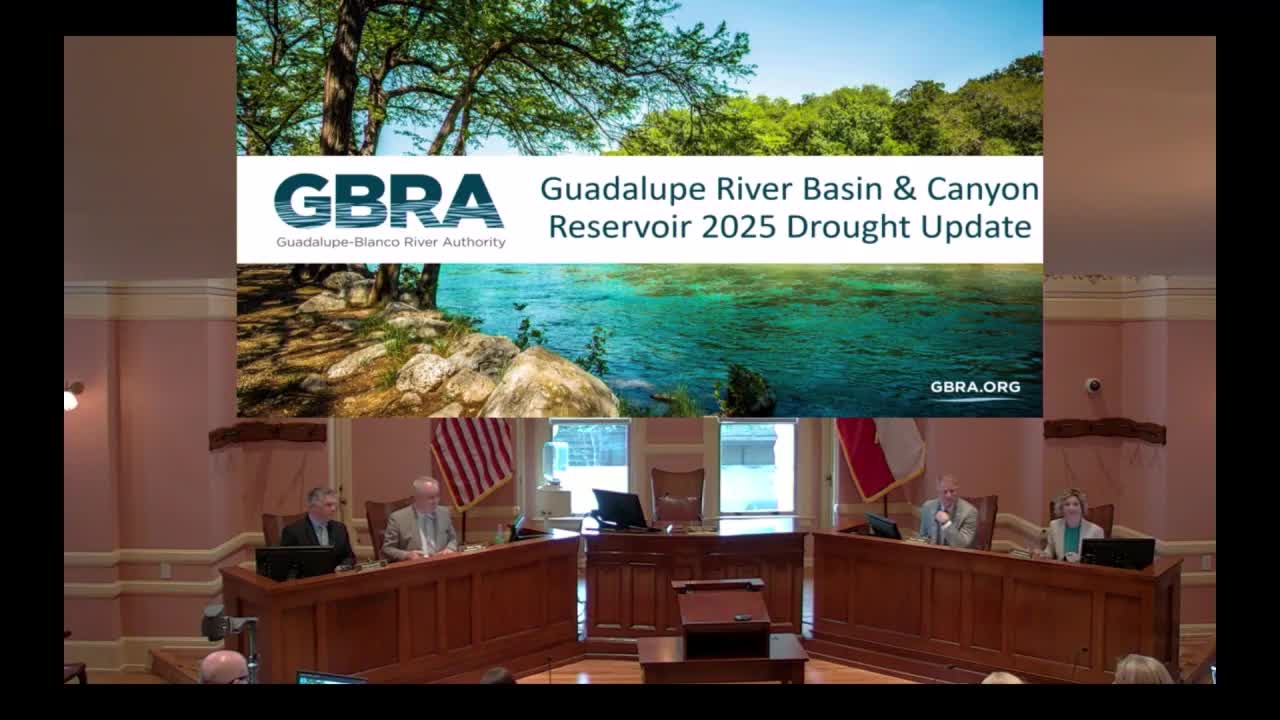
GBRA said Canyon Reservoir (Canyon Lake) was fully allocated under permits that allow 90,000 acre‑feet of diversion annually and that the watershed has seen “five years of a significant drought.” Daryl Nichols said GBRA has been implementing its drought contingency stages tied to lake elevation and streamflow, and that the authority now enforces mandatory reductions for contracted customers when the lake reaches the stage‑4 trigger. Nichols said the stage‑4 trigger corresponds to roughly 49% capacity (about an 880‑foot lake elevation) and that the next curtailment stage is at about 31% capacity (around 865 feet), which would require larger reductions.
“The 90,000 acre feet has been fully committed for almost two decades,” Nichols said, and described WaterSecure, a GBRA project under study that aims to develop roughly 100,000 acre‑feet of new firm water through a mix of GBRA surface rights, brackish groundwater development and aquifer storage and recovery; the project is planned for the early‑to‑mid 2030s.
The Comal‑Trinity Groundwater Conservation District emphasized long‑term groundwater monitoring and recharge limits. Larry Hall said the district has installed about 22 monitors across varied Trinity aquifer conditions and described declining well levels in some locations: “This well has dropped about 60 feet since January of 2020,” he said while showing monitored well hydrographs. He cited published recharge estimates in the 4–6% range and urged residents and officials to support recharge‑friendly practices.
Private utilities described immediate operational steps. Andrea Williams said Texas Water Company serves roughly 78,000 people and that “over half of our water comes from surface water” while about 36% is groundwater; she said the company has paused issuing new taps to protect service to existing customers and is updating its Water Availability Report and drought contingency plan. Williams said the company is pursuing infrastructure upgrades, leak detection and enforcement options tied to drought staging.
Ryan Kelso of New Braunfels Utilities said NBU’s supply portfolio is diversified and that the utility has roughly 18,060 acre‑feet contracted from Canyon Reservoir while using between 5,000 and 7,000 acre‑feet annually in recent years. Kelso described a planned aquifer storage and recovery (ASR) project to store about 7,000 acre‑feet in the Edwards Aquifer and a roughly $300 million five‑year capital program that includes aging‑infrastructure work and system expansion.
Public commenters urged stronger local limits on subdivision approvals and faster state action. Robert Luongo said, “Canyon Lake is drying up,” and asked commissioners to seek a moratorium on high‑density subdivision approvals. Linda Sisk cited pending legislation tightening water‑availability requirements, noting a Senate bill passed the Senate 31–0 and that a companion House bill was under consideration.
Discussion, not action: the workshop item was informational. Commissioners and staff said they will continue to meet with water providers and track legislative changes. The presentations stressed that while local conservation and infrastructure work can help, larger new supplies and multi‑jurisdictional projects will be necessary to maintain reliable service under continued drought and future growth.
The county asked agencies to return with updated data and recommended follow‑up briefings; no formal votes were taken during the workshop item.