Get Full Government Meeting Transcripts, Videos, & Alerts Forever!
Get email alerts on the Parking Policy topic
No spam. Unsubscribe anytime.
City begins formal rewrite of residential permit‑parking rules; moratorium, survey and hybrid models outlined
Summary
Transportation staff briefed the Mobility Committee on plans to rewrite Austin’s residential permit‑parking rules, describing a moratorium on new RPP approvals, an ongoing public survey and possible hybrid paid‑parking/permit zones.
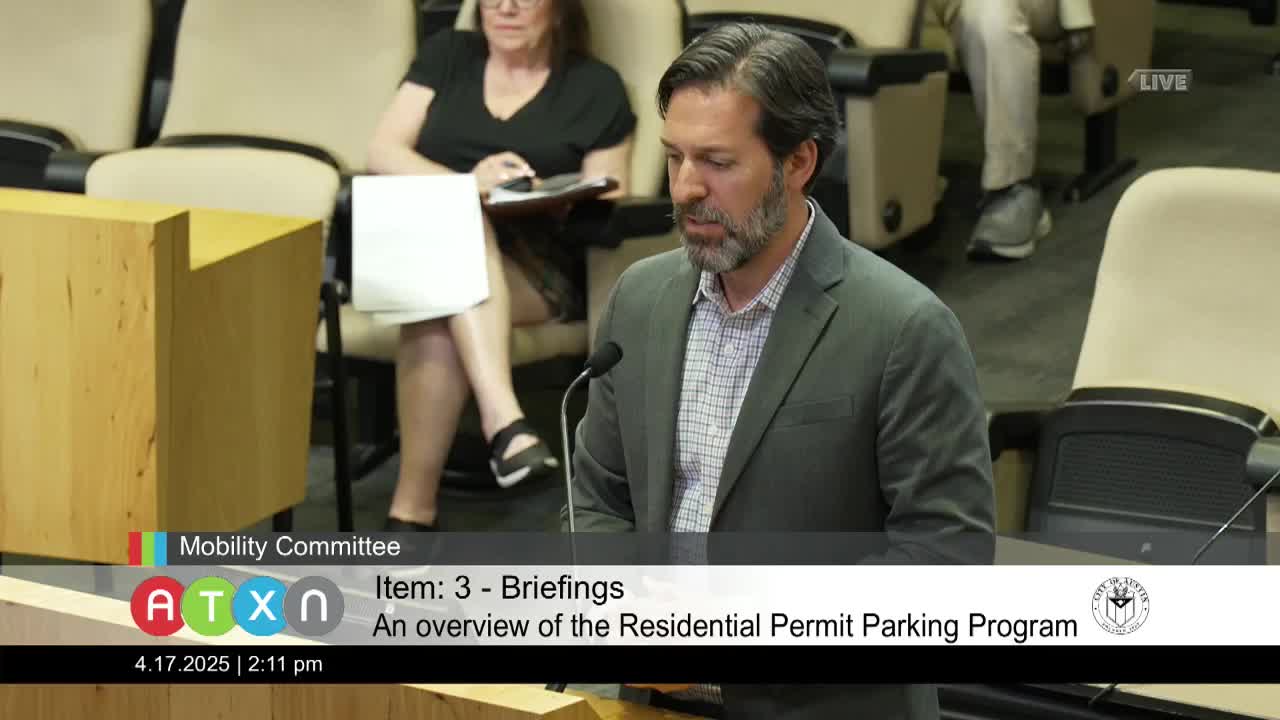
Transportation Public Works staff briefed the Mobility Committee on April 17 about a planned update to Austin’s Residential Permit Parking (RPP) program, including a temporary moratorium, an open public survey and the prospect of hybrid pay‑to‑park/permit zones.
Assistant Director Lewis Laff and program manager Joseph Al Hajari said the RPP program was created in 1997 and last updated in 2011; since then the city has added about 52 zones and roughly 6,000 permit spaces. To modernize rules and improve consistency, staff said they implemented a moratorium on new RPP approvals on March 21 and are drafting director’s rules to replace prior guidelines.
Staff outlined the existing application process: a $350 application fee, a petition circulated to neighbors requiring 60 percent support (with a two‑thirds threshold for areas inside a vertical mixed‑use corridor within 600 feet), parking occupancy surveys on two days over a two‑week period, and a minimum 75 percent occupancy trigger for zone creation. Staff said they are considering raising the level of neighborhood support required and adding regular zone reevaluation criteria.
Al Hajari summarized common public feedback staff has received: requests for better enforcement (including Sundays), permit misuse and resale, difficulty of permit purchase processes, and objections that zones can become a private use of public space. He said staff will examine eligibility rules, lower‑cost permit options tied to existing assistance programs, clearer enforcement and appeal procedures, and mechanisms to convert an RPP to a hybrid paid‑parking/permit zone where appropriate (for example, parts of South Congress).
Staff also reported strong early survey engagement: more than 700 participants and over 2,000 comments during the three‑week survey period that closes in late April. The draft director’s rules were expected to be finalized for legal review and posted on May 5 for public comment; staff said the Urban Transportation Commission will review the draft on May 6 and staff aim for a rules adoption in July.
Why it matters: The RPP program controls use of on‑street public parking in residential areas and can affect neighborhood quality of life, access to public amenities and curbspace equity. Staff emphasized the need for clearer criteria, stronger enforcement options and a process for reexamining long‑standing zones.
What’s next: Staff will conclude the public survey, present draft rules to the Urban Transportation Commission on May 6, and post the draft director’s rules for public comment on May 5 before returning with responses and a proposed adoption schedule.