Get Full Government Meeting Transcripts, Videos, & Alerts Forever!
Get email alerts on the Transportation Traffic Calming topic
No spam. Unsubscribe anytime.
Planning commission backs Georgia Avenue traffic-calming plan, urges council to weigh roundabout option and parking solutions
Summary
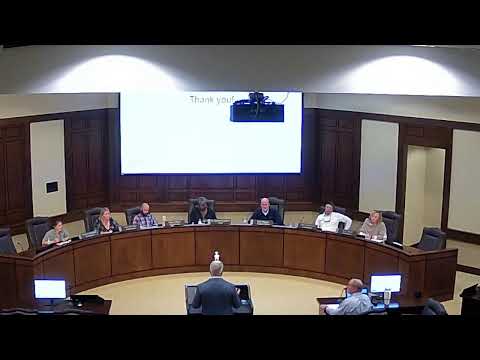
The North Augusta Planning Commission on Monday voted to recommend that City Council adopt the Georgia Avenue traffic calming and pedestrian access study, including gateway signage, prioritized corridor improvements and further study of parking replacements and low-cost traffic calming on adjacent city streets.
The North Augusta Planning Commission on Monday voted to recommend that City Council adopt the Georgia Avenue traffic calming and pedestrian access study, including gateway signage, prioritized corridor improvements and further study of parking replacements and low-cost traffic calming on adjacent city streets.
The commission also recommended that Council consider the major improvement option for the five-leg Georgia–Carolina–Jackson intersection — a dual-lane roundabout that the consultant said would require additional right-of-way but offers the strongest traffic-calming and crash-reduction benefits.
The study was led by consultant Joe Robertson, who described the project as a long-range vision to make Georgia Avenue a more pedestrian-oriented Main Street. "The 80th percentile speed is greater than 5 miles per hour over the posted speed limit of 30 miles per hour" at the corridor ends, Robertson said, summarizing the August 2022 speed data used to guide recommendations. He told the commission the study used speed, turning-movement and daily volume counts, and six years of crash records from the South Carolina Department of Public Safety to identify safety hot spots.
Why it matters
The study found roughly 300 reported crashes on Georgia Avenue over six years (about 50 per year on average), including angle and rear-end collisions and several involving pedestrians or bicyclists. Daily traffic volumes measured on the southern end approached 25,000 vehicles per day and fell toward 18,000 at the northern downtown end; the consultant projected those volumes could grow substantially by 2047 under a 2% annual growth assumption. The commission noted the corridor is a state- or federal-owned highway, requiring coordination with the South Carolina Department of Transportation (SCDOT) and federal funders for some changes.
Key recommendations and costs
• Gateway signage: The study recommends gateway and wayfinding signage to reduce speeds; Robertson cited research showing a 3–5 mph reduction in vehicle speed from gateway signage. The Planning Commission moved and approved a recommendation for gateway signage to City Council.
• Midblock crossings and high-visibility crosswalks: The consultant recommended upgrading marked crosswalks (including rectangular rapid-flashing beacons, RRFBs) and adding in-pavement warning lights at Pine Grove and other downtown locations; an RRFB already exists on West Avenue at Pine Grove, the consultant noted.
• Parking reconfiguration and medians: To create space for raised landscape medians and pedestrian refuge islands, the study recommends converting angle parking to parallel parking on multiple downtown blocks, narrowing travel lanes where feasible, and installing a 12-foot raised median in key segments. Robertson estimated a ballpark 25% reduction in on-street spaces when converting from angled to parallel parking. Later in the meeting a local volunteer count (reported to commissioners by a resident) estimated that the Pine Grove–Spring Grove block would lose about nine on-street spaces (roughly 25% of that block’s 32 spaces).
• Intersection options at Georgia/Carolina/Jackson: The report presented two alternatives for the five-leg intersection: a suite of minor geometric improvements and a larger dual-lane roundabout. Robertson said the roundabout fits the available geometry best where three adjacent parcels are city‑owned, though it would require additional right-of-way and affect one corner owned by First Baptist Church.
• Priorities and segment costs (as presented to the commission): Pine Grove Avenue to Spring Grove Avenue — $1,190,000; Buena Vista to Pine Grove — $260,000; Spring Grove to Jackson — $470,000. For the Georgia/Carolina/Jackson intersection, the report listed a minor-improvements option at about $280,000 and a major-improvements (roundabout) option at about $3,740,000.
Funding and next steps
Tommy Paradise, a city planning staff member who coordinated on the project, told the commission initial funds for the southern phase (bridge to the downtown area) are set aside and the city planned to seek design authorization once Council acts. He said the roundabout option would likely rely on capital project sales tax funds (referred to in the meeting as the Capital Project Sales Tax 5) that begin collecting in 2026; the consultant and staff said some early design or implementation could also use grant funds the city has already pursued. Paradise also reported earlier phases of the study were funded by a $50,000 Augusta Regional Transportation Study grant (federal funds routed through SCDOT) with the city responsible for a 20% local match ($10,000); an additional $20,000 was later authorized with a $4,000 local match to study the five‑leg intersection more closely.
Commission direction and actions
The commission voted to forward the study and its recommendations to City Council and approved the priority list for the corridor segments (as listed above) with motions asking Council to consider: (1) gateway signage; (2) parallel-parking buffers and the potential to reduce median width in order to expand sidewalk space in some blocks; (3) the major-improvement roundabout option for the Georgia/Carolina/Jackson intersection (the commission recommended Option B in its motion); and (4) additional study of parking replacement options and low-cost traffic-calming measures on city‑owned side streets, especially West Avenue. Paradise and Robertson told commissioners they would present details, counts and design documentation at an upcoming Council study session.
Public and commissioner comments
John Hecksworth, a resident, told the commission he was concerned about lost parking and suggested using existing rear parking lots behind downtown businesses: "Years ago, we parked behind the businesses on Georgia Avenue ... now those parking lots are still there, but they're empty," he said.
Austin Taylor, a downtown business owner who gave his address as 820 Carolina Avenue, supported both additional sidewalk space for outdoor dining and the roundabout at the five‑leg intersection: "Can we shrink the median size in order to grow the sidewalks?" he asked, and added his support for the traffic circle option because he regularly sees high speeds on Carolina Avenue.
Commissioners pressed for follow-up details at the Council presentation, including precise parking counts, final cost estimates, funding sources for gateways and medians, and SCDOT coordination. Tommy Paradise said staff and the assistant city administrator had discussed use of private rear lots and that more work on parking options would be handled out of the administrator’s office and could require separate studies or agreements with private property owners.
Closing
The commission’s recommendation sends the study and prioritized project list to City Council with requests for additional analysis of parking mitigation and alternative calming on city streets; Council will receive the report and the consultant’s materials at an upcoming study session for action or further direction. "If you slow traffic down on Georgia Avenue ... maybe they are gonna go over to West," Robertson said during the discussion, summarizing a recurring concern commissioners asked staff to study further.
(Article based on the October 27, 2025 Planning Commission meeting transcript and presentations.)