Get Full Government Meeting Transcripts, Videos, & Alerts Forever!
Get email alerts on the Construction Coordination topic
No spam. Unsubscribe anytime.
City outlines interagency Construction Partnership Program and downtown convention center traffic plan
Summary
Transportation staff briefed the Mobility Committee on a new multi‑agency Construction Partnership Program to coordinate overlapping projects across Central Texas and on early traffic control plans for the downtown convention center demolition and rebuild, including phased lane closures, truck routing and a May 1 demolition start date.
Transportation and Public Works staff on April 17 described a nascent Construction Partnership Program (CPP) intended to coordinate dozens of major public projects in Central Texas, and gave a separate update on traffic control measures for the downtown Austin Convention Center redevelopment.
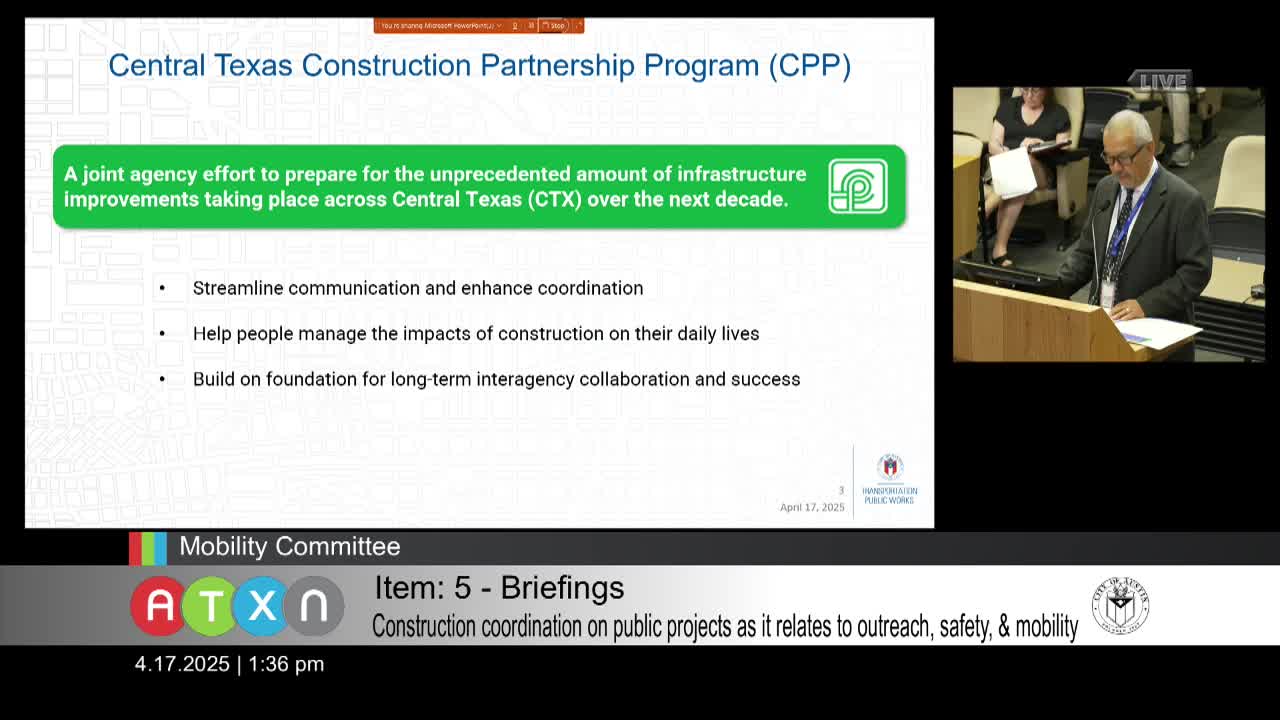
Director Richard Mendoza said the CPP aims to coordinate construction across agencies (TxDOT, CAMPO, CapMetro, Austin Transit Partnership, CTRMA, Travis County and multiple city departments), to provide a single public information source and to deploy transportation demand management and real‑time operations to limit traffic impacts. “We have three main objectives: streamline communication and coordination among partners, help people manage impacts to daily commutes, and build sustainable long‑term interagency collaboration,” Mendoza said.
Staff said the combined pipeline includes more than 35 major projects across Central Texas — I‑35 CapEx, Project Connect lines, MoPac work and large city and county bond projects — and roughly $20 billion in public mobility investments over the coming decade. To communicate closures and lane impacts, city staff said they will use an existing TxDOT tool (CTX GO) as the regional public app, launch an informational website and create a hotline. A pilot of the CTX GO mobile app is already available for testing, staff said.
Mendoza outlined four CPP strategies: coordinated project scheduling and analytics to avoid concurrent network gridlock; a single-source communications platform with real‑time lane‑closure and construction alerts; expanded transportation demand management (TDM) to reduce single‑occupancy vehicle trips (including a recently executed EPA Climate Pollution Reduction Grant); and investments in operations, such as an integrated regional traffic operations center that would bring multiple agencies’ traffic engineers together for real‑time response.
Transportation staff said the EPA grant (fully executed) will support TDM measures including improvements to transit frequency, investment in “mobility hubs” and additional air‑quality and bike/ped counters to measure shifts in behavior. Staff said collaboration with CapMetro and CAMPO will be central to delivery of demand‑management measures.
Separate but related, Amika Bose, Transportation Public Works officer for right‑of‑way and special events, outlined the convention center construction traffic plan. The center closed earlier in April and contractor mobilization began April 5. Staff said the project anticipates a demolition start on May 1 and an approximately 3½‑year construction schedule with a planned move‑in date in January 2029.
Bose said Phase 1 traffic control will reduce Red River to a single northbound lane with southbound closed, close Trinity Street to motor vehicles while maintaining a bidirectional bike lane, and detour bikes to Fifth Street. Cesar Chavez Boulevard will remain open with five lanes; the contractor will demo south‑curb bulbouts to allow a covered pedestrian walkway on the north curb with continuous vehicle lanes. Initial truck volumes were estimated at roughly 80–110 trucks per day through July, followed by heavier hauling for about a year beginning this fall, staff said.
Staff described coordination measures for the convention center: biweekly project coordination meetings, a Teams channel that includes city operations and project staff, programmed overhead message boards, a point of contact for public complaints and monitoring by the city’s Mobility Management Center to detect and respond to queuing or incidents in real time.
Why it matters: Downtown and regional construction from multiple agencies could overlap and cause significant traffic impacts. The CPP aims to reduce duplicate work, improve public messaging and use demand‑management strategies to limit congestion during years of concurrent projects.
What’s next: Staff will continue focus‑group testing of the CTX GO app, finalize the CPP public hotline and website, and continue enforcement and monitoring during convention center demolition and ensuing construction.