Get Full Government Meeting Transcripts, Videos, & Alerts Forever!
Get email alerts on the Homelessness And Public Health topic
No spam. Unsubscribe anytime.
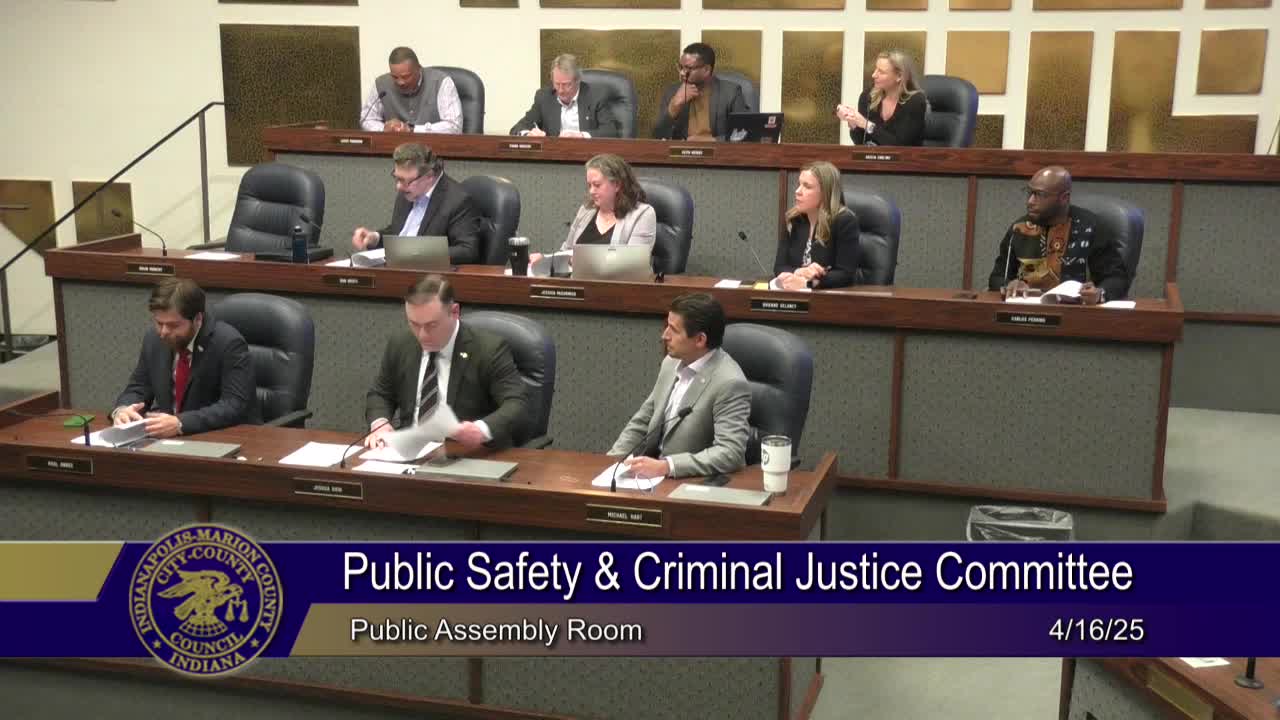
Council committee confirms Andrew Merkley as director of Office of Public Health and Safety after months of debate over shelter response
Summary
The committee approved Andrew Merkley as director of the Office of Public Health and Safety (OPHS) following his presentation on homelessness, eviction-prevention programs and winter contingency operations and extensive public testimony criticizing conditions at a temporary family shelter.
The Indianapolis City County Council committee voted to confirm Andrew Merkley as director of the Office of Public Health and Safety (OPHS) after a presentation on the office’s programs and a lengthy public-comment period that raised concerns about winter contingency shelter conditions and program oversight.
Merkley, introduced to the committee as the mayor’s nominee, outlined his experience in homelessness and eviction-prevention work and summarized OPHS initiatives including the Tenant Advocacy Project (TAP), the Assessment and Intervention Center (AIC), clinician-led community response teams, reentry services, and a planned housing hub. He told the committee that the AIC served more than 500 unique people this winter and that 21 of those guests moved into recovery services; that a School 68 winter site served more than 61 families and that more than half of those families moved into permanent housing during roughly four months of operation; and that the clinician-led response teams logged 1,224 calls in 2024 and responded to 738 within their service area.
“This is the first time that the city of Indianapolis has engaged in any way in winter contingency outside of the pandemic,” Merkley said, and he described efforts to coordinate city, philanthropic and service-provider partners to reduce pressure on existing providers. He said OPHS is creating program dashboards and standardizing data collection to measure effectiveness and to pursue sustainability after American Rescue Plan funding ended.
The committee heard more than a dozen public comments, many from residents and grassroots organizations that directly assisted families in this winter’s contingency operation. KT White, executive director of Allies for Humanity, said the group opposed Merkley’s appointment and asserted that “the city has documented 588 deaths of unhoused neighbors over the past 4 years,” a claim she said was supported in written testimony submitted to the committee. Families and advocates described crowded or unsanitary conditions at School 68, claiming mold, flooding, and inadequate supervision. Resident Carrie Cline described being “exposed to the mold, the urine, the burst pipes, the flooding bathrooms, a rat literally scratching at my toes” and said her grandson was hospitalized while the family stayed at the site. Multiple young people who stayed at the site described feeling unsafe; one young witness described being assaulted and said staff did not sufficiently address the incident.
Merkley acknowledged School 68 was an older facility with challenges and said it was “the only option for us to provide shelter space for families this winter.” He said the city provided expanded case management through partner Aspire Indiana Health, including behavioral health and medical care, rides to school and work, and car repairs, and pointed to the outcome that “50 percent of the families that were in that shelter are permanently housed.” He said OPHS is awaiting the winter-contingency report from Aspire and that any incidents recorded by that operator will be included in that report.
Council members pressed for better data, clearer reporting and broader engagement with grassroots providers. Councilor Carlos Perkins (District 6) and Councilor Keith Graves (District 9) urged a systematic review of programs funded during the pandemic era and said the committee needs evidence of program effectiveness before committing ongoing local dollars. Councilor Josh Bain (District 21) and others noted the nationwide decline in homicides and asked OPHS to show how city programs contributed to a cited 31 percent drop in criminal homicides from 2021 to 2024.
Several councilors and community speakers asked the administration to convene a broader symposium or planning process involving the continuum of care, faith-based groups and smaller grassroots organizations that deliver services on the ground. Merkley committed to engaging grassroots partners and to continuing work on data, procurement and standardized contract metrics.
The committee approved the appointment by roll-call vote. Multiple members signaled continued oversight: councilors said they would require regular reporting back to the committee and tighter accountability on grant rollout and performance measurement as the city moves into the next budget cycle.
The confirmation moves Merkley into a role overseeing OPHS programs that rely on a mix of federal, state and local funding and that include eviction-prevention, reentry and violence-reduction work. Council members and community advocates said they will monitor winter/“weather contingency” planning and expect improved reporting on program outcomes and shelter conditions.
Ending note: Committee members asked OPHS to provide updates as data and external reports become available and urged immediate outreach by the new director to organizations and families who raised concerns during public comment.