Get Full Government Meeting Transcripts, Videos, & Alerts Forever!
Get email alerts on the Civic Process topic
No spam. Unsubscribe anytime.
City attorney briefs Tacoma committee on council rules, public-comment limits and enforcement
Summary
City Attorney Chris Boccia told the Government Reports and Finance Committee that the council may adopt rules of procedure consistent with the city charter and state law, described the legal boundaries for public comment and limited public forums, and urged viewpoint-neutral enforcement of time, place and manner rules.
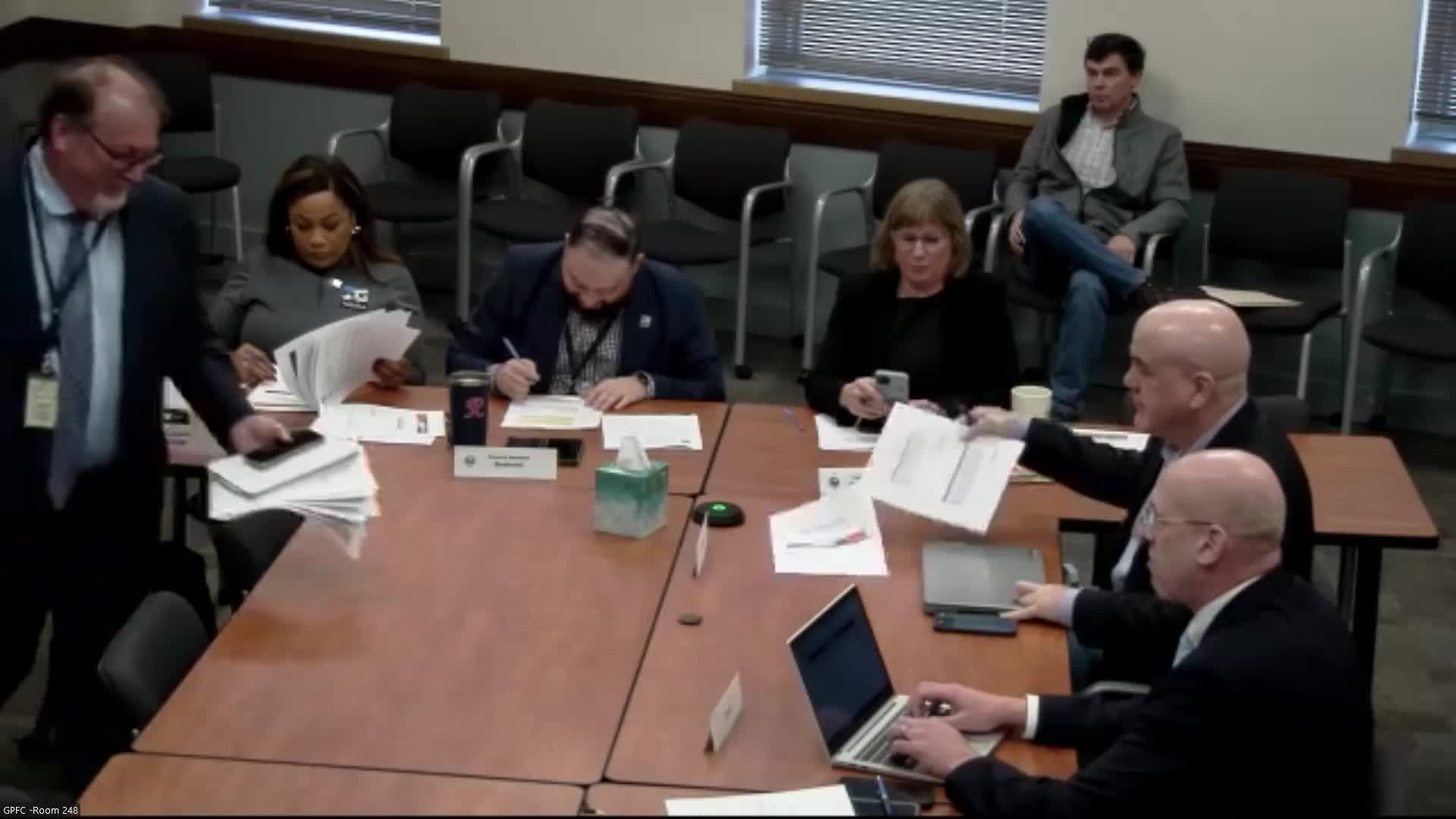
City Attorney Chris Boccia briefed the City of Tacoma Government Reports and Finance Committee on April 15 on the legal authority and limits for the council's rules of procedure, including consent agendas, public comment, public hearings and the standards governing when a speaker may be cut off or removed.
Boccia told the committee the council's authority to adopt rules is grounded in the city charter (he cited Sections 2.9 and 2.4) and in the council's inherent common-law powers. He said the council's rules must conform to applicable law and common parliamentary practice; the council has long adopted and referenced Robert's Rules of Order for that purpose.
On consent agendas, Boccia said the mechanism exists to streamline routine, noncontroversial items but that the council may place any item on consent and that any member should be able to remove an item for discussion. "The purpose of the consent agenda is really to streamline your meetings by grouping routine noncontroversial items together," he said.
Boccia described three exceptions that create firm public-participation rights: statutory requirements, public hearings required by code or statute, and public forums. He explained a 2023 amendment to Washington's Open Public Meetings Act requires that governing bodies provide an opportunity for public comment at regular business meetings, but he emphasized that statute applies to regular business meetings and not to committee or special meetings.
The City Attorney spent substantial time on constitutional limits in a limited public forum. He said the city may impose reasonable time, place and manner rules that are viewpoint neutral and tailored to the governmental purpose of conducting an orderly meeting. "You can impose a limitation on public comment to a specific time and place on the agenda," he said, "and that's not a First Amendment violation." By contrast, he said the government may not stop speech because it disagrees with the speaker's viewpoint.
Boccia warned elected officials that profanity and even offensive or hateful speech are often protected in a public forum unless the speaker becomes irrelevant, repetitious or actually disrupts the meeting. "It is nevertheless often true that one man's vulgarity is another man's lyric," he quoted from Justice Harlan, underscoring courts'wide protection for speech even when offensive.
The briefing covered typical operational questions: signs and megaphones can be regulated under time, place and manner rules; courts have required councils to enforce rules consistently to avoid viewpoint discrimination; and the presiding officer (the mayor or deputy mayor) has discretion to determine when speech becomes disruptive, though Boccia recommended using recesses as a measured response.
On liability, Boccia said presiding officers acting within the scope of their authority are generally defended and indemnified by the city if sued; deliberate, intentional misconduct could raise coverage questions. He recommended clear, consistently applied rules and nondiscriminatory enforcement to reduce legal risk.
Ending: Committee members asked multiple hypotheticals about what constitutes a disruption and how to handle threatening speech; Boccia said the assessment is fact-specific and that his office can help draft clarifying rule language if the council seeks revisions.