Get Full Government Meeting Transcripts, Videos, & Alerts Forever!
Get email alerts on the State Budget topic
No spam. Unsubscribe anytime.
Appropriations bill HB1409 advances to full finance after subcommittee review
Summary
The Finance, Ways, and Means Subcommittee advanced House Bill 1409, the fiscal year 2026 appropriations bill, to full finance by a 13-0 vote after adopting three amendments and hearing a line-by-line overview of revenues and major spending priorities.
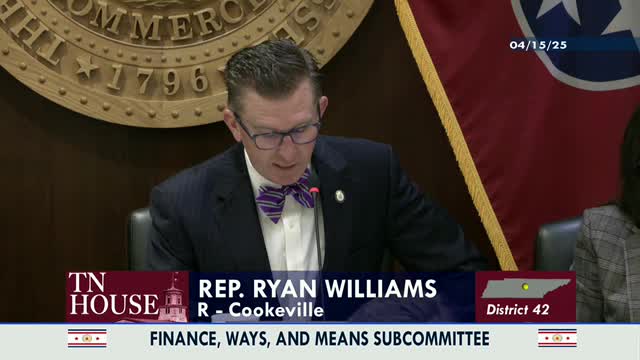
The Finance, Ways, and Means Subcommittee voted 13-0 on April 15, 2025, to send House Bill 1409 — the fiscal year 2026 appropriations bill — to the full Finance committee after adopting three amendments.
Chairman Hicks presented the bill and walked members through the budget’s revenue assumptions and major spending priorities. "The budget this year, the fiscal year 26 budget is 59,700,000,000.0," Hicks said, summarizing the overall size of the plan. He told members the bill assumes 2% recurring tax revenue growth in fiscal year 2026 and that departments reverted more than $1.5 billion in unspent funds at the close of fiscal year 2024.
The subcommittee heard a breakdown of funding sources and major allocations. Hicks said roughly 50% of the $59.7 billion comes from state appropriations (about $29.7 billion), 35% from federal funds (about $20.8 billion) and 15% from other sources (about $9.2 billion). He said the budget relies on a mix of recurring tax growth, reversions of unspent funds, departmental revenues and investment earnings.
Members received detailed line items the chairman highlighted: approximately $597 million for disaster relief (including $240 million for grants tied to nonfederal disaster recovery costs, $125 million to the governor’s response and recovery fund and smaller allocations for local assistance and school reconstruction); more than $640 million in new K–12 state funding (including $198 million for one-time teacher bonuses, $148 million for TISA growth and $27.3 million for summer learning camps and transportation); about $264 million in higher education capital and outcomes funding; and over $1.5 billion in new spending for health and social services (including wage increases for direct support professionals and $24 million for year 4 of a dental pilot program).
Hicks also described public-safety and economic development allocations: roughly $378 million for law-enforcement and safety initiatives (including funds for additional TBI and highway patrol positions and public-safety grants), $213 million through Economic and Community Development (ECD) and $1 billion of general-fund subsidy for TDOT projects. He said a set of grant pools—previously used for volunteer fire departments, EMS and senior centers—will again include courthouse capital-maintenance grants and a $500,000 allocation for food banks.
Representative Shaw asked for clarification about courthouse grants; Hicks replied the new grant pool is intended for local governments to assist with courthouse capital maintenance and improvements, and that municipalities receiving a tax increment financing (TIF) allocation would not be eligible for those grants.
After discussion, the subcommittee adopted the three Hicks-sponsored amendments and voted to move HB1409 as amended to full Finance, with the clerk recording 13 ayes and 0 no votes.
House Bill 1409 now goes to the Finance committee for further consideration.