Get Full Government Meeting Transcripts, Videos, & Alerts Forever!
Get email alerts on the Restoration Of Rights topic
No spam. Unsubscribe anytime.
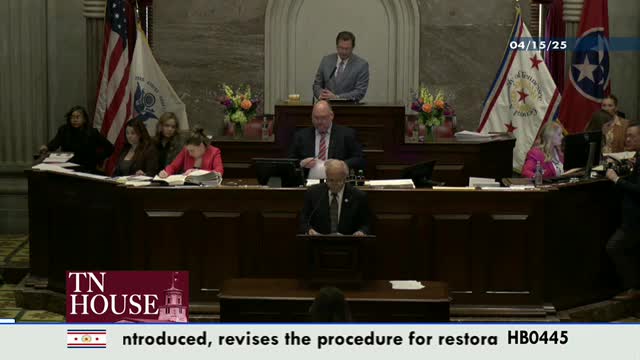
House approves unified restoration-of-rights process after prolonged floor debate
Summary
Lawmakers passed Senate Bill 407 to establish a single court petition process for restoring rights of citizenship, clarifying when voting and firearm rights can be restored separately. The bill drew extended debate over costs, sworn statements and barriers such as child support and fees.
The Tennessee House approved Senate Bill 407 on third reading after extensive floor discussion about how people convicted of felonies regain rights of citizenship, including voting and firearm rights.
Sponsor Representative Hosey and others said SB 407 creates one process for anyone seeking restoration of rights of citizenship, requires petition to a circuit court, requires notice to the district attorney and elections coordinator, and clarifies which rights may be restored and in what circumstances. The bill allows courts to restore one or more rights (for example, voting but not firearm rights) and codifies factors a court should consider for restoration.
Several members warned the bill could erect barriers for returning citizens. Representative Parkinson and Representative Pearson—both of whom said they worked on related proposals previously—objected to provisions they said would discourage or financially burden people seeking restoration. Representative Pearson raised concerns that the bill reintroduces a pre-2006 petition process and that filing fees in some counties can be hundreds of dollars; she said some returning citizens would be required to sign sworn statements that could expose them to legal risk if records are inaccurate. Representative Parkinson asked whether child support and other arrearages would continue to block restoration; the sponsor said that remains a practical barrier and that judges retain some discretion under current law.
Sponsor response and vote Sponsor Representative Hosey and other backers said the bill was the result of work across committees to streamline and standardize the process and to allow rights to be granted separately where appropriate. Supporters described cases of long-term rehabilitated residents who remain unable to vote under the current patchwork process.
After floor debate, the House voted and passed SB 407 on third and final consideration; leadership announced the bill had received the constitutional majority and the chair declared passage with objections noted on the record.
What the bill does and outstanding concerns - Creates a single judicial petition process for restoration of rights of citizenship and clarifies which rights are eligible for restoration in whole or in part. - Requires notice to specified state actors (district attorney general, coordinator of elections, attorney general) and gives certain officials standing to intervene when they object. - Does not alter filing fees statewide; members and advocates said local fees and child-support obligations continue to be practical barriers for many seeking restoration.
Votes and outcomes - Committee amendment (withdrawn/handled by floor): withdrawn as noted on the record. - House adoption: Senate Bill 407 passed third reading; clerk recorded the roll and leadership declared constitutional majority present and bill passed.
Next steps The bill will proceed through the enrollment process and onward to the governor (or other procedural steps as applicable). Lawmakers and advocates signaled intent to continue working on issues such as child-support arrearages and fee waivers to reduce barriers for returning citizens.