Get Full Government Meeting Transcripts, Videos, & Alerts Forever!
Get email alerts on the Building And Safety topic
No spam. Unsubscribe anytime.
Cathedral City building official outlines permitting, inspections, EV and accessibility rules
Summary
Chief Building Official Jeremy Fry told the Planning Commission how the building and safety division processes permits, enforces accessibility and energy rules, and is working to keep inspection turnaround at 24 hours while moving to a fully digital permitting portal.
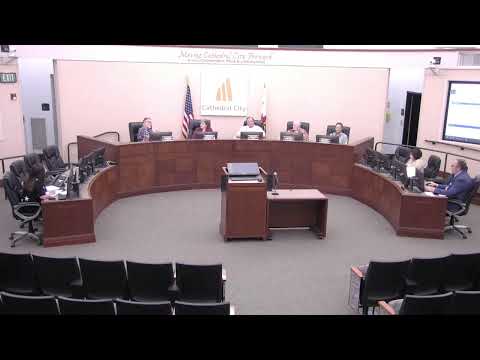
Jeremy Fry, Cathedral City’s chief building official, told the Planning Commission on April 16 that the Building and Safety Department’s primary duties are to “observe, assess, document, and then educate” during permit review and construction inspections.
Fry gave commissioners a short walkthrough of the department’s workflow—from permit technician quality control and plan review to field inspections—and described changes intended to speed approvals and improve customer service. “When permit techs deem [an application] complete, it moves forward into a plan review process,” Fry said. He described the department’s goal of a single inspector following a project “from start to finish” when possible and summarized technical rules the department enforces, including accessibility, energy and solar provisions, and EV-charging requirements for new construction.
The presentation matters because the department’s procedures determine how fast repairs, remodels and new construction start, and because recent changes in state and local codes increase requirements for solar-ready roof areas, energy storage readiness and EV infrastructure on many new projects. Fry said the department completed a shift to an all-digital customer self-service (CSS) portal in the last year: “Here, you can pretty much do anything, licensing wise, permitting wise, throughout city hall,” he said, adding that some expedited permits can be approved within a business day.
Most important technical points Fry highlighted: - Inspections and turnaround: a typical new single-family home requires about nine milestone inspections from footing to final; Fry said the department’s current target is a 24-hour turnaround for inspection requests and that inspectors work longer field days (Monday–Thursday) to achieve this. - Expedited permits: seven permit categories (including water heaters, HVAC change-outs, residential reroofs and sewer connections) are treated as expedited; applicants frequently receive approval within the next business day. - Accessibility: Fry referenced California Building Code chapters 11A and 11B and reviewed parking and accessible route requirements (for example, a van-accessible parking stall minimum width of 12 feet, an access aisle of 5 feet, and a standard accessible stall width of 9 feet; required accessible stalls scale with total parking counts). - Solar and energy: under current state energy rules Fry summarized, new single-family and some multi‑family projects must provide 250 square feet of designated rooftop solar zone where solar is not already proposed; he also described “battery-ready” requirements including conduit and a circuit space sized to accommodate future ESS (energy storage system) breakers. - EV infrastructure: Fry outlined the three common categories enforced by the California Green Building Standards—EV-capable (conduit and panel capacity), EV-ready (conduit plus wiring and a parking box), and EVSE (installed charging station). Multifamily projects over 20 units must provide a higher share of EV-capable and EV-ready spaces; Fry repeated that the code distinguishes EV-capable, EV-ready, and EV supply equipment.
On utility capacity and discretionary relief, Fry said developers typically receive a utility assessment early in the process and that the building official can work with applicants and utilities if upgrades would drastically increase project costs. “It'll start with me and then it'll climb up the ladder,” he said, describing coordination with utilities when capacity is limited.
Commissioners asked about who must pull permits, owner‑builder liability and education. Fry said homeowners may pull permits as owner‑builders but that liability rests with the homeowner; he recommended licensed contractors pull permits for most work to avoid delays. He also told commissioners the department is considering public outreach such as how‑to videos and workshops to reduce common permitting mistakes and increase compliance.
Staffing and operations: Fry credited the department’s inspections improvement to staffing changes and said the city manager’s recommended budget proposes converting a vacant FTE to a second full‑time building inspector to sustain the 24‑hour inspection target. Planning staff later confirmed that conversion is included in the recommended budget.
Ending: Commissioners praised the presentation and asked that the department’s outreach products be distributed in the city’s regular mailings and web materials. Fry and planning staff said they will return with details as the department implements the 2025 building code adoption and expands public education on permit types and when they are required.