Get Full Government Meeting Transcripts, Videos, & Alerts Forever!
Get email alerts on the Outdoor Advertising topic
No spam. Unsubscribe anytime.
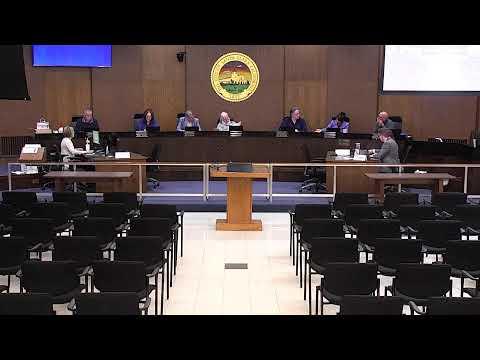
Planning commission continues decision on proposed 60‑foot LED billboard at 1700 Duane Ave.; asks staff for safety and structural studies
Summary
The Santa Clara Planning Commission on April 16 continued action on a conditional use permit for a 60‑foot, single‑sided digital LED billboard at 1700 Duane Avenue and asked staff to gather studies on traffic safety, illumination and structural collapse risk before the commission takes a final vote. The hearing was continued to June 11.
The Santa Clara Planning Commission on April 16 continued a public hearing on a conditional use permit and related minor modification for a proposed single‑sided digital LED billboard at 1700 Duane Avenue, setting the matter for a date‑certain continuation on June 11 while staff researches traffic‑safety studies, illumination impacts and a possible structural collapse analysis.
The proposal would install a single west‑facing digital display mounted on a new 46‑foot supporting column with a 60‑foot overall height and a 672‑square‑foot face visible to southbound vehicles on U.S. 101. The applicant has asked for a minor modification to reduce the code‑required 1,500‑foot separation from other electronic message signs by up to 25%; staff said the requested separation would be about 1,125 feet from an on‑premise LED sign at 3250 Jay Street and about 1,440 feet from another billboard at 1130 Duane Avenue. As part of a billboard relocation agreement, the project would remove three existing billboard faces in the city (one face at 2983 El Camino Real and two faces at 3362 El Camino Real), a 3‑for‑1 removal required by city policy.
Staff planner Maya Patel told the commission the sign would change static images every 8 seconds, would not show video or motion, and would meet the city code's operational limits (maximum about 5,000 nits daytime and 300 nits nighttime with ambient dimming controls). The project is proposed to be categorically exempt from environmental review under the California Environmental Quality Act (CEQA) Guidelines, Class 3 (New Construction or Conversion of Small Structures, CEQA Guidelines §15303). San Jose Airport planning staff told the Planning Division that the applicant will have to file FAA Form 7460‑1 (Notice of Proposed Construction or Alteration) and obtain a FAA determination of no hazard prior to building permit issuance; staff proposed that be added as a condition.
Commissioners and members of the public pressed staff and the applicant on safety issues. Commissioners asked staff to pull studies that examine whether digital billboards increase crash rates or certain collision types, whether the 8‑second image hold is consistent with best practices used in other Bay Area jurisdictions, and whether brightness/dimming standards are effective in practice. Several commissioners asked whether the city could require a structural “collapse” or sight‑hazard analysis similar to reports required for tall towers so the city could better understand the consequences of an extreme event (for example, seismic collapse or severe corrosion) and whether a fallen sign could obstruct emergency access or strike infrastructure.
Commissioners also questioned how the proposed sign would look from nearby streets and how many other LED signs drivers would see in quick succession while traveling southbound on U.S. 101 during commute periods. One commissioner noted that at highway speeds multiple eight‑second displays could result in a motorist seeing two or more different off‑site advertisements within the same short drive; another commissioner cited the City of Sunnyvale's longer minimum message hold time (two minutes) as an example of a different approach. Resident Linda Nepra told the commission she had seen LED signs she described as “blinding” at sunset and urged staff to study glare and solar angles.
Applicant representatives said the project would follow the city's relocation policy, include commitments for public service messages (for example Amber Alerts and other emergency messages), and that the industry uses dimmer controls and timing to meet local standards. OutFront Media representative Jeff McEwen described the sign as immediate flip transitions (no dissolves or animated video) and said similar signs have been installed elsewhere along U.S. 101.
Because commissioners wanted time for staff to collect safety data and examples from neighboring jurisdictions and for staff to draft potential conditions (including language for a structural analysis if the commission wished to require one), the commission continued the public hearing to June 11 and directed staff to return with research on: traffic‑safety/crash studies about LED billboards and message hold times, practical experience with illumination/dimming limits, possible structural/collapse study language (similar to the AT&T tower condition referenced in the hearing), and the FAA coordination requirement and its typical timing relative to the building permit.
The continuation was approved by the Planning Commission on a motion to continue the public hearing to June 11, 2025; staff will prepare the requested research and potential conditions ahead of the continued hearing.