Get Full Government Meeting Transcripts, Videos, & Alerts Forever!
Get email alerts on the State Budget topic
No spam. Unsubscribe anytime.
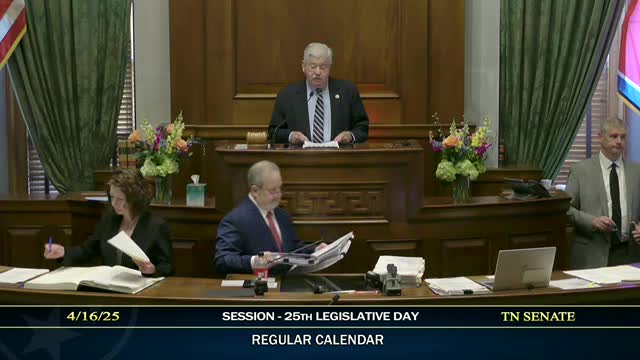
Tennessee Senate approves $59.8 billion budget after hours of debate over vouchers, roads and health funding
Summary
The Tennessee Senate passed a $59.8 billion fiscal-year budget after extended debate over a $150 million school choice program, infrastructure spending and funding for TennCare and disaster recovery. Lawmakers approved the budget and related implementation measures and bond authorization on final passage votes.
The Tennessee Senate on Thursday approved a $59,800,000,000 state budget after extended debate about school choice funding, infrastructure investments and health-care spending.
Leader Johnson moved the budget forward on the floor after the House amendments were received. "Members, this is a $59,800,000,000 state budget," Leader Johnson said as the Senate took up the appropriations package and its legislative amendments.
The budget — described by Chairman Watson, the Senate finance chair, as the product of a broad team effort — funds a range of priorities including a $244,000,000 boost to the K–12 funding formula known in the bill as the Tennessee Investment and Student Achievement Act (TISA), $27,300,000 for summer-learning programs, $25,000,000 for a fast-track growth fund, $10,000,000 for paid parental leave for local education agency employees and $20,000,000 for school safety grants. The legislative amendment also directed more than $78,000,000 of shared savings to TennCare to restore services previously supported by an assessment fee and set aside new disaster relief and preparedness dollars for recent storms and flooding.
"This legislative amendment perhaps more than any other legislative amendment we have considered here in my time as finance chair truly reflects the priorities of the senate and the general assembly," Chairman Watson said on the floor while highlighting disaster relief, health-care and local grant pools included in the package.
The budget plan moved amid a series of floor amendments and procedural motions. Senator Yarborough offered an amendment intended to remove funding for the newly enacted private school voucher program, saying the state should not "launch a new $150,000,000 program" while federal revenues and the economy were uncertain. "I don't think it's a responsible time, Mr. Speaker, for us to launch a new $150,000,000 program," Yarborough said, arguing the expense could crowd out other priorities if revenues decline. That amendment was debated and ultimately tabled.
Senator Campbell urged additional, sustainable revenue for roads and infrastructure, saying, "We have over $68,000,000,000 in infrastructure needs in our state," and pressed for long-term options beyond the one-time and redirected funds included in the amendment. Leaders pointed to a $1,000,000,000 proposed cash injection to the road fund and a plan to redirect approximately $80,000,000 a year in tire sale revenue into the road fund as part of the package.
The legislative amendment also included nonrecurring and recurring allocations: reductions of vacant positions and agency cuts to fund increases elsewhere, plus a transfer plan that avoids recognizing potential revenues from bills not yet passed (notably bills regarding vaping and hemp-derived products). The Senate amendment set aside the unrecognized potential revenue in a special reserve for future consideration.
Other items in the legislative amendment included: - Increased reserve contributions, bringing Tennessee's rainy-day fund to a reported record high of approximately $2.1856 billion. - New and expanded grant pools totaling $42,000,000 for local capital projects and first responders, including $20,000,000 for volunteer fire departments and $5,000,000 each for rescue squads, EMS, senior centers and local museums. - Targeted health-care investments, including increased pediatric dental reimbursement (about $4,000,000 recurring) and $1,400,000 recurring for scholarships tied to a public–private medical-school pipeline program.
Supporters said the package strengthens long-term fiscal stability and targets local needs; critics warned that some provisions are one-time fixes and that ongoing obligations could stress future budgets. "We are kicking cans down the road," Senator Yarborough said during debate, urging more caution about recurring commitments given revenue uncertainty.
On final passage of the appropriations bill as amended, the chamber recorded a roll call: House Bill 14‑09 (the Senate-conformed appropriations bill) passed, 30 Aye, 2 Nay. Earlier companion measures that implement and authorize elements of the budget were also passed by the Senate on final consideration, including the budget-implementation bill and a bond authorization bill.
Votes at a glance: House bills and measures acted on by the Senate during this session included: House Bill 14‑09 (appropriations, as conformed) — Passed (Aye 30, Nay 2). Motion: conform and substitute to House Bill 14‑09; final passage on third and final consideration. House Bill 14‑08 (budget implementation bill) — Passed (Aye 33, Nay 0). Motion: conform and substitute; final passage on third and final consideration. House Bill 14‑07 (general obligation bond authorization) — Passed (Aye 33, Nay 0). Motion: conform and substitute; final passage on third and final consideration. House Bill 8‑58 (limits on step therapy for certain metastatic cancers) — Passed (Aye 32, Nay 0). Motion: conform and substitute to House Bill 8‑58; final passage. Other bills taken up later in the calendar (bills on bonds, health policy changes, and additional statutory changes tied to the budget) were advanced or scheduled for future consideration; where the Senate recorded a specific roll-call tally it is shown above. For other measures referenced on the floor the recorded roll-call tally was not specified in the transcript and is therefore noted as "not specified."
What happens next: Having passed the budget bills and related measures on final consideration, the Senate laid motions to reconsider on the table. The bills will proceed to enrollment and further processing consistent with legislative procedures before being returned to the governor for signature or veto. The House and Senate also left several related measures for future consideration and placed other amended bills on a message calendar for subsequent action.
The floor debate included detailed line-item discussion and plea for more durable funding streams for infrastructure and health care; budget leaders described the package as fiscally conservative while acknowledging that some investments were one-time or nonrecurring to preserve a balanced bottom line. The Senate's votes complete the chamber's final consideration of the main fiscal package for the coming year.