Get Full Government Meeting Transcripts, Videos, & Alerts Forever!
Get email alerts on the Cash Assistance topic
No spam. Unsubscribe anytime.
Residents and advocates urge Cambridge to continue Rise Up-style cash assistance and expand housing supports
Summary
Multiple public commenters urged the Council to create a successor to the ARPA-funded 'Rise Up' cash assistance program and to expand municipal housing vouchers and legal supports; commenters cited prior pilot numbers and the city’s high cost of living.
Several public commenters urged the Finance Committee to preserve or create a successor to the ARPA-funded "Rise Up" guaranteed-income pilot and to expand direct cash assistance and housing supports for low-income families.
Geeta Pradhan of the Cambridge Community Foundation told the committee the philanthropic community contributed "$1,600,000" for an early guaranteed-basic-income pilot that served about 30 single-parent households and said the city later invested "over 18,000,000" (as stated in the transcript) in a program serving low-income families with average household incomes quoted by the speaker as $26,500 annually. Pradhan said flexible monthly cash helped families pay rent, utilities and other immediate needs and urged the Council to prioritize a successor program.
Tina Allou of the CEOC described tax-preparation and food-bank demand among low-income residents and urged continued cash assistance. Resident Dan Totten and others argued the Transition Wellness Center should be funded and suggested redirecting existing city resources; Totten also highlighted the social value of shelter. Rabbi Yoni recommended the Council consider a pilot "right to counsel" program to preserve tenancies, suggesting an $840,000 pilot and legal vouchers up to $10,000 per tenant.
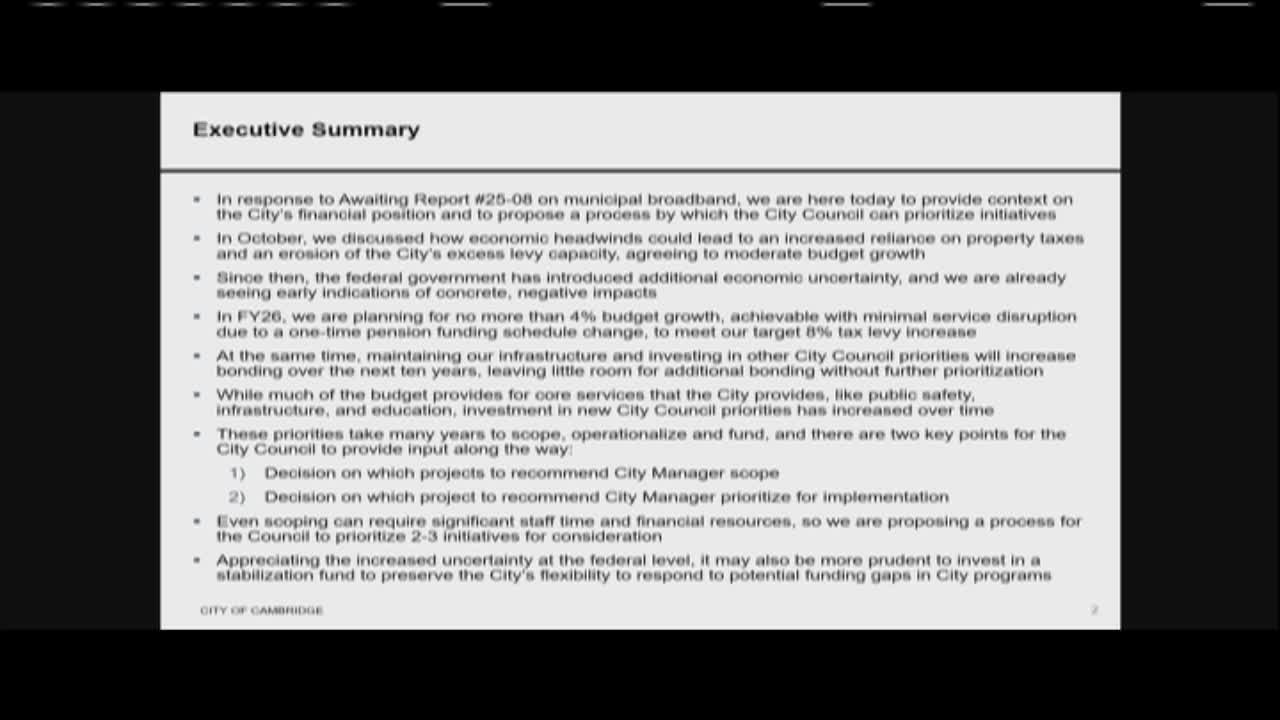
Councilors and staff discussed funding limits and trade-offs. Finance staff said the $5 million stabilization fund is one-time free cash and that any successor cash program funded from it could create ongoing obligations that must be absorbed in future budgets. Speakers urged the Council to consider targeting cash to the lowest-income households and to weigh means-testing and program scale.
No formal action was taken; public comment was recorded and staff asked to return with scoping work for council review.