Get Full Government Meeting Transcripts, Videos, & Alerts Forever!
Get email alerts on the Public Health And Safety Appointment topic
No spam. Unsubscribe anytime.
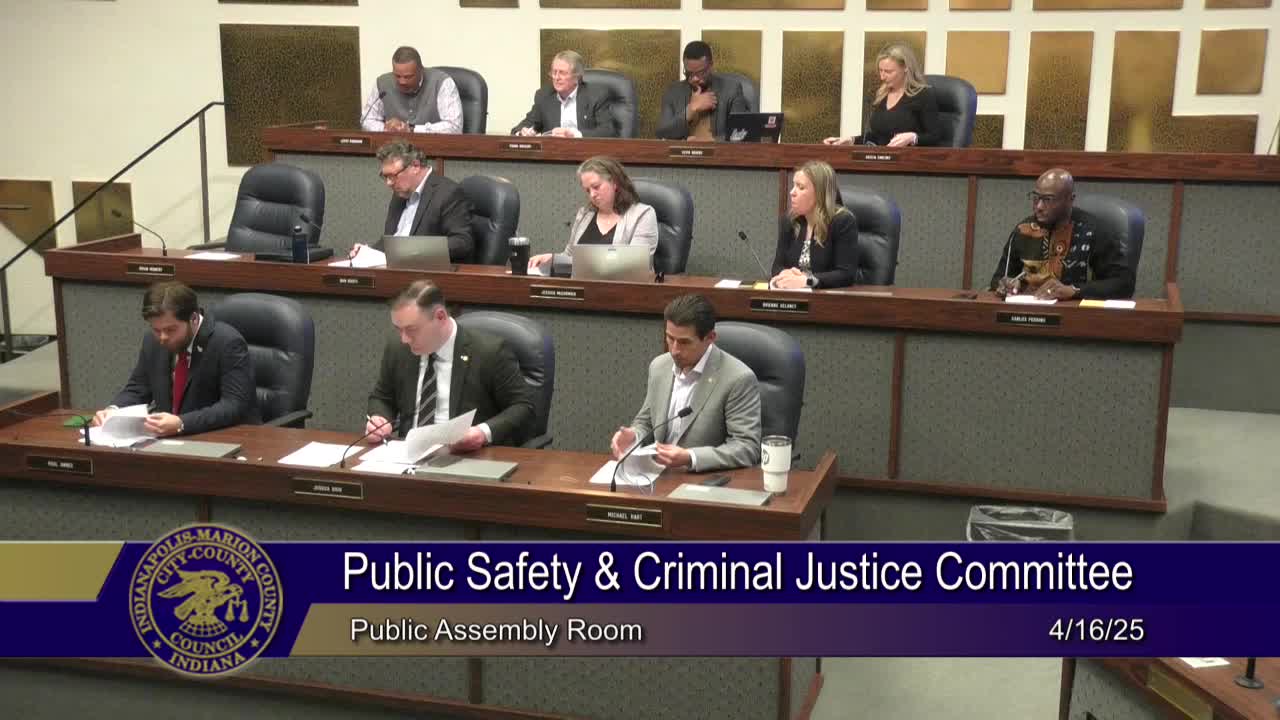
Public Safety Committee confirms Andrew Merkley as OPHS director amid testimony on shelter conditions
Summary
The Public Safety Committee voted to approve Andrew Merkley as director of the Office of Public Health and Safety after Merkley outlined programs on eviction prevention, emergency sheltering and violence intervention and after multiple residents and advocates testified about poor conditions at winter contingency sites including School 68.
Andrew Merkley, the mayor's nominee to lead the Office of Public Health and Safety (OPHS), was approved by the Indianapolis City‑County Council Public Safety Committee on Wednesday in April following a presentation of the department's programs and extended public testimony about winter contingency shelter conditions.
Merkley described his work leading homelessness, eviction-prevention and violence-reduction programs in OPHS and outlined metrics and recent initiatives. He told the committee the tenant advocacy project (TAP) has grown countywide and said the city is developing a permanent housing hub planned to break ground later this summer. "Eviction is the front door to homelessness," Merkley said during his remarks, urging more prevention and outreach.
Why it matters: The confirmation came as residents, grassroots groups and faith leaders urged the committee to hold OPHS accountable for conditions they say occurred in winter contingency shelters. Witnesses recounted mold, inadequate heating and sanitation, alleged assaults, and delayed services at School 68 and other temporary sites. Committee members pressed Merkley for follow‑up and for improved data, reporting and engagement with grassroots providers.
Merkley's presentation and numbers Merkley described OPHS's divisions and recent activity, including the Assessment and Intervention Center (AIC), clinician‑led community response teams and reentry services. He said the AIC served more than 500 unique people this winter and that 21 guests moved into recovery services from the AIC; he said 46% of AIC clients in 2024 were African American and that 90% were housing insecure. Merkley told the committee the clinician‑led community response team logged 1,224 calls in 2024 and responded to 738 within its service area. He said OPHS has used dashboards to track program reach and demographics and that many programs were initially expanded with COVID‑era funding.
Merkley described School 68, a vacant Indianapolis Public Schools building used this winter for family sheltering, and said more than 61 families with children were served there during roughly four months of operation, with "over half" of those families moving into permanent housing. He said the city is planning a housing hub influenced by lessons learned this winter.
Public testimony: complaints and numbers cited Several community speakers and nonprofit leaders criticized OPHS operations during winter contingency. Katie (KT) White, executive director of Allies for Humanity, opposed Merkley's appointment and said her written testimony documents "588 deaths of unhoused neighbors over the past 4 years"; she asked the committee to consider broader leadership and accountability failures.
Several residents who stayed at School 68 described unsanitary conditions. Carrie Cline said she and her family encountered mold, clogged and flooded bathrooms, a rat inside the shelter and what she described as "detestable food." Melanie Gloth said her children were sexually assaulted in a cubicle and that staff did not act, and her account said she had to leave employment because of safety issues. Young people who stayed at the site also testified: Isabella Gloth said, "I didn't always feel safe," and Jocelyn Gloth said she reported an assault that staff did not investigate to her satisfaction.
Brandon Kennedy, a nonprofit leader who said he helped coordinate with families during the winter contingency, said the program operated on approximately $1,200,000 and reported that housing families in hotels cost about $22,000–$24,000 per week when roughly 40 families were housed there. He urged further review of delays and planning that postponed the shelter opening until December instead of November.
Councilors' requests and administration response Council members pressed Merkley on program evaluation and accountability. Councilor Carlos Perkins asked Merkley to assess his performance as administrator of the Division of Homelessness and Eviction Prevention; Merkley replied he would rate himself "at least an 8 or above" but acknowledged unfinished work due to funding and partner challenges. Councilor Keith Grates (Graves) thanked Merkley for providing a large packet of materials and asked the director to retroactively review ARPA/CARES‑era program efficacy; Merkley said dashboards and analysis are underway.
Merkley said OPHS is already planning for a future weather contingency and intends to invite a wider set of stakeholders to planning meetings, expand data collection and standardize contract metrics. When committee members pressed him about specific allegations from children and families, Merkley said he was not previously made aware of certain individual assault reports and that the committee should await Aspire Indiana Health's incident report from its winter contingency operations; he agreed to meet with several public commenters and grassroots groups after the meeting.
Vote and committee action The committee approved Merkley's appointment in a roll call vote. Committee members indicated they will continue oversight of OPHS programming, data collection and grant reporting.
Ending: follow up and next steps Several council members asked OPHS to return with more detailed program evaluations and pledged continued oversight during the upcoming budget process. Merkley thanked the committee and said he would engage grassroots organizations and those who testified to address outstanding concerns.
Votes at a glance - Proposal 107: Reappointment of Fred Pervine to the Emergency Services Agency Board — approved by voice/consent. - Proposal 108: Appointment of Ashley Barnett to the Emergency Services Agency Board — approved by voice/consent. - Proposal 98: Appointment of Claudette Peterson to the General Orders Board — approved by voice/consent.