Get Full Government Meeting Transcripts, Videos, & Alerts Forever!
Get email alerts on the Budget Stabilization topic
No spam. Unsubscribe anytime.
Cambridge finance staff propose $5 million stabilization fund to cover potential federal funding cuts
Summary
City finance staff recommended using $5 million in one-time free cash to create a stabilization fund to backfill expected federal grant losses, while urging the Council to prioritize a small number of initiatives for scoping given uncertain revenue projections.
Cambridge finance staff recommended that the City set aside $5 million in one-time free cash as a stabilization fund to cover expected federal funding gaps, and outlined a new council-driven process to prioritize and scope future initiatives.
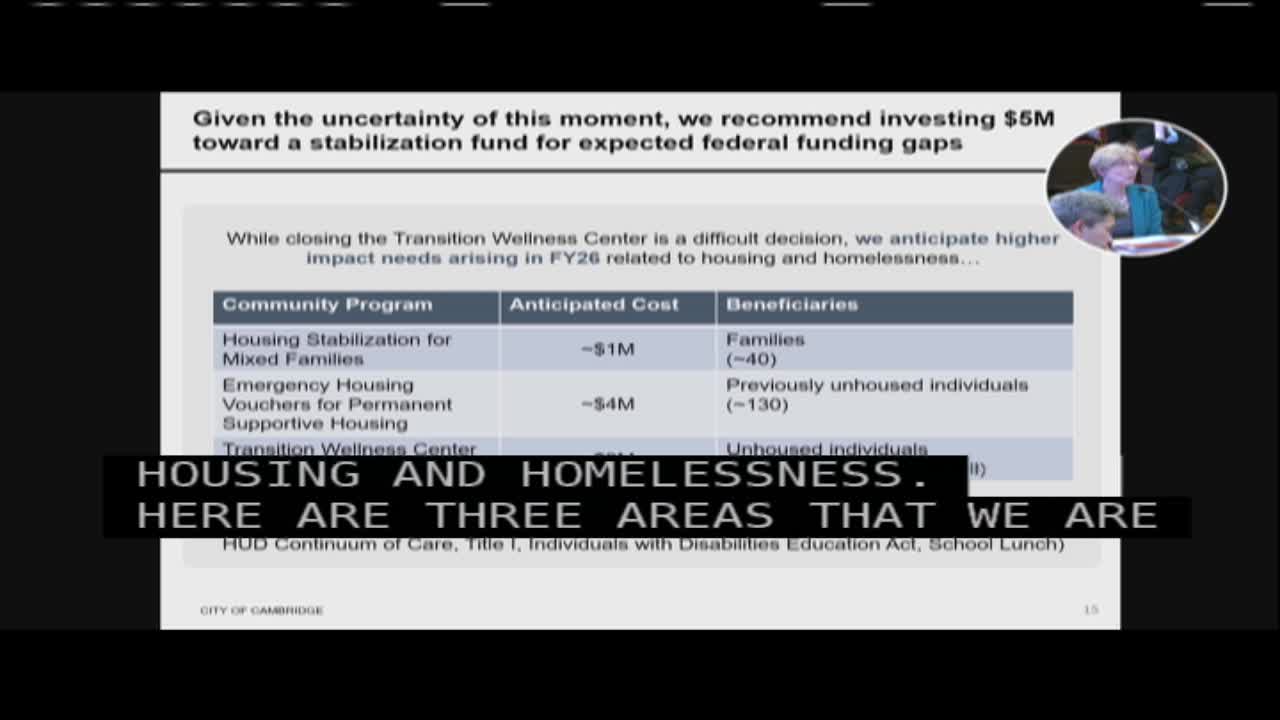
Claire Spinner, assistant city manager for finance, told the Finance Committee that "given this uncertainty at this moment, we are recommending investing $5,000,000 towards a stabilization fund for expected federal funding gaps." Spinner said the money would come from certified free cash and would not be invested in a special account; it would be available if federal grants are cut.
The recommendation grew out of staff presentations that showed longer-term operating- and capital-budget pressures, including rising debt-service costs and an uncertain commercial tax base. Spinner said the city typically receives about $20 million in federal grants each year for programs that include housing supports, special education, fuel assistance and school meals; she told the committee that the city faces "more than $20,000,000 of exposure in federal funding gaps in different areas." She highlighted three specific near-term concerns: housing stabilization for mixed-status families (staff estimated about 40 families could be affected), emergency housing vouchers (staff said $4,000,000 in federal funding currently supports roughly 130 people), and the Transition Wellness Center.
Spinner and City Manager remarks emphasized that the $5 million is a one-time use of free cash and that any programs supported with that money in FY26 would create ongoing operating obligations that the city must absorb in subsequent budgets. "If we invest our reserves in FY '26, we'll need to find $5,000,000 elsewhere in future budgets," Spinner said, and later added that the administration "can work that problem over the next 12 months, but we can't add more than that." Councilors pressed staff about whether the $5 million could be larger; staff replied that the $5 million reflects a limit based on realistic ability to absorb ongoing costs in FY27 and beyond.
Committee members and public commenters urged prioritizing direct aid to low-income families, and several councilors said they want a formal prioritization process. Spinner outlined a proposed schedule: solicit ideas from councilors, hold a council working session, select two or three initiatives to have staff scope in detail, then return to the council with operational and financial analysis to guide final prioritization.
No appropriation was adopted at the meeting. The recommendation was presented for council discussion; any use of the stabilization fund would require a later appropriation vote by the Council.
Chair Cher Nolan opened the meeting by noting the presentation had been adjusted to include a discussion of the Transition Wellness Center. The Committee continued its meeting despite remote-communication outages after the Law Department advised the chair could decide to proceed when reasonable efforts to fix technical issues are underway.
What happens next: staff will continue to refine projections and return with scoped cost and operational plans for the highest-priority initiatives. Any appropriation of the proposed stabilization fund would require a subsequent Council vote.