Get Full Government Meeting Transcripts, Videos, & Alerts Forever!
Get email alerts on the Homelessness topic
No spam. Unsubscribe anytime.
Homeless Strategy Office details outreach, shelters and rapid expansion of permanent supportive housing for downtown Austin
Summary
The citys Homeless Strategy Office told the Austin Downtown Commission it is expanding outreach and permanent supportive housing, reporting roughly 6,300 people experiencing homelessness in Austin and outlining program results and capacity challenges.
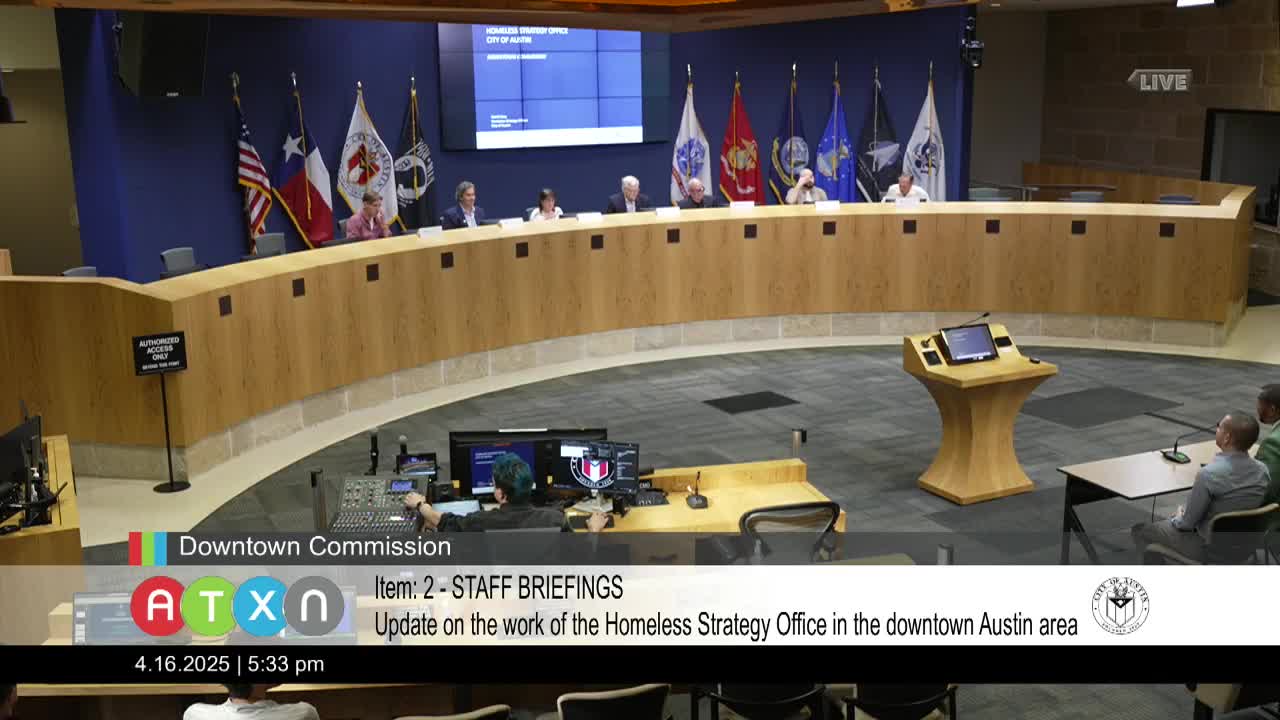
David Gray, director of Austins Homeless Strategy Office, told the Austin Downtown Commission on April 16 that the city is expanding outreach, shelter capacity and project-based permanent supportive housing to address homelessness in downtown Austin.
Gray said the Homeless Strategy Office (HSO) estimates about 6,300 people are experiencing homelessness in Austin and Travis County, a figure he said is based on the Homeless Management Information System rather than the point-in-time count. "Our estimated homeless population here in Austin and Travis County is around 6,300 people," Gray said.
The office reported that in 2023 about 3,000 people exited homelessness, a 50% increase from 2022. HSO also said 24,300 unique people were served in 2023 (a 60% increase over 2022), and 8,400 of those were first-time service recipients (a 72% increase).
Why it matters: Downtown commissioners said the trends show both progress in rehousing and growing demand for services. Gray described a two-track emphasis: prevention and rapid rehousing for newly homeless people, and a larger investment strategy in permanent supportive housing (PSH) for people who are chronically unsheltered.
HSO described a suite of services delivered downtown. Outreach and enforcement are handled through an approach the office calls HEAL (Housing-Focused Encampment Assistance Link) for high-risk encampments, a multidisciplinary HOST (Homeless Outreach Street Team) that partners with police, EMS, the Downtown Community Court and Integral Care, and a civilian first-responder pilot run by Urban Alchemy called HEART (Homeless Engagement Assistance Response Team).
HSO gave performance figures for those programs. Since inception, HEAL has led 31 encampment decommissions and moved just over 1,075 clients into shelters or services; 71% of HEAL clients were chronically homeless and half of clients leaving the bridge shelters have transitioned to a housing destination, HSO said. HSO said the city and county manage about 1,500 shelter beds in the region and that the city operates just under 950 of those. City-owned shelters downtown mentioned by HSO include the Arch (an all-mens shelter with about 130 beds), the recently converted H Street shelter for women and gender-diverse clients (about 60 beds), an 81-bed Salvation Army facility for women and children, the Marshfield Yard congregate shelter (capacity about 300), and two bridge shelters (Northbridge, 25 beds; Southbridge, 45 beds).
HSO provided year-to-date and program metrics for HOST and HEART. HOST delivered over 3,400 contacts with 1,500 unique individuals in the most recent full year, performed more than 3,100 interventions (medical and substance-use supports), completed 68 ER diversions, 37 psychiatric-hold diversions, 70 jail diversions, over 300 coordinated housing assessments, assisted 126 people with obtaining housing, and helped more than 200 people access shelter. HEART (a newer Urban Alchemy civilian response team) reported January totals of about 900 engagements (roughly 28 per day), 729 referrals to social services, 85 people receiving clean clothes, 17 transportation assists, 7 clients helped into housing and 5 additional referrals to housing services.
Gray said the office prioritizes leading with outreach before enforcement and uses HEAL when encampments are unsafe or imminent weather hazards exist. "Most of the time, we will lead with outreach before we do enforcement. We want to make sure people have access to services and assistance before we have to close an encampment," Gray said.
On permanent supportive housing, Gray said prior council and county investments will increase PSH capacity substantially: HSO said the citys PSH pipeline reflects a large expansion, including a recent opening of about 100 units and another roughly 50-unit opening expected soon. HSO displayed a map and a chart showing increases in project-based PSH across the city and said the city is trying to geographically disperse PSH so one neighborhood does not carry a disproportionate share of units.
Commissioners pressed HSO on capacity and funding. Gray said funding for the current fiscal year is secured and all contracts are on target; the office will present investment considerations to council in a joint Austin Public Health and Audit & Finance Committee meeting on April 28. "Following that, the city manager will release his proposed budget for FY '26," Gray said, and council will determine next-year funding.
HSO also described supply- and system-level constraints: city staff said there is currently roughly one shelter bed for every five people who are unsheltered and that shelter availability is a limiting factor for same-day placement when outreach teams respond. Gray and staff described diversion, transportation and partner-run programs (including a Housing Connector landlord outreach partnership) as tools to place clients when shelter beds are scarce; HSO said Housing Connector listed about 2,300 units in its soft-launch month as potential placements for people exiting homelessness.
Federal funding and staffing changes were discussed. Gray said the city has received assurances the latest HUD Continuum of Care awards will be honored, but added that staffing cuts at federal agencies such as HUD and the VA have made interagency work and reimbursements harder to obtain.
Ending note: Gray said HSO would return with updates and encouraged commissioners and the public to report downtown concerns via the office so crews can respond. HSO staff indicated they will present council-level investment recommendations on April 28 and said they are continuing to pursue philanthropic and private partners to help sustain programs beyond city funding.