Get Full Government Meeting Transcripts, Videos, & Alerts Forever!
Get email alerts on the Vineyard Research Climate Resilience topic
No spam. Unsubscribe anytime.
UC Cooperative Extension outlines vineyard research to help Lake County growers adapt to climate, smoke and frost risks
Summary
Dr. Christopher Chin of the University of California Cooperative Extension presented research and outreach programs aimed at helping Lake County wine-grape growers respond to drought, frost and smoke-taint risks, including field studies at the Hopland Research and Extension Center and preliminary smoke-taint results.
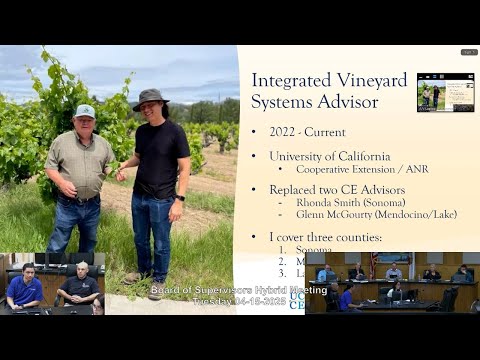
Dr. Christopher Chin, Ph.D., Integrated Vineyard Systems Advisor for the University of California Cooperative Extension, told the Lake County Board of Supervisors that UC Extension is conducting applied research and outreach to help local wine-grape growers address climate resilience, drought recovery, frost protection and smoke-taint risks.
Chin said his office covers Sonoma, Mendocino and Lake counties and that his work combines one-on-one consultations, educational events and field research at the Hopland Research and Extension Center. "We try to help the farmers who grow grapes in this area, with one-on-one assistance, in-person visits, and making resources accessible online, at no charge to them," Chin said.
The program targets three elements Chin described as essential to sustainable agriculture: economic viability, social responsibility and environmentally sound practices. Matthew Barnes, area director for UC Cooperative Extension, introduced Chin and said the advisor’s ‘‘innovative research addresses critical issues facing our region’s vineyards, including climate resilience, drought adaptation, smoke taint mitigation, and sustainable vineyard practices.’’
Chin reviewed several active projects. At Hopland, researchers are conducting a field study of prescribed burns to measure volatile phenols associated with smoke taint; Chin described the work as preliminary and aimed at measuring how fuel type and distance affect compounds that can damage grapes. He said an earlier preliminary study found an average 31% decrease in the compounds at distances of less than a quarter mile from the smoke source, but added that the finding does not remove concern for grapes.
On frost protection, Chin described trials in Lake County testing whether frost fans can reduce or replace high water-use frost irrigation. He said frost irrigation can require "20 to 30% of the water" over a two-week period in a typical year, and that installing fans or using propane- or electric-powered devices could conserve water. In response to Supervisor Oren’s question about noise, Chin said there are no purpose-built quiet models he could point to and that noise differences vary by power source and placement.
Chin also discussed work on berry shrivel, sunburn avoidance, rootstocks for drought recovery and educational programming including annual field days, pest-control breakfasts and UC Davis "On the Road" talks. He said vineyard research time comprises about 20–30% of an advisor’s work and emphasized outreach to growers across the three counties he covers.
During board discussion, Supervisor Pyska asked whether Chin’s observations matched a reported 10% reduction in Lake County wine-grape acreage over the prior 18 months. Chin said he does not personally track that exact figure but follows published reports and that Lake County appeared to be at the lower end of statewide losses. A member of the public, Margo Kambara, asked whether wine grapes could be repurposed for other products; Chin noted alternatives such as vinegar or nonalcoholic beverages are possible but said those approaches often are not economical given the typical management cost of wine grapes, which he estimated at $5,000 to $10,000 per acre.
Chin identified local field sites being used for trials, including a berry-shrivel study at a Beck’s Stauffer research block referenced during the meeting, and said UC Extension will continue outreach and monitoring. The presentation ended with the board thanking Chin and noting they would watch the research as local growers consider adaptation options.