Get Full Government Meeting Transcripts, Videos, & Alerts Forever!
Get email alerts on the Community Choice Aggregation topic
No spam. Unsubscribe anytime.
Lake County supervisors direct staff to seek Sonoma Clean Power feasibility study on joining CCA; geothermal development discussed
Summary
The Lake County Board of Supervisors signaled consensus to ask Sonoma Clean Power to update a feasibility study on whether the county should join a community choice aggregator; presenters also outlined geothermal development opportunities and timelines.
The Lake County Board of Supervisors on Oct. 27 directed staff to request that Sonoma Clean Power update a feasibility study on whether Lake County should join a community choice aggregator, a step county staff and the CCA said would let the county evaluate potential rate and program benefits and local participation in geothermal development.
The feasibility request follows earlier studies done for the county in 2019 and 2020, which found Sonoma Clean Power's expected rates then would have been about 5% to 8% higher than Pacific Gas & Electric for Lake County customers. Matthew Rothstein, chief deputy county administrative officer, told the board the landscape has changed since 2020 — including regulatory shifts that affect the power charge indifference adjustment — and that Sonoma Clean Power has offered to update its analysis.
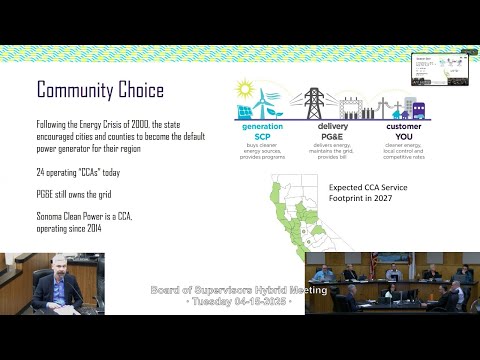
Sonoma Clean Power (SCP) Chief Executive Officer Jeff Cyphers and county economic-development deputy Benjamin (Ben) Rickleman outlined what SCP said it could add if Lake County joined: customer programs aimed at lowering bills, in-region procurement opportunities that could let residents use power generated locally, and a partnership role in steering new geothermal development so projects meet local environmental and community standards.
"We cannot promise cost savings," Cyphers said, adding candidly that SCP had been cheaper than investor-owned utilities in a little more than 80% of months historically and that last year the agency returned roughly the equivalent of a 7% savings to customers. He noted a premium service called "Evergreen" is locally produced geothermal and solar and can cost an average household an additional $15 to $30 per month.
Rothstein summarized the procedural steps: if the board directs staff to request an updated feasibility study, SCP expects to take roughly two to three months to prepare an analysis and then present results to its own board; the Sonoma Clean Power board would then decide whether to extend an offer of service. Rothstein said a formal ordinance by the Lake County Board of Supervisors would be required to join, and SCP would need to file an implementation plan with the California Public Utilities Commission by Jan. 1, 2026 to target early-summer 2027 as a realistic earliest start date for service.
The presentation also focused on geothermal. Cyphers and Rickleman described advances in enhanced geothermal systems (EGS) that they say make new geothermal development commercially viable beyond existing sites such as The Geysers. Rickleman cited the Fervo Energy Cape Station project in Utah as a recent large-scale example (announced as 500 megawatts) and said industry estimates place drilling costs near $4 million per well with each well producing roughly 10 megawatts in some projects.
Rickelman and Cyphers described permitting and transmission constraints: federal reviews such as the National Environmental Policy Act (NEPA) and California Environmental Quality Act (CEQA) processes can extend timelines (they cited multi-year federal review timelines of about seven years for full projects), and California currently requires separate CEQA phases for exploration and development, which they said some in the industry and state Legislature are seeking to change to speed deployment.
Board members and public commenters raised economic-development and environmental concerns. Supervisor Owen said many Geysers workers live in Lake County and urged SCP to prioritize local hiring if projects develop. Supervisor Sabatier said geothermal jobs typically pay well but warned that raw resources can be exported and urged negotiation of benefits for local residents and businesses. Several supervisors asked how tribal governments would be engaged; Cyphers said SCP has begun tribal consultation and is handling some requests for immediate assistance on existing energy installations while continuing longer-term engagement.
Denise Rushing, a former Lake County supervisor and energy-industry professional, urged the board to approve the feasibility request. "It's a no-brainer to get the feasibility study," she said, arguing CCAs have matured and can deliver customer programs and innovation.
County staff clarified several logistical points: the cities of Lakeport and Clearlake have already submitted letters requesting feasibility analysis; the county would not be charged for SCP's feasibility study work; feasibility and implementation timelines depend on SCP board actions and CPUC filing deadlines; and joining SCP would not remove local permitting authority over geothermal projects or change existing county geothermal setback rules around Clear Lake.
The board indicated consensus to direct staff to submit the feasibility request to Sonoma Clean Power; no formal roll-call vote was recorded in the public transcript. Next steps identified were: staff to transmit the formal request to SCP, SCP to prepare and present the updated feasibility analysis (estimated two to three months for study work), SCP board consideration of whether to extend service, and if both SCP and Lake County proceed, the Lake County Board would consider an ordinance and staff would work toward the CPUC implementation-plan filing deadline.
Ending: The board's direction begins a formal study process rather than a decision to join SCP. SCP and county staff said the feasibility update would return to the boards with detailed rate, program and risk information before any binding action. The timeline discussed targets a potential service start in 2027 if subsequent approvals and regulatory filings proceed on the schedule discussed during the presentation.