Get Full Government Meeting Transcripts, Videos, & Alerts Forever!
Get email alerts on the Land Division topic
No spam. Unsubscribe anytime.
House approves Land Division Act changes in 96-6 vote after infrastructure, farmland warnings
Summary
The Michigan House passed House Bill 4081 on April 16, 2025, changing the Land Division Act to allow additional residential lot splits in certain circumstances. Supporters said it creates another local tool for housing; opponents warned it could outpace infrastructure and threaten farmland. The bill passed 96-6 and was given immediate effect.
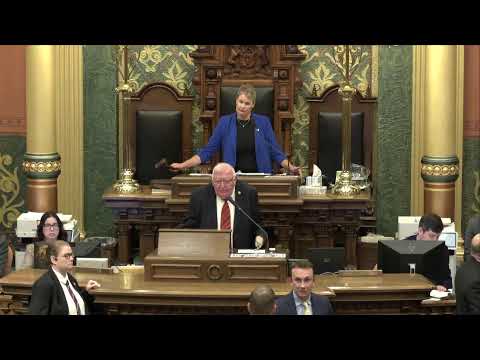
The Michigan House of Representatives passed House Bill 4081 on April 16, 2025, by a 96-6 roll-call vote, approving changes to the Land Division Act that would allow local jurisdictions to divide parcels into more lots in certain circumstances.
The change is intended by supporters to give local governments another tool to increase housing supply; critics warned during floor debate that the measure could encourage development in areas lacking roads, utilities or adequate wastewater systems and could threaten farmland and sensitive environmental areas.
Representative Skaggs, speaking in opposition, said, “This bill promotes the development of housing in areas where we may not have the infrastructure to support it,” and raised concerns about impacts to roads, water, sewage, internet and farmland. Skaggs said the bill relies on the quick review processes in Land Division Act sections 108 and 109b and argued that those sections are “not the place for creating residential development because of the quick and severely limited nature of the review and approval process.”
Representative DeBoyer said the bill “puts another tool in local jurisdictions' toolbox” and noted the proposal would allow a local jurisdiction to expand the number of lots that may be created on a parent parcel from the current four to as many as 10 during a 10-year window, subject to local lot-size, setback, road-frontage, survey and wastewater requirements. “All of those things are determined by the local jurisdiction,” DeBoyer said. “This just allows them to provide additional lots … to take one simple step in the direction of making housing more affordable.”
After debate the clerk opened a recorded roll-call vote. The clerk announced: “On the question of final passage of House Bill 4081, there are 96 I votes and 6 nay votes.” A majority voted in favor, and the bill passed. The majority floor leader then moved for immediate effect; members rose and the motion for immediate effect was ordered.
Discussion versus decision: the floor debate recorded clear opposition and support but did not identify amendments that altered the bill text on the floor. The formal decision was the recorded passage (96–6) and the separate motion granting the bill immediate effect.
Key details from the debate and transcript: - Statute cited: Land Division Act; speakers specifically referenced “sections 108 and 109b.” - Change described by proponents: permit local jurisdictions to create up to 10 lots (from four) on a parent parcel within a 10-year window, with local standards for lot size, setbacks, road frontage, surveys, and wastewater/water requirements remaining under local control. - Vote: final passage 96 yes, 6 no; immediate effect ordered.
What happens next: Because the House ordered immediate effect, the bill proceeds under the immediate-effect procedures in the legislative process; the transcript does not record subsequent Senate action or enactment into law.
Provenance: Excerpts of the floor debate and the roll-call tally are recorded in the House transcript beginning with Representative remarks on House Bill 4081 and ending with the clerk’s announcement of the 96–6 vote and the motion for immediate effect.