Get Full Government Meeting Transcripts, Videos, & Alerts Forever!
Get email alerts on the Agriculture topic
No spam. Unsubscribe anytime.
Senate committee hears broad accounting of U.S. Virgin Islands agriculture needs and plans
Summary
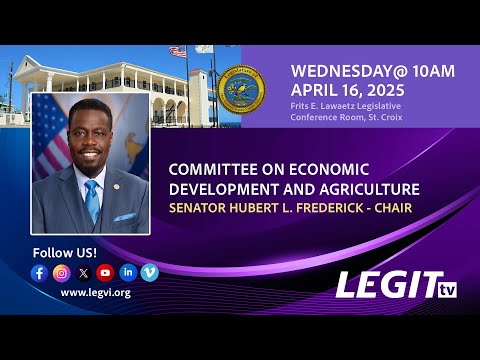
The Committee on Economic Development and Agriculture spent several hours on April 16 hearing a wide-ranging update on the state of agriculture in the U.S. Virgin Islands from Commissioner Louis E. Peterson Jr., University of the Virgin Islands School of Agriculture leaders, nonprofit food-system groups and local farmers.
The Committee on Economic Development and Agriculture spent several hours on April 16 hearing a wide-ranging update on the state of agriculture in the U.S. Virgin Islands from Commissioner Louis E. Peterson Jr., University of the Virgin Islands School of Agriculture leaders, nonprofit food-system groups and local farmers.
Committee members heard that the territory’s Department of Agriculture has maintained core services but faces persistent staffing and equipment shortages, an unstable inter-island slaughter capacity, and a backlog of expired farm leases that hamstring production and investment. “The mission of our agency is to develop, support, and promote an economically lucrative agricultural industry in The U.S. Virgin Islands,” Commissioner Louis E. Peterson Jr. told senators as he outlined the department’s divisions, recent purchases and outstanding gaps.
The testimony detailed both recent investments and continuing constraints. Agency staff said the department has used a portion of an allocated $10 million in ARPA recovery funds for infrastructure and equipment and estimated it has received roughly $3.5 million so far for specific projects including design work and purchases. The department reported completed and planned items that include a 200,000-gallon cistern project for Estate Bordeaux, new abattoir equipment and backhoe purchases for St. Thomas/St. John, and repair or replacement of abattoir systems on St. Croix.
Farmers and advocates emphasized how the gaps affect day-to-day operations and long-term planning. Summer Sibley Brown, founder and executive director of the Virgin Islands Good Food Coalition, cited USDA Census figures and argued the territory has “a layered lack of access — access to land, capital, markets, services, support, and respect” that constrains farms, many of them smaller than 20 acres. She urged a data-driven approach to match investments to opportunities and said existing programs are too fragmented to produce scale.
Several presenters addressed the abattoir situation in detail. Officials said the St. Croix facility is operating and compliant with USDA requirements and described equipment upgrades being funded through ARPA and other sources; the Department of Agriculture said it is seeking bids for additional repairs and expects a phased renovation to begin in months. At the same time the committee heard there remains no reliably scheduled marine cargo service from St. Thomas to St. Croix for moving livestock, and that St. Thomas currently lacks an operational abattoir — forcing producers to transport animals at their own expense when possible.
Speakers gave quantitative examples of recent work and services: the department reported baling 526 rolls of hay, purchasing and delivering about 70,500 gallons of water to farms and noting farmers collected about 80,400 gallons free from departmental standpipes. The department also cited grant awards: a $225,000 award to produce and distribute native tree seedlings for reforestation and a roughly $500,000 grant to support small forest landowners and scale fruit-tree production for the department’s food-orchard initiative.
Lease and insurance issues were a recurring theme. Officials said the department has reviewed hundreds of leases: on St. Croix they reported 149 active leases/permits with 83 expired leases recommended for renewal, 30 not recommended, and 24 for probationary renewal; in St. Thomas/St. John the department identified about 40 expired leases, with a subset being processed. Farmers and staff told the committee that a lack of liability insurance had stalled many renewals; Department of Agriculture witnesses said three insurers recently agreed to offer coverage for farmers, which should unblock some renewals.
Witnesses described several programmatic responses and proposals. The UVI School of Agriculture outlined academic and extension programs (certificates, associate and bachelor programs and Cooperative Extension outreach) intended to expand workforce training and applied research. Farmer groups urged cooperative business models, shared procurement and shared equipment, mobile or renovated slaughter capacity, a territorial food hub and greater use of specialty-crop block-grant funding for youth training and agroecological research. Sager Farm and Island Food Security Inc. described participation in regional meetings and workshops aimed at mobile meat-processing and genetics improvement for livestock.
Committee members asked for follow-up details the department said it would provide, including spending and timelines for ARPA-funded projects, a plan and cost estimates for St. Thomas abattoir renovation and a schedule for hiring key administrative and technical staff such as an assistant commissioner, fiscal administrator and additional heavy-equipment mechanics. Peterson said an assistant commissioner candidate interview process was underway and he hoped to fill that role within about a month.
Why it matters: senators and community witnesses framed the testimony in economic and resilience terms — noting high import dependence, aging producers and farm staff, limited market infrastructure, and climate-related water stress. Testifiers said modest increases in local production for poultry, eggs, fish and vegetables would recirculate millions in the territory’s economy. At several points witnesses cautioned that program promises dating to earlier recovery plans have not always translated into funds in farmers’ hands and asked the legislature to adopt clearer benchmarks and oversight for agricultural allocations.
The committee did not take formal votes on agriculture programs during this hearing; senators directed multiple follow-ups and asked staff to provide written reports and procurement and spending details requested from departments and UVI. The hearing recorded a high level of engagement from farmers, university staff and nonprofit advocates and ended with committee leaders promising additional briefings and closer tracking of the department’s hiring and capital projects.