Get Full Government Meeting Transcripts, Videos, & Alerts Forever!
Get email alerts on the Septa Budget topic
No spam. Unsubscribe anytime.
SEPTA says $213 million shortfall would force deep service cuts and fare hikes without state action; Council pledges advocacy
Summary
Scott Sauer, interim general manager of SEPTA, told Philadelphia City Council that the transit agency faces a $213 million deficit for FY2026 and would impose steep service cuts and fare increases unless the state adopts new transit funding.
Scott Sauer, interim general manager of the Southeastern Pennsylvania Transportation Authority, told the Philadelphia City Council's Transportation and Public Utilities Committee that SEPTA faces a $213 million operating shortfall for fiscal year 2026 and would be forced to enact deep service cuts, steep fare increases and hiring freezes unless state legislation provides new transit funding.
"Last Thursday, SEPTA re-released its fiscal year 2026 budget that would require 45% service cuts coupled with major fare increases and workforce reductions, to balance a $213,000,000 budget deficit without a permanent state funding solution for transit," Sauer said in opening testimony. He said a 20% service reduction would take effect in August followed by a fare increase in September, and that cuts could grow to include elimination of some regional rail lines and 50 bus routes by January.
Why it matters: SEPTA records about 800,000 passenger trips on an average weekday; Sauer said a diminished system could cut weekday trips to about 350,000 and would limit the agency's ability to provide event service for major 2026 events, including World Cup matches and Semiquincentennial activities. Sauer and council members framed the crisis around state-level funding: he thanked council for support at rallies and said legislative action on Governor Josh Shapiro's statewide transit funding plan would prevent the proposed measures.
Budget and contingency details: Sauer described steps SEPTA has taken to narrow the gap, including an "aggressive austerity plan" of management pay freezes and consultant cuts plus revenue measures that lowered a prior deficit estimate from $240 million to about $213 million. He also said SEPTA plans to dip into its service-stabilization working-capital fund: "the fund sits at just over $200,000,000" and SEPTA would use roughly $113,000,000 to close FY2026 after initial cuts, leaving less than one month of operating liquidity if the full package is enacted.
State and local funding context: Sauer said the City of Philadelphia's proposed contribution of about $135,000,000 under Mayor Parker's budget would help SEPTA meet local matching requirements and "match the additional state assistance that would be generated through Governor Shapiro's statewide transit funding plan." He also noted SEPTA's statewide operating subsidy is about $896,000,000 and that SEPTA receives less local operating support than many peer agencies.
Zero-fare pilot and city funding: Councilmembers asked about the future of the city-funded zero-fare pilot. Sauer said SEPTA supports continuing 0-fare as proposed by the Mayor's office and that discussions are ongoing about how the city will restructure already-committed local funds (including a prior city overmatch) to support the program for FY2026.
Public safety, outreach and SCOPE audit: Chief Charles Lawson of the SEPTA Transit Police testified on public-safety initiatives and the SCOPE outreach program (Safety, Cleaning, Outreach, Engagement, Planning). Lawson said transit crime is down 33% year-over-year and the transit police now have 248 sworn officers, with additional academy classes planned. He described use of 30,000 cameras and a new surface-transportation unit focused on buses and trolleys.
SCOPE contract issues: Sauer and Chief Lawson described an Office of Inspector General audit that found problems with the outreach portion of the SCOPE program. SEPTA paused certain contracts while it restructured oversight. Sauer said there were two outreach providers involved: NET (Northeast Treatment) and Merakey; he said Merakey remains under contract while the contract with Northeast Treatment was terminated "for convenience" prior to the inspector general report, and that some contracted work was paused pending new supervisory and verification practices. Sauer described plans to reissue outreach contracts and to have new oversight in place by July 1.
Operator safety: Sauer described a pilot of a full operator cabin enclosure that includes ballistic glass. He said the first bus with a full enclosure will be available in June and another seven buses will follow for operator testing, with engineering work to address the extra weight on the bus's front axle. "This should prevent almost every physical encounter that they unfortunately have to endure," Sauer said, while noting enclosures do not prevent shootings.
Fare collection, Key 2 and revenue generation: Sauer updated council on a contract awarded to Cubic to deliver SEPTA Key 2, an upgrade of the contactless fare system. He said the contract totals $211,000,000 over its life and includes back-office infrastructure; the project is in initial engineering and customers should begin to see Key 2 elements in about two years. Sauer said interim revenue measures have included reinstating parking fees at regional-rail lots (about $4,000,000 new revenue) and earlier fare actions that generated $14,000,000. Advertising and station/naming-rights sales were cited as additional revenue streams.
Capital projects and bus network redesign: Sauer said the Bus Revolution network redesign is paused pending a funding resolution; he said implementation could begin as early as February 2026 if funding is available. He reported $3.7 million spent to date on the redesign (consultant and staff costs) and characterized the planned network as resource-neutral when executed. On capital projects, Sauer said some items (trolley modernization, a T5 project) are progressing and that SEPTA faces a roughly $5 billion state-of-good-repair backlog and a $17 billion 12-year capital program that is only partially funded.
Station leases and FASO concerns: Council members pressed SEPTA about recent 99-year, $1 leases under a Finding a Special Opportunity (FASO) program for several station buildings. Sauer said the leases transferred maintenance responsibility and saved SEPTA about $150,000 per station per year while obligating a developer to invest roughly $4,000,000 in capital improvements; he said locations included Gravers, Mount Airy, Carpenter, Tulpahannock (as spoken in the hearing) and Upsal stations. Council members asked for demographic and procurement details; SEPTA agreed to provide further documentation.
Governance and representation: Several council members raised the composition of the SEPTA board and the limits of SEPTA's governance. Sauer and SEPTA board member Michael (Mike) Carroll said board structure is set by state authorizing legislation and that changes would require action in Harrisburg. Carroll said the board has formed subcommittees on safety and real estate and that the board is engaged on accountability and safety culture.
Council response and next steps: Multiple council members urged aggressive advocacy in Harrisburg; Council President Johnson and others pledged support for state action and for coordinated visits to the legislature. Council members also requested data from SEPTA on FASO leases, demographics, contract vendors, bus-revolution spending and other details.
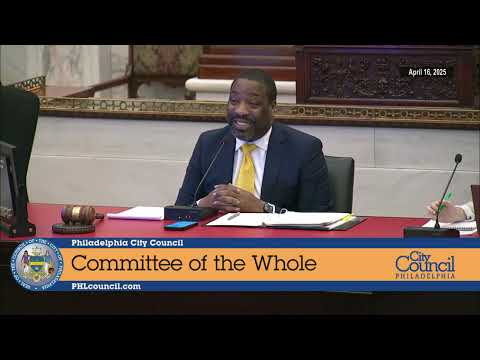
Formal committee action: The hearing concluded with a council motion to stand in recess until Tuesday, April 22 at 10:00 a.m., which the committee carried by voice vote.
What council asked SEPTA to provide: council members sought (1) the list and demographic details of recent FASO/ finding-a-special-opportunity transactions, (2) the cost and scope of Bus Revolution spending to date, (3) details on SCOPE contract pauses and inspector general findings, (4) clarification of the city's proposed local match and how 0-fare would be funded in FY2026, and (5) a clearer schedule for capital projects such as Fern Rock and Lawndale. SEPTA agreed to follow up in writing and provide requested materials.