Get Full Government Meeting Transcripts, Videos, & Alerts Forever!
Get email alerts on the Neighborhood Business Development Budget topic
No spam. Unsubscribe anytime.
Syracuse officials outline housing strategy, East Adams funding and brownfields work during Neighborhood and Business Development budget hearing
Summary
City department leaders told the Syracuse City Common Council they have stalled access to committed housing-strategy dollars, secured major federal grants for East Adams, and are pursuing brownfield cleanups and planning updates as part of the Neighborhood and Business Development budget.
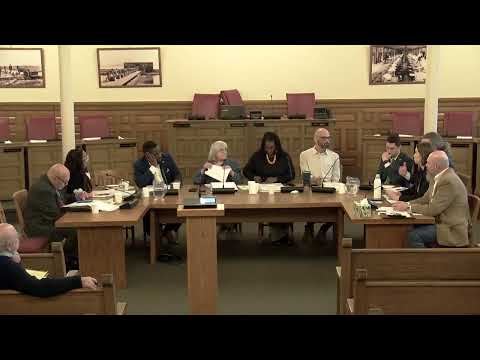
Syracuse City officials detailed plans and funding prospects for the city's housing strategy, the East Adams neighborhood transformation and a slate of brownfield cleanups during a budget hearing for the Department of Neighborhood and Business Development (NBD) on Oct. 27, 2025.
The hearing centered on how federal, state and settlement funds feed the department's work and on steps needed to move committed but not yet accessible housing strategy dollars into projects. Commissioner Michael Collins introduced the hearing and said the department is presenting division-level budgets for Neighborhood Development, Planning & Sustainability and Business Development.
"A big chunk of the work'is really concentrated within our annual federal entitlement grant spending," Deputy Commissioner Michelle Stefanski said, referring to the department's Community Development Block Grant (CDBG) and related HUD funding. Stefanski said the city typically receives about $6.5 million in HUD entitlement funds that are distributed to housing, workforce development and community-based programming.
Stefanski said the department also is administering roughly $1 million in opioid-settlement funds received through the New York State Attorney General's office and that four agencies received subgrants after an RFP process; so far about 401 individuals have been served by those programs. "We expect that that's gonna be, for at least a couple years," she said of the settlement funding.
Officials said NBD helped secure $80 million in federal grant funding to support the East Adams neighborhood transformation: $50 million from HUD through the Choice Neighborhoods initiative and $30 million from the U.S. Department of Transportation. "So it's really, will be a big focus of work throughout the next upcoming year as well," Stefanski said.
Housing strategy funding, access and staffing
City leaders described the Syracuse housing strategy as authorized by the council and now being operationalized through a newly formed Housing Strategies Corporation. Stefanski said $7.5 million has been committed to the initiative ("$2.5 million that was committed in the city budget last year and then $5,000,000 from New York State, Empire State Development"), but she told councilors "At this exact moment, it is $0," meaning the committed funds are not yet in an account available for grants or loans.
Stefanski said corporation counsel advised using SURA (a city pass-through) to move city dollars to the Housing Strategies Corporation to comply with state rules that limit direct city spending on private residences. She also said Empire State Development (ESD) is expected to authorize its $5 million on an ESD board agenda in May, and that ESD disbursements will come in tranches.
The department told the council it expects to add about four positions to implement the housing strategy; those positions would be funded by the Housing Strategies Corporation, not the general fund. Stefanski said the proposal to sustain the program includes a recommendation in the housing strategy document that the city consider a $2 million annual contribution to continue the work.
On scope and targets, Stefanski said the housing strategy aims to fully remediate properties in worst condition and to improve roughly 25% of properties currently at average-or-better condition in targeted neighborhoods over a multi-year timeframe. She said the department has done detailed cost modeling with consultant CZB and will continue governance discussions through the strategy's board.
Planning, sustainability and parks projects
Owen Kearney, Deputy Commissioner for Planning and Sustainability, described the office's work updating the city's comprehensive plan (the last was completed in 2012) and said the next budget would fund a larger public-engagement phase. "It's a long range plan that sets general direction for policy and investment for a 10 to 20 year timeframe," Kearney said.
Kearney said the division has state-funded projects under way, including a greenhouse gas inventory and development of a city sustainability task force, Progress Park redesign on the Inner Harbor (state-funded) and preliminary investigations and design work for city-owned Inner Harbor piers. He also noted completion of U.S. Department of Energy-funded solar lighting upgrades in multiple parks, which he said reduce future energy costs immediately.
Brownfields and waterfront planning
Kearney and departmental staff reviewed brownfield and site-specific cleanup work the city is pursuing. He listed three city-owned sites with ongoing or planned cleanup work: 1410 Erie Boulevard (preliminary work this year, cleanup expected next year; about 90% state-funded), 2176 Erie Boulevard (state and city matching funds for cleanup) and 101 Chester Street (state-funded cleanup already completed; ongoing required testing and reporting).
Eric Ennis, Deputy Commissioner for Business Development, described the department's Brownfield Opportunity Area (BOA) work and said the city is preparing two BOA designations for state submission: one anchored on South Salina (amended to include East Adams) and another along the Erie Boulevard corridor. He said state planning funds are being used to hire consultants for BOA work.
Business development, permitting and downtown projects
Ennis said his division provides technical assistance and capital tools for businesses across the city. He highlighted a newly colocated North Central Small Business Development Center advisor in the NBD office and said the Financial Empowerment Center (FEC), now under Business Development, has served more than 2,500 unique clients, helped consolidate or pay off about $6.9 million in debt and improved credit scores for 71% of clients.
Ennis and other staff discussed the city's active development pipeline, including the Syracuse Industrial Development Agency (SIDA) project at 801 Hiawatha Boulevard: a roughly $15 million investment expected to bring about 100 jobs. He also described Sedco (the Syracuse Economic Development Corporation) lending and revolving-fund work used to reactivate storefronts and support projects that struggle to access conventional bank financing.
Staff noted the growing permitting and plan-review workload associated with increased construction activity and said part of the budget request discussed by planning/permitting is to outsource some plan review to third parties to accelerate review times.
Demolition, redevelopment and pilot agreements
On the former developmental center demolition and redevelopment, Ennis said the demolition contract is underway and that redevelopment will require state tax-credit financing; a funding gap remains for the first phase of roughly 288 units. He said sale proceeds tied to redevelopment contracts are structured in the agreement at $20,000 per unit, and the department took a conservative approach and did not count those sale proceeds as available revenue in the current budget until project financing is certain.
Public questions and councilor concerns
Councilors pressed staff on implementation details, on whether committed housing strategy dollars were immediately available (staff said they were not), on the sustainability of funding and on who would staff the Housing Strategies Corporation. Stefanski and others emphasized that ESD and state processes will control timing and that additional council legislation will be required to move city-committed funds through the recommended mechanism.
Decision versus discussion
Most items at the hearing were informational and budgetary discussions; no final council votes to appropriate funds or adopt ordinances were recorded during the session. The meeting concluded with a motion to adjourn that was moved and seconded.
The council hearing will be followed by additional committee meetings and forthcoming legislation to enable the transfer of city-committed housing strategy dollars into the Housing Strategies Corporation and to clarify staffing and program rules before grant-making or loan programs begin.