Get Full Government Meeting Transcripts, Videos, & Alerts Forever!
Get email alerts on the Education Oversight topic
No spam. Unsubscribe anytime.
Senate committee advances bill to create oversight board for underperforming school districts, including Shelby County
Summary
The Senate Finance, Ways and Means Committee recommended Senate Bill 714 as amended for passage to the calendar after extended debate over local control, charter expansion, scholarship eligibility and an oversight board to advise struggling districts such as Shelby County.
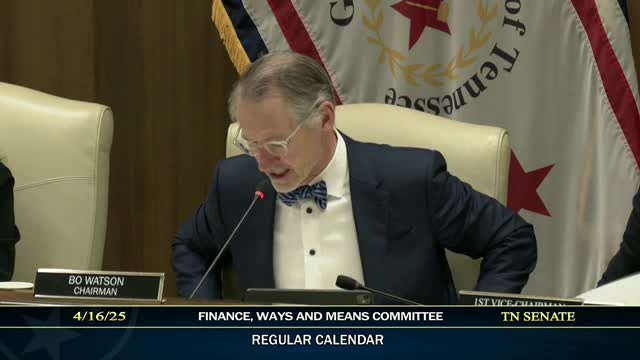
The Senate Finance, Ways and Means Committee on April 16 recommended Senate Bill 714 as amended for passage to the committee on the calendar. The bill establishes criteria for a "challenged school district," creates a nine-member oversight (advisory) board for such districts and authorizes a range of interventions that include removal of superintendents and expansion of Education Scholarship Account (ESA) eligibility.
Supporters say the measure is intended to provide extra oversight and tools to improve student outcomes in districts that meet the bill—s thresholds. Senator Taylor, the bill—s sponsor, told the committee the measure is not a takeover but an advisory framework that would help local school boards manage almost $1.8 billion in annual education spending and implement a transformation plan after a comprehensive needs assessment.
Opponents said the bill undermines local control and may exceed constitutional limits. Senator Lamar, who represents Shelby County, argued the measure imposes an unelected, state-linked advisory board on a locally elected body and warned the approach echoes previously failed interventions. Lamar said the bill targets low-income communities rather than addressing broader investments in housing, public safety and supports that affect student outcomes.
Under the bill, a district becomes eligible for the oversight regime if it has at least 50% of students classified as economically disadvantaged, fails to meet expectations in math and English, and has had at least one school on the state—s priority list in the last five lists issued by the Department of Education. The oversight board would produce a comprehensive needs assessment within 90 days and a transformation plan thereafter; the board—s recommendations would be provided to the elected school board and read into its public meeting minutes. Contracts larger than $50,000 would be submitted for the board—s review and comment.
Membership and pay are specified in the bill: nine members appointed (three by the governor, two by the lieutenant governor, two by the speaker of the House, plus the county mayor and the city mayor or their designees), four-year terms with an optional two-year extension, and compensation equal to that of the local elected school board (committee discussion cited an estimated $20,000 ollars to $30,000 per member). The oversight board may have up to three staff members paid by the county commission.
The bill also lifts the income cap for ESA scholarships in qualifying districts, expedites and expands charter school opportunities, and authorizes the commissioner of education, with consent of the State Board of Education, to remove the superintendent or recommend removal of school board members if the local board repeatedly fails to adopt corrective measures.
Committee members debated constitutional implications. Several senators asked how appointing and confirming replacements for removed board members would align with the Tennessee constitutional provisions on county offices; the sponsor responded that the State Board of Education has removed elected school board members in past decades and that the bill builds consent steps into the process.
After debate and two finance amendments (which clarified advisory-board compensation and other details), the committee voted to recommend SB 714 as amended for passage to the calendar. The roll call recorded two "no" votes; the committee advanced the measure despite continued objections from some members representing Shelby County.
The bill now moves to the Senate calendar for further consideration.