Get Full Government Meeting Transcripts, Videos, & Alerts Forever!
Get email alerts on the State Aeronautics Funding topic
No spam. Unsubscribe anytime.
MDOT official warns aeronautics capital program faces gap as Detroit Metro parking-tax bonds near retirement
Summary
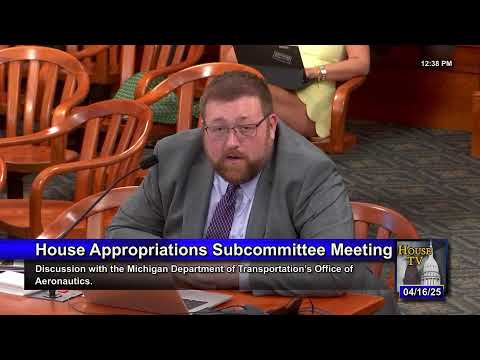
Brian Buds, head of the Michigan Department of Transportation Aeronautics Division, told the House appropriation subcommittee that Detroit Metro’s off-site parking tax helps fund state airport capital projects and that debt tied to that tax is set to retire in about five years, threatening a gap in aeronautics funding.
Brian Buds, head of the Michigan Department of Transportation (MDOT) Aeronautics Division, told the House appropriation subcommittee on state and local transportation on Oct. 27, 2025, that the department’s airport capital program depends on a mix of restricted revenues and federal grants, and that a key local revenue stream — an off-site parking tax tied to Detroit Metro Airport — will stop when related bonds retire in about five years.
Buds said the aeronautics fund is supported principally by several restricted revenue streams: a 3-cent-per-gallon aviation fuel excise tax, a package of registration and licensing fees (including aircraft registration), federal block grants routed through MDOT, and an off-site Detroit Metro airport parking tax. “Of the approximately $35,000,000 that’s generated from this airport parking tax, $6,000,000 of that comes to the department to support debt service on those bonds, which are set to retire in about 5 years,” Buds said, adding that roughly half of the department’s share has gone into MDOT’s capital development program for airports.
Why it matters: MDOT and local airports use the state capital outlay appropriation — including state match and pass-through funds for federal grants — to pay for runway and terminal projects, pavement and safety work, and airport planning. Buds told legislators the airport improvement program is the department’s primary vehicle for capital projects and that a substantial portion of those dollars are federal grants administered by MDOT under a Federal Aviation Administration (FAA) block-grant arrangement. If the parking-tax revenue stream sunsets when related bonds retire, Buds said, the aeronautics fund will have “a pretty significant” hole for some programs that rely on that state contribution.
MDOT’s Aeronautics Division provides both capital and operational functions. Buds gave legislators these figures: the state has about 220 licensed public-use airports, roughly 15 airports support scheduled air carrier service, nine Michigan airports participate in the federal Essential Air Service program, and the department estimates aviation supports roughly $22 billion in statewide economic impact. Buds also said MDOT administers a capital improvement program and provides partial state match so local airports need only a 5% local share of typical FAA-funded projects (MDOT covers half of the usual 10% local match, he said).
On restricted revenues, Buds explained the fuel excise tax is 3 cents per gallon and that a partial rebate is available for interstate commercial air carriers. He also noted that aircraft registration fees and other licensing charges produce modest revenue, and that the governor has proposed changes to the aircraft registration fee in the past to bolster grant programs.
Committee members asked for additional documentation and a forward-looking capital plan. Buds told members the packet at the meeting included a five-year capital outlook for primary commercial service airports and that MDOT would email a similar five-year plan for general aviation airports.
Procedural note: Representative Borton moved to adopt the minutes of the March 19 meeting; the motion prevailed by unanimous consent.
Buds’ presentation referenced the department’s role as one of 10 FAA block-grant states that administer federal airport development funds directly and emphasized that most federal airport grants require state and local matching funds and environmental review under federal law.
Looking ahead, Buds recommended that legislators consider the long-term implications of the parking-tax sunset on MDOT’s ability to provide matching funds and to support smaller, rural airports. He said MDOT would provide more details on revenue assumptions and the five-year capital program on request.