Get Full Government Meeting Transcripts, Videos, & Alerts Forever!
Get email alerts on the Infrastructure Sewer topic
No spam. Unsubscribe anytime.
Ventura LAFCO backs Ojai Valley Sanitary District septic-to-sewer grant effort, authorizes support letter
Summary
Ventura County LAFCO voted to provide a letter of support for Ojai Valley Sanitary District—fforts to convert septic systems to sewer service in four state-designated disadvantaged communities, after hearing planning estimates, funding obstacles and questions about homeowner costs and annexation.
Ventura County—oard of Local Agency Formation Commissioners (LAFCO) voted to authorize the chair to sign a letter of support for grant applications from the Ojai Valley Sanitary District to plan and seek funding for septic-to-sewer conversions in four disadvantaged neighborhoods.
The measure, approved by roll call vote, followed a staff presentation and a 40-minute discussion with the district bout scope, planning estimates and implementation issues. Scott Mextrot (surname recorded in the meeting transcript), introduced as the general manager of the Ojai Valley Sanitary District, told commissioners the district is seeking state funding for four state-designated disadvantaged communities: North Rice Road, Trustee Lane and the east and west portions of Casita Springs.
"We're looking at around a $700,000 project to plan the septic sewer conversion for those 48 parcels," Mextrot said, referring to North Rice Road. He said Trustee Lane (about 17 parcels) would need roughly $565,000 for initial planning and that Casita Springs' planning and construction has an early, overall estimate of about $11,600,000.
Why it matters: District officials said septic systems in the four areas are in close proximity to the Ventura River and can degrade groundwater and surface-influenced waters. Commissioners and staff discussed the public-health and water-quality drivers for converting septic systems to sewer service and noted the projects would require annexations into the sanitary district.
Key details presented and discussed included: - Project scale and preliminary planning estimates: ~48 parcels (North Rice Road) with planning estimated at ~$700,000; Trustee Lane ~17 parcels with planning estimated at ~$565,000; Casita Springs roughly split by Highway 33 into a west grouping (~31 parcels) and east grouping (~25 parcels), with combined planning/construction estimated at ~$11.6 million (district estimate, not final). - Funding constraints: the district and staff said state funding for disadvantaged-community sewer conversions is limited and competitive; project ranking within state programs will influence award likelihood. Commissioners noted Caltrans permitting and right-of-way issues where Highway 33 bisects Casita Springs could complicate timelines and costs for the east-side parcels. - Annexation and connection questions: The district said the parcels would require annexation; most parcels are already inside the district sphere of influence, but annexation would be required for service. District staff said property owners are not currently required to connect immediately on annexation; connection can be voluntary unless a septic system fails later. - Household cost considerations: Commissioners urged the district to assess the distance from houses to new mains and to plan for potential connection costs for homeowners. The district said its planning intends to fund design and to minimize up-front connection burdens; once connected, homeowners would become ratepayers and pay a monthly sewer rate the district estimates at roughly $68 per month. The district contrasted that with common septic costs: periodic septic pumping (~$800 every three years) and anticipated septic replacement costs (roughly $10,000—2,000 every 20—0 years). - Reuse limitations and regulatory constraints: The district said its treatment plant achieves tertiary filtration and UV disinfection but is required by existing permits to discharge the treated effluent to the Ventura River; absent changes to discharge permits, the district cannot market the treated water for irrigation or other reuse.
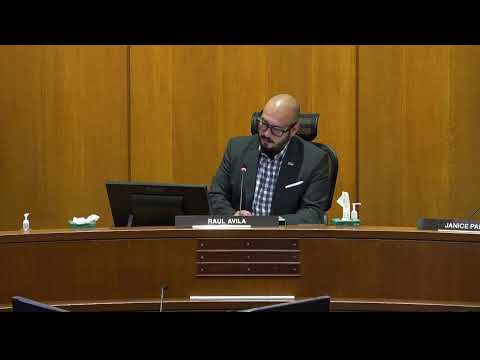
Commission action and outcome: Commissioners moved and seconded a motion authorizing the chair to sign a letter of support and directed staff to coordinate the letter with district staff. The motion passed on a roll call vote (all commissioners present voted in favor). Chair Avila said the chair would sign the letter, and staff will work with Ojai Valley Sanitary District to finalize it.
What commissioners requested next: Several commissioners recommended the district gather written support from residents in the affected neighborhoods and continue coordination with Caltrans and the state funding agencies. Commissioners also suggested looking at case experience from similar projects (for example, Los Osos in San Luis Obispo County) to understand funding and implementation pitfalls.
The commission id not take any action to require immediate homeowner hookups or to change existing discharge permits; those issues were described as outside LAFCO's direct authority and as matters for the district and state regulators and funders.