Get Full Government Meeting Transcripts, Videos, & Alerts Forever!
Get email alerts on the Homelessness Outreach topic
No spam. Unsubscribe anytime.
Tualatin hears homelessness update as county outreach workers report rising need and new shelter resources
Summary
County homelessness liaison and outreach teams told the Tualatin City Council that housing unaffordability and cuts to eviction-prevention funding are increasing need. Presenters described outreach practices, recent successes placing families and youth, and new regional shelter and safe-parking capacity.
Megan Cohen, the city–county homelessness liaison for southeast Washington County, briefed the Tualatin City Council on April 14 about outreach, data trends and resources serving people experiencing homelessness in Tualatin.
Cohen said housing costs and limited local services are driving higher counts and made the case for local referral pathways: “Street Outreach is working with folks who are, literally unsheltered,” she told council, noting the teams focus on people living in cars, on the street or in tents.
Cohen and outreach staff described how the system operates locally and the limits of existing data. The presenters said point-in-time and McKinney-Vento counts undercount the population because they rely on self-identification and broad geographic aggregates. Cohen said 31% of Tualatin households live at 50% of area median income or below — roughly $41,000 for a family of four — and that the city currently has about 720 regulated affordable units but would need an estimated 4,300 additional units to meet local need. She noted online rental searches show very few available low-cost units: “If you go on Zillow, and look for units that are $1,500 or less in Tualatin right now, you’ll get 4 units,” Cohen said.
Outreach model and pathways
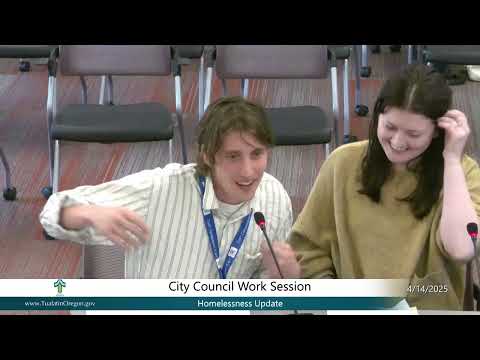
Lucy Simmons, outreach coordinator at Home Plate Youth Services, and Caleb Peterson, street outreach coordinator at Just Compassion, described outreach as a long, relationship-driven process that begins with trust-building and basic needs. Lucy Simmons said Home Plate works with youth ages 12 to 24 and that Home Plate’s programs worked with 969 youth in 2024 and its outreach team with about 500 of those young people countywide.
Peterson said outreach teams use a central intake process and a Homeless Management Information System (HMIS) profile to keep people visible to referral sources. He described the phase 1 assessment used to screen for housing options and disabilities and to determine eligibility for programs such as rapid rehousing, permanent supportive housing and ARLA vouchers. “Street outreach is a long relational process,” Peterson said. He explained that assessments include questions on length of homelessness, disability status, medical needs, debts, justice involvement and domestic violence to identify appropriate referrals.
Shelter, safe parking and other resources
Presenters said recent additions in the region include a newly opened 60‑bed shelter in Tigard, an expansion of safe‑parking programs for people living in vehicles, and three “e‑beds” at the Tigard shelter that law enforcement can use for direct drop‑offs. Cohen said outreach services are contracted and funded through Washington County Supportive Housing Services (SHS) and that those county systems are central to access for most programs.
Teams described long waits for noncongregate shelter and permanent housing placements, and said it can take months to years for a household to move from unsheltered status into stable housing. Peterson warned that HMIS profiles must stay active with service transactions to keep referrals flowing; otherwise a record may look resolved and referrals can stop.
Case examples and coordination
Simmons and Peterson gave specific examples of outreach work in Tualatin: a local young person who sleeps on public transit and has been engaged by Home Plate for six months; and two connected households living in vehicles that included six minors and three adults, where coordinated work with Just Compassion, Home Plate, the Department of Human Services, animal services and Tualatin Police resulted in one household moving into family shelter.
Peterson also described a man he encountered who had been homeless in Tualatin for more than 14 years, had no identification and was not on HMIS. He said another person he had worked with who had long-term visible homelessness died during the winter before outreach could get him into shelter — an outcome Peterson said highlighted the need for persistent outreach and referral pathways.
Data, inclement weather and policy notes
Cohen said Portland State University now manages the regional point-in-time count and that draft data would likely be available in early summer, with final numbers later. She highlighted four inclement‑weather activations early in the winter and said coordinated transportation to shelters during activations — including library staff and police notifying outreach teams — was a critical local practice.
Cohen warned that Washington County SHS faces cuts in eviction-prevention funding under the county’s current SHS structure and that staff expect to see impacts this summer as those protections decline.
How to request outreach
Cohen asked council to direct residents who want to report someone for outreach to showtheway.org, the county’s centralized reporting tool; referrals entered there are routed to the appropriate outreach team and can trigger same‑day responses. She said Tualatin Library staff and the local community services officer at Tualatin Police are regular referral sources.
What council heard
Councilors thanked outreach staff and recognized the scale of the problem. Several councilors emphasized the need for services to accompany housing investments. Cohen and outreach staff avoided policy prescriptions but urged more local access points — drop‑in services such as laundry, showers and food distribution — that serve as first contact points for people who then can be linked to assessment and housing referrals.
The presenters left council with a short list of near-term items: expect early point-in-time drafts around June; continue use of the county’s Show the Way referral site for local reports; and that the new Tigard shelter, e‑beds and safe‑parking expansions are available resources for adults while youth‑specific services remain provided by Home Plate and partners.