Get Full Government Meeting Transcripts, Videos, & Alerts Forever!
Get email alerts on the Municipal Budget topic
No spam. Unsubscribe anytime.
Acton presents $40.8 million municipal budget; seeks $300,000 OPEB transfer
Summary
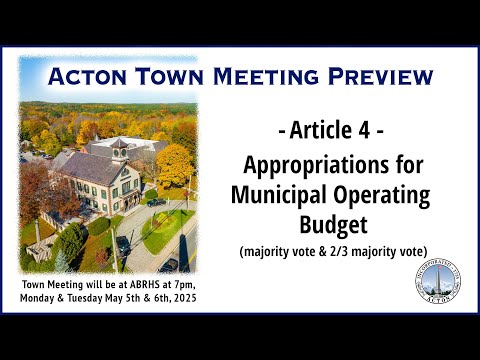
David Martin, a member of the Select Board, presented Warrant Article 4 — the Town of Acton’s municipal operating budget for fiscal year 2026 — saying the proposal would be voted in two parts: a two‑thirds vote to transfer $300,000 from the town’s OPEB trust to pay retiree benefits, and a majority vote to fund municipal operations.
David Martin, a member of the Select Board, presented Warrant Article 4 — the Town of Acton’s municipal operating budget for fiscal year 2026 — saying the proposal would be voted in two parts: a two‑thirds vote to transfer $300,000 from the town’s OPEB (other post‑employment benefits) trust to pay retiree benefits, and a majority vote to fund the municipal operating budget.
Martin said the proposed municipal operating budget is $40,810,464, an increase of about 4.6% over the current year, and that “all but $300,000 of that is covered by the main motion,” with the smaller line item requiring the two‑thirds vote. He also summarized the roles of the town manager, the Advisory Liaison Group (ALG), the Finance Committee (FinCom) and the Select Board in producing and recommending the budget.
Martin outlined the town’s revenue structure, saying the largest share of general revenue comes from real‑estate taxes (residential and commercial). He said other revenue sources include motor vehicle excise, meals taxes, state aid and appropriations from free cash. He explained that, under Proposition 2½, most of the levy grows by 2.5% plus new growth each year and described “debt exclusions” and “overlay” as separate budget elements used for tax abatements and for financing new buildings or major renovations.
On expenses, Martin described the three funded entities covered by town finances: municipal government, the Acton‑Boxborough Regional School District and the Minuteman Regional School District. He said overall operating expenditures are rising only modestly this year (he reported an increase of about 1.9% for expenses), in part because some school renovation debt is rolling off and the Acton‑Boxborough district assessment is increasing less than in previous years.
Within the municipal budget, Martin identified the largest departments as police, fire and public works; he said the finance category is large because it includes townwide insurance and debt service. He said health insurance and pension cost increases are a principal driver of upward pressure on the town budget.
Martin said some projects postponed after last year’s override are being funded this year, naming investments in the library, the public safety facility, town hall, sidewalks, road‑safety work, public‑safety vehicles and gear, stormwater vehicles and culverts. He noted that more detailed funding proposals for specific capital items appear in Articles 5 and 6.
The Select Board voted unanimously to recommend Article 4, Martin said. He closed by reminding listeners that the town’s fiscal year 2026 begins July 1 and that the Article includes the two separate votes to be taken at town meeting.