Get Full Government Meeting Transcripts, Videos, & Alerts Forever!
Get email alerts on the Water Management topic
No spam. Unsubscribe anytime.
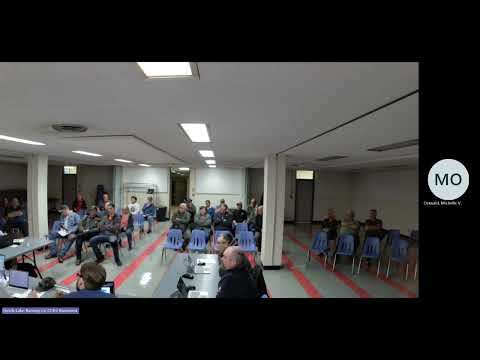
Ramsey County commissioners deny proposed Edmore snag-and-clear project after lengthy hearing
Summary
After a multi-hour public hearing, the Ramsey County Board of Commissioners voted to deny a water board petition to authorize a snag-and-clear project near Edmore, citing concerns about downstream impacts, assessment boundaries and insufficient information.
Ramsey County commissioners voted to deny a petition from the county Water Resource District to perform a snag-and-clear cleaning of a natural waterway near Edmore, a project the water board said would be financed by a loan and repaid through landowner assessments.
At a public hearing, landowners, farmers and engineers debated whether the proposed cleaning — limited to work that would not exceed $100,000 in initial borrowing under North Dakota Century Code snag-and-clear provisions — would move water faster through a largely flat coulee and whether that change would harm property downstream. The commission voted to deny the petition after hearing repeated objections from downstream landowners and questions about assessment boundaries and project scope.
The petition would have allowed the water board to borrow up to $100,000 to pay for dirt work, administrative costs and notice and publication; the water board and its engineer calculated assessments based on parcels that the engineering analysis identified as benefiting from the cleanout. “We have received two bids for the dirt work,” said Paul Bjartson of KLJ Engineering, the consultant who prepared maps and the benefit analysis for the petition. “We would take and borrow the $100,000. But when the work was done, we would pay off what was done and then pay back the remaining amount.”
Residents and landowners urged the commission to either reject the petition or require more study. Several speakers said the immediate problem in the coulee is perennial aquatic vegetation — described variously as sago pondweed and dense mats of cattails — rather than silt, and that vegetation could re-form quickly after a mechanical cleanout unless a longer-term vegetation-control plan is adopted. “There’s absolutely no benefit to this program for me. I don’t see why I should be assessed for the benefit to land I don’t use,” one landowner said during public comment.
Others asked why the proposed work would begin at the easterly end of the coulee rather than starting farther downstream or at a different choke point. Multiple speakers said starting the project where the petition proposed could move water more quickly to County Road 4 and create new backwater on land that currently drains slowly. Several residents recommended beginning work at a different crossing or extending the project so it would not stop at a single road crossing and merely transfer the drainage problem.
The commission also heard a written comment citing North Dakota Century Code §61-16.1-10, asking the board to ensure that its planning “fully consider downstream impacts,” and asking the commission to require quantification of the project’s benefits and downstream impacts before voting.
Commissioners noted the water board’s authority and the limited process for projects below the $100,000 threshold: smaller projects require a simpler approval process than larger projects and can proceed more quickly, but that process also limits the commission’s opportunity to require supplemental studies. Multiple commissioners said the hearing revealed unresolved questions about benefit calculations and parcel assessments and suggested returning the petition to the water board for more work.
The motion to approve the petition failed; the commission denied the project and invited the water board to revise the proposal and return with additional information addressing downstream impacts, assessment boundaries and vegetation-management options.
The denial leaves the water board and petitioning landowners the option to redesign a larger project or seek an assessment district with a different scope and financing plan, which would require a more detailed process and higher upfront costs for publication and bonding than the simpler snag-and-clear pathway.