
Schererville merit commission reviews hiring, promotion and discipline rules; debates age, testing and performance standards
Get AI-powered insights, summaries, and transcripts
Sign Up Free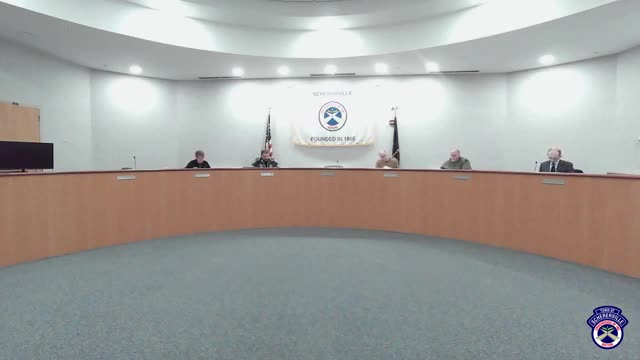
Summary
Schererville Town — The Schererville Fire Merit Commission held a study session to review a draft rules-and-regulations worksheet for the Fire Department Merit Board, focusing on hiring, testing, probation, performance reviews, promotions and disciplinary procedures.
Schererville Town — The Schererville Fire Merit Commission held a study session to review a draft rules-and-regulations worksheet for the Fire Department Merit Board, focusing on hiring, testing, probation, performance reviews, promotions and disciplinary procedures.
The draft, prepared as an outline of roughly 15 sections, is intended to implement the commission’s obligations under state merit-board statutes while leaving operational details to department practice. The board attorney recommended adding explicit statutory citations to make clear that state law controls when there is any conflict between local rules and statute, and attendees agreed the draft should be a “hybrid” of spelled‑out rules plus cross‑references to applicable Indiana law.
Why it matters: The commission’s rules will determine minimum candidate qualifications, how applicants are tested and ranked for hire and promotion, how probationary periods are handled, and what procedural protections apply for discipline. Those choices affect who can be hired, the timeline for meeting paramedic and other certifications, how promotion lists are produced, and whether the town or the commission’s rules govern due‑process rights.
Key points from the session
• Statutory authority and cross‑references. The board attorney told the commission the draft should explicitly reference the controlling statute often cited in the discussion as “IC 36‑8‑3.5,” and he said the statute should “govern in their entirety” where conflicts arise. The attorney also flagged related provisions (for example, references during the meeting to sections covering appointment, testing and performance ratings) and said he will include precise citations in the next draft.
• Minimum age and pension interactions. Commissioners and staff discussed an apparent mismatch between the age appearing in the merit statute (21) and recent pension‑fund or PERF guidance allowing hiring at 18 in some circumstances. The commission agreed to research current controlling law and stated they will use “whatever the current standard is” once verified rather than assume the statute or the pension rule alone.
• Candidate testing and vendor use. The commission discussed the department’s practice of outsourcing the general aptitude test to a private provider, identified in the meeting as Public Safety Answers. The vendor administers an online cognitive/behavioral assessment and scores video interviews; the group discussed treating that vendor’s procedures as the operative “general aptitude test” under the commission’s rules. The attorney asked the commission to adopt rules that allow the appointing authority to use a competent third‑party vendor and to document the vendor procedures in the rules. One participant summarized the vendor’s current pass line as 70% and the attorney noted that the statute allows the commission to establish the passing score.
• Physical standards and CPAT. The physical agility requirement discussed in the draft is the CPAT (Candidate Physical Ability Test). The commission confirmed the CPAT remains a required element of the hiring process and discussed operational details — for example, the department typically requires proof of a CPAT completed within one year prior to interview and may allow candidates time to obtain CPAT certification before being scheduled for the face‑to‑face interview.
• Paramedic certification timing. The group discussed a two‑year window for paramedic certification. Department staff said the department enforces a contractual requirement that new hires either enter paramedic training or hold paramedic licensure and that recruits generally have up to 24 months from enrollment to complete paramedic training; the commission agreed that requirement should be reflected in the rules or a referenced contract.
• Probationary period and discipline. The draft states probationary periods may not exceed one year, consistent with the statute. The commission also reviewed how town personnel policies currently treat discipline and noted differences in due‑process protections between the town policy (older, more general) and the statutory scheme for firefighters (which provides specific hearing and review rights). The attorney recommended incorporating the town’s disciplinary procedures by reference while making clear that where the statute provides additional protections the statute controls.
• Performance ratings and promotion standards. The commission spent significant time on performance ratings and how to use them in promotions. The statute requires the commission to adopt rules for grading applicants and to establish a passing score; it also specifies performance ratings are to be completed by a member’s superior. The commission discussed that department performance forms currently in use include a scoring component and that reviews must be conducted at least every six months. Commissioners debated how objective the review form is and asked the department to revise the review to emphasize measurable items (attendance, training completion, safety compliance, ability to cover shifts) and to minimize purely subjective measures.
• Promotion scoring weights (proposals). Commissioners proposed several weighting schemes for promotion decisions during the session. Suggestions included: (a) 40% performance review, 30% written exam, 20% oral, 10% length of service; (b) 30% written, 30% performance, 20% oral, 20% service; and (c) a tentative working starting point of 30% written, 30% performance, 20% oral, 20% service while the commission obtains written‑test capability and refines the performance review. The commission agreed on the need to adopt weighting and pass/fail thresholds in the rules and to revisit the weights after more data (for example, historical scores) are available.
• Administrative next steps. The board attorney said he will synthesize the session’s comments into a draft rules document and present a revised draft at the next meeting. The commission asked the fire department to produce a revised, less‑subjective performance review form and to provide additional data from the pension board secretary showing how prior applicant scores were aggregated (weighting details for written/video/in‑person components). The group also asked for copies of the paramedic contract and the vendor’s promotional‑testing estimate so the commission can evaluate cost and feasibility.
Quotes from the session
• "The only thing that, I would recommend adding is is probably a a citation to the, the other particular statute that we're dealing with. That's 36 8 3.5, which is the the broad merit board, statute," the board attorney said while urging explicit statutory cross‑references.
• Chief Patterson, the fire chief, confirmed the department’s current testing and hiring practice: "We gave them some time ... the CPAT test ... that is definitely part of the process" and said candidates without required proof are not scheduled for interviews until they meet those prerequisites.
• On vendor testing, a department representative said the pension‑board reviewer commented that "the system's obviously working because they said they haven't seen this quality of candidates come through before," describing early positive feedback after the commission’s first use of the online vendor system.
What the commission did not decide
The session was a study session; no formal votes or adoptive actions were taken. The commission did not set final promotion weights, did not fix a final passing score for the general aptitude test, and did not adopt a final performance‑review form. Several items were deferred pending the attorney’s redraft and receipt of data and documents requested from the department and the pension board secretary.
Next steps and what to expect
The board attorney will produce a revised draft rules document that: (1) incorporates statutory citations; (2) references the department’s hiring appendix where appropriate; (3) includes language authorizing use of competent third‑party testing vendors; and (4) describes probationary and disciplinary processes consistent with statute. The fire department will deliver its current performance review form, the paramedic contract and clarification about CPAT timing; the pension board secretary will be asked to provide scoring/weighting spreadsheets used in the last hiring cycle. The commission plans to review those materials and return later for additional edits before scheduling a public hearing and any final adoption.
Ending note: Because this meeting was a study session, commissioners emphasized that the draft rules are intended as a working framework. Several commissioners said they expect to revisit promotion weights, performance review content and statutory cross‑references once the attorney’s redraft and the department’s clarifying materials are available.