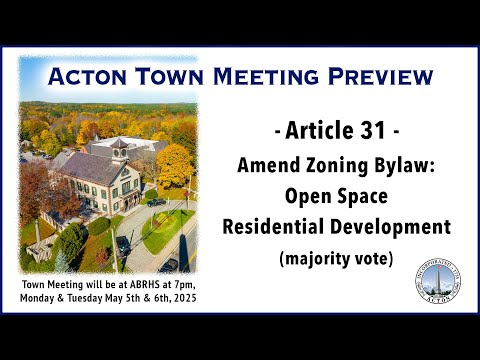
Acton officials present Article 31 to make open-space residential development the by-right subdivision method
Loading...
Summary
Alyssa Nickel, a member of the Town of Acton Select Board, presented Article 31 proposing to make Open Space Residential Development (PCRC) the by-right method for new residential subdivisions, requiring protected resource land and new landscaping and dimensional standards.
Alyssa Nickel, a member of the Town of Acton Select Board, presented Article 31 proposing to make Open Space Residential Development known in Acton as Planned Conservation Residential Community (PCRC)the by-right method for new residential subdivisions. The proposal, developed through a town working group, would require developers to set aside a portion of each parcel as protected resource land and adopt new dimensional and landscaping standards while retaining existing density limits.
The measure is intended to preserve natural areas while creating incentives for smaller and more affordable homes. "This article proposes to make open space residential development the by right method for subdivision," Nickel said, describing the product of public engagement and a 2023 grant that supported the working group. If Town Meeting adopts Article 31, the Planning Board would then amend the subdivision rules and regulations to implement the new requirements.
Under current practice and Massachusetts Subdivision Control Law, Nickel said, Actonthrough the Planning Boardadministers a by-right subdivision process that typically divides a parcel into individual lots with a new road to access them. "There is no requirement for any of the land to be preserved as resource land, and it is typical for the majority or even all of the property to be clear cut," she said. Open-space residential development via a PCRC special permit instead clusters homes and preserves the remainder of the parcel as resource land; Article 31 would make that cluster-and-preserve approach the default.
The proposal calls for new subdivision rules and regulations that would require developers to identify and site highest-priority natural resources first and place development areas last, Nickel said. The rules would also add enhanced landscaping and screening requirements designed to reduce visual impacts from existing streets. Holly Van Joseph of the Design Review Board described proposed buffer standards: trees in buffers would be a minimum 3-inch caliper or evergreens 8—to—10 feet tall, and shrubs 3 feet tall at planting; where natural vegetation exists, priority would be given to retention.
Members of the working group highlighted preservation and housing goals. Bettina Abe of the Open Space Committee said Acton—s PCRC bylaw, adopted nearly 30 years ago, has protected substantial acreage through clustering and conservation. She reported that PCRC special permits have preserved about 628 acres of land, and that since 1991 the town—s standard subdivision method has led to about 208.3 acres developed without resource-land protection. Abe noted that roughly 5% of the town has been protected through combinations of these approaches and that Town Meeting approvals have acquired 202 acres of open space at a cost of almost $11,000,000.
The article also includes provisions aimed at encouraging smaller houses and affordable units. Bob Van Meter of the Acton Community Housing Corporation said new homes under current zoning are often 5,000 to 8,000 square feet and that the bylaw offers three approaches to change incentives. One approach would require more land area for homes over 3,000 square feet and less land area for homes under 3,000 square feet to encourage smaller building footprints. A second approach allows inclusionary development by right for homes under 1,500 square feet if 10% of units are deed-restricted to households at 80% of area median income (AMI); the town—s economic analysis found feasibility at 7 units per acre. A third approach creates a special-permit option for multifamily development at up to 15 units per acre for homes under 1,500 square feet when 10% of units are deed-restricted at 80% AMI and 80% of the land is protected; the special-permit option would keep the existing 36-foot maximum height for homes while adding stronger landscape and screening standards.
Proponents listed expected environmental benefits of making PCRC the by-right standard, including improved water quality and supply, enhanced wildlife habitat and biodiversity, better stormwater management and groundwater recharge, natural flood control, and increased carbon sequestration without additional paved surface. The draft rules would also increase plant sizes at installation for developments using the multifamily special-permit optionfor example, requiring 5-inch-caliper trees or 12—to—14-foot-tall evergreens at planting for those sites.
No formal vote occurred at the presentation. Nickel said the article and a warrant summary will be available to voters and that planning staff will provide an FAQ prior to Town Meeting. "Please join us in voting yes on Article 31," she said at the close of the presentation.
The proposal now proceeds to Town Meeting for consideration; if adopted by voters, the Planning Board must hold public hearings and amend Acton—s subdivision rules and regulations to implement the changes.