Get Full Government Meeting Transcripts, Videos, & Alerts Forever!
Get email alerts on the Mid Valencia Bikeway topic
No spam. Unsubscribe anytime.
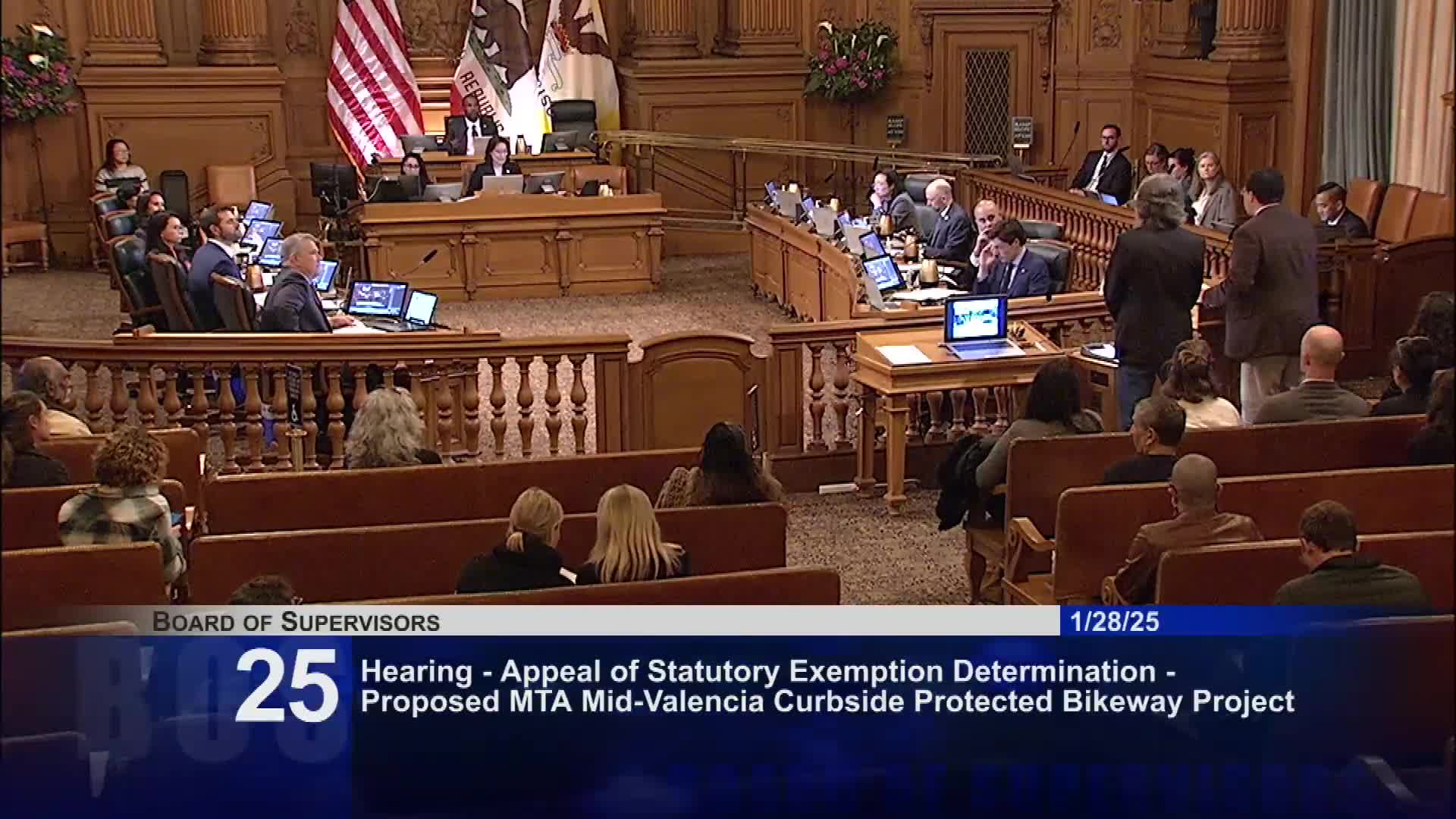
Board upholds CEQA statutory exemption, clears way for Mid Valencia curbside protected bikeway
Summary
After a three‑hour public hearing, the Board of Supervisors voted to affirm the Planning Department’s finding that the Mid Valencia curbside bikeway project qualifies for a CEQA statutory exemption (SB 922). The appeal by local merchants and neighborhood advocates was denied and construction may proceed.
The San Francisco Board of Supervisors on Jan. 28 voted to affirm the Planning Department’s determination that the Municipal Transportation Agency’s Mid Valencia curbside protected bikeway project is statutorily exempt from environmental review under California Public Resources Code section 21080.25, commonly associated with SB 922. The board’s action effectively denied an appeal by local merchants and the community group Vamanos and cleared the way for SFMTA to begin construction of a side‑running curbside protected bikeway on an eight‑block section of Valencia Street.
Why it matters: Valencia is one of the city’s highest‑use north‑south bike corridors and has been a focus of recurring debate about how to balance pedestrian and cyclist safety with parking, loading, and small‑business recovery after the pandemic. Supporters argued the curbside design improves safety and access, while appellants said the project would harm historic character, remove parking critical to merchants, and should be reviewed under CEQA.
The appeal: Julio Ramos, representing appellant group Vamanos, told the board the project meets exceptions that would disqualify a categorical exemption and that the Planning Department had failed to consider potential impacts to historic resources and the corridor’s commercial character. Merchant David Quimby said many Valencia business owners had only recently seen the final design and did not have sufficient time to understand how the changes would affect commerce and access.
The city’s response: Jennifer McKellar, senior environmental planner for the Planning Department, explained that the department applied a statutory exemption created by state legislation (SB 922, enacted in 2020–21) that specifically streamlines environmental review for certain public transportation and active‑transportation projects that reduce car dependency. She told the board that statutory exemptions are subject to a “substantial evidence” standard of review — a more deferential test than the “fair argument” standard used for categorical exemptions — and that the department’s finding was supported by its eligibility checklist and factual record. The Planning Department noted that the project’s estimated cost (up to $2.5 million) falls below statutory thresholds that would otherwise trigger additional public‑notification requirements.
SFMTA presentation: Paul Stannis (project manager, SFMTA) reviewed the corridor history, the safety problems the project intends to address and the outreach undertaken since the center‑running pilot. He said SFMTA met with more than 100 businesses personally, held open houses, walking tours, and regular stakeholder briefings, and that the curbside design approved by the SFMTA board balances parklet placement, parking and loading access, accessible zones, emergency access and sight lines. SFMTA said an engineering pivot to a curbside design followed evaluation and direction from the SFMTA board after a center‑running pilot.
Public comment: More than two dozen members of the public spoke. Speakers in support of the appeal emphasized lost parking, damage to small businesses still recovering from the pandemic, the timing of outreach and the speed of construction. Speakers supporting the project noted injury reductions after the separated lanes were installed, called for faster construction of safe bike facilities under state law, and urged the board not to use CEQA appeals to delay safety projects. Several safety and transportation advocacy groups, including the San Francisco Bicycle Coalition and Kidsafe SF, urged denial of the appeal.
Motion and vote: Acting President Shamon Walton moved to affirm the Planning Department’s exemption determination for item 26 and to table items 27 and 28 (which would have reversed or required written findings). Supervisor Mark Dorsey seconded the motion. After roll‑call, the motion passed: 10 ayes, 0 no, 1 excused (board president was excused for this part of the meeting). The board’s vote means the statutory CEQA exemption stands and SFMTA may proceed toward construction planning and implementation as authorized at the agency level.
Legal and procedural note: Planning staff explained the key distinction between a statutory exemption (SB 922) and categorical exemptions under CEQA — statutory exemptions do not include the traditional “exceptions” that trigger further review for unusual circumstances or significant historic impacts; they are reviewed under substantial evidence standards and, where applicable, may not require public notification for projects under certain dollar thresholds. Appellants argued that the historic district context and cumulative business impacts warranted an environmental review; the board concluded the statutory exemption applied based on the Planning Department record.
Implementation and next steps: SFMTA described planned construction sequencing and outreach, including weekly contractor notifications and an “open for business” marketing campaign with OEWD to support merchants during construction. SFMTA estimated construction would last two to three months, weather permitting, and said it would repave the center of the street and install the curbside facility. Board members asked SFMTA to continue merchant outreach, to avoid peak commercial seasons and holiday periods where possible, and to provide weekly “look ahead” notices during construction.
Ending: The board’s vote affirms the statutory exemption and allows SFMTA to continue with the curbside protected bikeway project subject to the agency’s implementation plan and ongoing outreach. Quotes in this article come from the official meeting transcript of the San Francisco Board of Supervisors, Jan. 28, 2025.