Get Full Government Meeting Transcripts, Videos, & Alerts Forever!
Get email alerts on the Overnight RV Parking topic
No spam. Unsubscribe anytime.
Board conditionally reverses SFMTAovernight RV-parking rule after hours-long hearing
Summary
After a daylong hearing with dozens of public speakers, the San Francisco Board of Supervisors voted 7-3 to conditionally reverse a Sept. 10 SFMTA decision that would allow the transportation director to ban overnight parking of large recreational vehicles in locations citywide, and directed the preparation of written findings.
The San Francisco Board of Supervisors on Dec. 10 conditionally reversed a 10/01/2024 San Francisco Municipal Transportation Agency decision that would have allowed the SFMTA director to ban overnight parking of large recreational vehicles (RVs) at particular locations across the city.
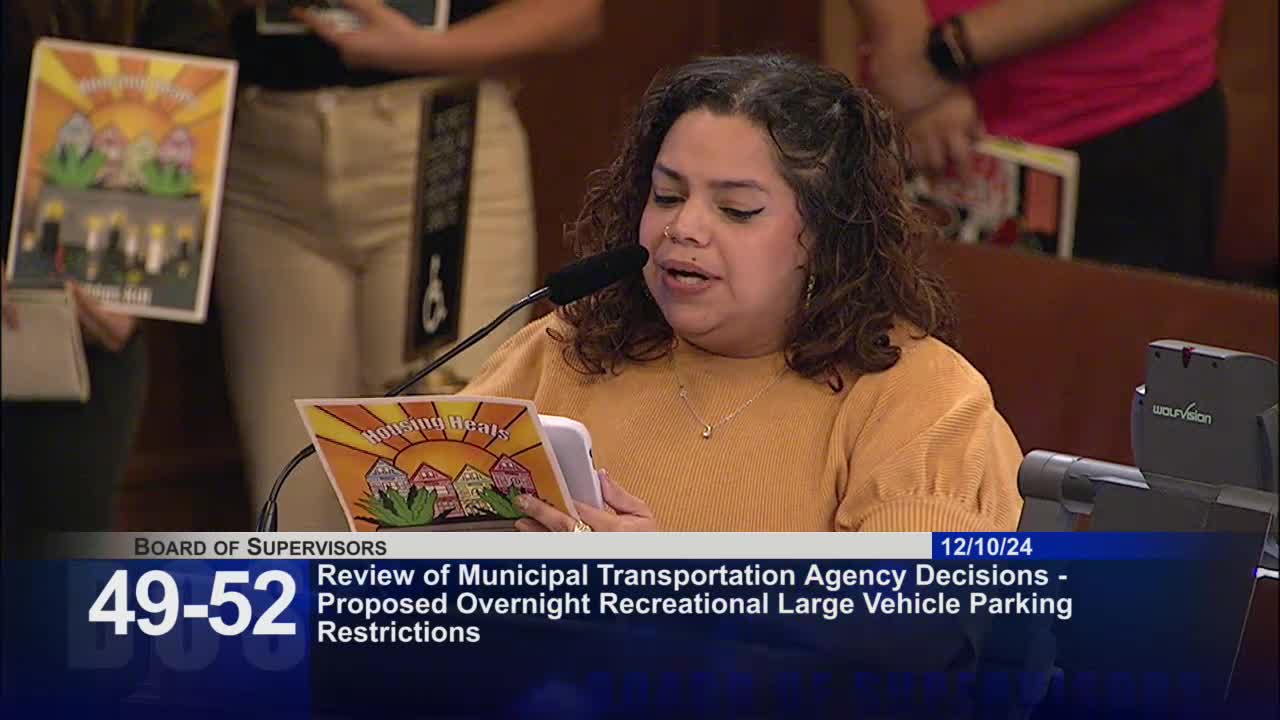
The action came after a four-hour public hearing that drew scores of speakers and advocates who said the change would tear familiesfrom their only available shelter. The board voted 7-3 to approve the motion to reverse the SFMTA decision in all respects within the boards jurisdiction and to direct staff to prepare written findings; supervisors Dorsey, Engardio and Mandelmann voted no.
Why it matters: Advocates and multiple service providers told the board that many families, seniors, people with disabilities, immigrants and working people shelter in vehicles and that towing would result in the permanent loss of belongings, identity documents and medication. City and SFMTA staff said the change was intended as a narrowly used enforcement tool of last resort to address public-safety and traffic circulation problems at specific blocks, and that offers of shelter must be made before enforcement against an occupied vehicle.
What the board decided: Supervisor Aaron Preston made the motion to conditionally reverse the SFMTA resolution; Supervisor Connie Walton seconded. The clerk recorded 7 ayes and 3 nos; the board also voted to table the motion to affirm the SFMTA decision. The board directed the city attorney and staff to prepare written findings in support of the supervisorsaction.
What supporters of reversal said: Gabriel Medina, executive director of the Lehi Raza Community Resource Center, spoke for the End Poverty Toes Coalition and told the board about families who lived in RVs for years and who had been housed only after sustained advocacy. "We will continue to fight as a family and as a community," Medina said, describing how his family and others had been displaced when signs went up at Winston Drive and when vehicles were targeted for enforcement.
Multiple social-service providers and advocates said city shelter capacity is insufficient. "We have no shelter beds left," said Hope Kammer of Compass Family Services, which serves families. "To force families from fragile stability into situations of unsheltered homelessness while failing to add any money to the shelter system is lazy policymaking."
How SFMTA and city staff described the proposal: Victoria Wise, SFMTA streets director, told the board the SFMTA decision did three things: (1) authorize the transportation director to implement nighttime parking restrictions for large recreational vehicles, (2) require written findings of traffic, circulation or public health and safety before signs are posted, and (3) make the offense enforceable by tow in the limited circumstances identified. "If the vehicle is occupied, an offer of shelter must be made," Wise said.
Sam Dodge, director of the Department of Emergency Management, said outreach teams and interagency coordination have reduced vehicles with people living in them from "about a thousand to around 500" but stressed the complexity of individual cases and the need to coordinate outreach, shelter offers and enforcement.
Concerns raised by opponents: Public commenters and service providers warned that making towing the potential penalty would increase trauma and instability. Eliana Bender of GLIDE told the board: "This ban will be harmful to RV residents and a misuse of already limited city resources." Advocates flagged language-access problems, the risk to undocumented residents, and the prospect that setting aside shelter beds for RV residents could reduce availability for people already waiting for shelter.
How enforcement would work in practice: According to SFMTA staff, if outreach identifies a block with conditions that warrant intervention, the director would document the public-safety or circulation finding, flyers would be posted, signs installed and outreach would return to make a final offer of shelter. Staff said implementation would be gradual and block-by-block and that the item was framed as an 18-month pilot.
The board action and next steps: The board approved the motions to reverse and to direct written findings. The city attorney will prepare the written findings that the board requested. Because the boards motion reversed the SFMTA action only in the respects within the boards jurisdiction, the decision directs staff to document the basis for that reversal.
Context and background: The SFMTA board adopted amendments in October 2024 to make prohibitions on overnight parking of oversized vehicles enforceable in certain locations; under the revised Transportation Code those restrictions apply between midnight and 6 a.m. The policy has been controversial because of the local homelessness crisis: the citys 2024 point-in-time count and numerous service providers reported more than 1,400 people living in vehicles and that roughly 90% of unsheltered families stay in cars or RVs. Advocates and providers told the supervisors that the city does not have sufficient family shelter capacity for the people affected.
What was not decided today: The board did not adopt a substitute citywide policy or new funding. The reversal is procedural and contingent on the written findings the board requested; it does not by itself create additional safe parking sites or new shelter capacity. Advocates urged the board and the mayors office to prioritize safe parking, targeted outreach and housing funding instead of enforcement.
Votes at a glance: On the motion to table the SFMTAaffirmation and to approve motions to conditionally reverse and to direct findings, the board voted 7 ayes (Walton, Chan, Melgar, Peskin, Preston, Ronan, Safaie) and 3 nos (Dorsey, Engardio, Mandelmann).
Closing note: The hearing drew sustained public turnout and cross-sector testimony; the board directed written findings and signaled the issue will remain central to the citys policy debates as it balances right-of-way management with homelessness response and equity concerns.