Get Full Government Meeting Transcripts, Videos, & Alerts Forever!
Get email alerts on the Land Use topic
No spam. Unsubscribe anytime.
Board upholds planning department's general plan evaluation for proposed Dogpatch biotech lab after heated CEQA appeal
Summary
The Board of Supervisors voted Sept. 24 to uphold the Planning Department's general plan evaluation for a proposed 70,650-square-foot laboratory at 700 Indiana Street, rejecting neighborhood appeals that alleged inadequate CEQA review of air quality, shadows and hazardous materials.
The San Francisco Board of Supervisors on Sept. 24 voted to uphold the Planning Department's determination that a proposed three-story laboratory building at 700 Indiana Street is eligible for a general plan evaluation (GPE) under CEQA, rejecting an appeal by neighborhood groups who argued the department had not conducted sufficient environmental review.
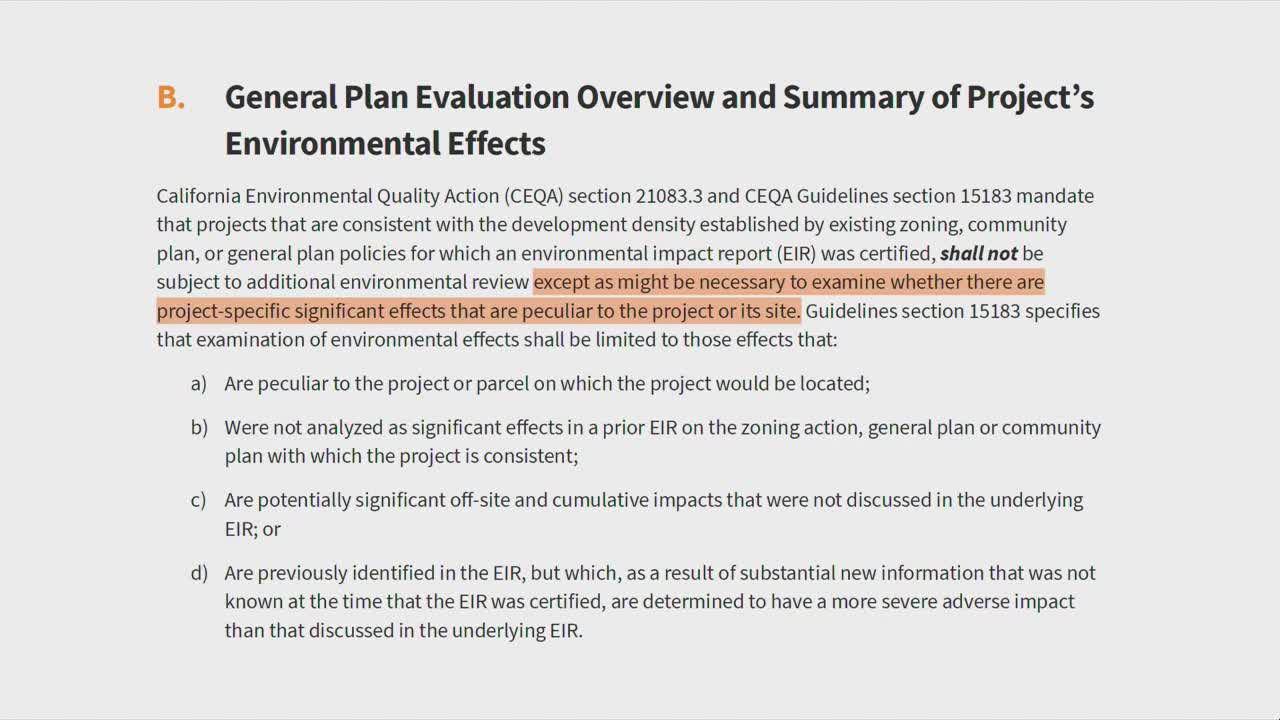
The project would demolish an existing one-story commercial building on the site and construct approximately 70,650 gross square feet of laboratory space in the Central Waterfront plan area of the Eastern Neighborhoods. Planning staff concluded the project is consistent with the development density analyzed in the Eastern Neighborhoods EIR and that the GPE process was appropriate because no new or "peculiar" environmental impacts would result beyond those examined in the earlier program EIR.
Appellants, represented at the hearing by Jar Epler of the Potrero Boosters Neighborhood Association and Donovan Lacy of the Dogpatch Neighborhood Association, argued that the project description lacked sufficient detail about the biotech and laboratory uses; that air-quality mitigations required by the Eastern Neighborhoods EIR had not been applied prior to entitlement; that the Planning Department's shadow analysis omitted the Dogpatch Arts Plaza in a timely way; and that the project's potential hazardous-materials and biosafety impacts were not adequately analyzed.
Planning staff and the project sponsor'represented by project counsel and by Leah Minkley of MBC BioLabs'responded that laboratory use was anticipated by the Eastern Neighborhoods planning documents, the GPE standard is a streamlined CEQA pathway when projects are consistent with development density in a certified EIR, and that the department had obtained additional shadow analysis and would apply project-level air-quality review and mitigation prior to occupancy. Staff also said multiple federal, state and local regulatory programs govern hazardous materials and biosafety in laboratory operations and that many compliance steps occur during permitting and prior to operation.
After public comment both for and against the appeal and a commission-level review, the board voted 9-1 to approve the Planning Department's GPE. Supervisor Walton cast the lone no vote and several supervisors expressed sympathy for neighbors' concerns about proximity to parks, schools and housing but said the legal standard for overturning a GPE had not been met.
The record shows the Planning Department conducted shadow and supplemental qualitative analyses for nearby parks and public spaces, and staff said air-quality and hazardous-material compliance will be investigated and enforced through standard permitting, health-code and regulatory processes. The appellants said they may seek further remedies in court.
Key particulars recorded during the hearing include: the project site is adjacent to Esprit Park and Dogpatch Arts Plaza and within about 1,000 feet of multiple school and childcare sites; the appellants asked for pre-entitlement site surveys of sensitive receptors under the Eastern Neighborhoods EIR mitigation language; planning staff said those surveys and project-specific toxic air contaminant analyses would occur prior to operation and that updated mitigation tailored to the project is lawful and often more effective than generic programmatic measures.
Votes and formal actions on the agenda were recorded by the clerk; the motion to affirm the Planning Department's GPE carried by a recorded roll-call vote of nine in favor and one opposed.