Get Full Government Meeting Transcripts, Videos, & Alerts Forever!
Get email alerts on the Ceqa Exemption Appeal topic
No spam. Unsubscribe anytime.
Supervisors order further review of CEQA exemption for 1151 Washington Street after neighbors raise contamination and shadow concerns
Summary
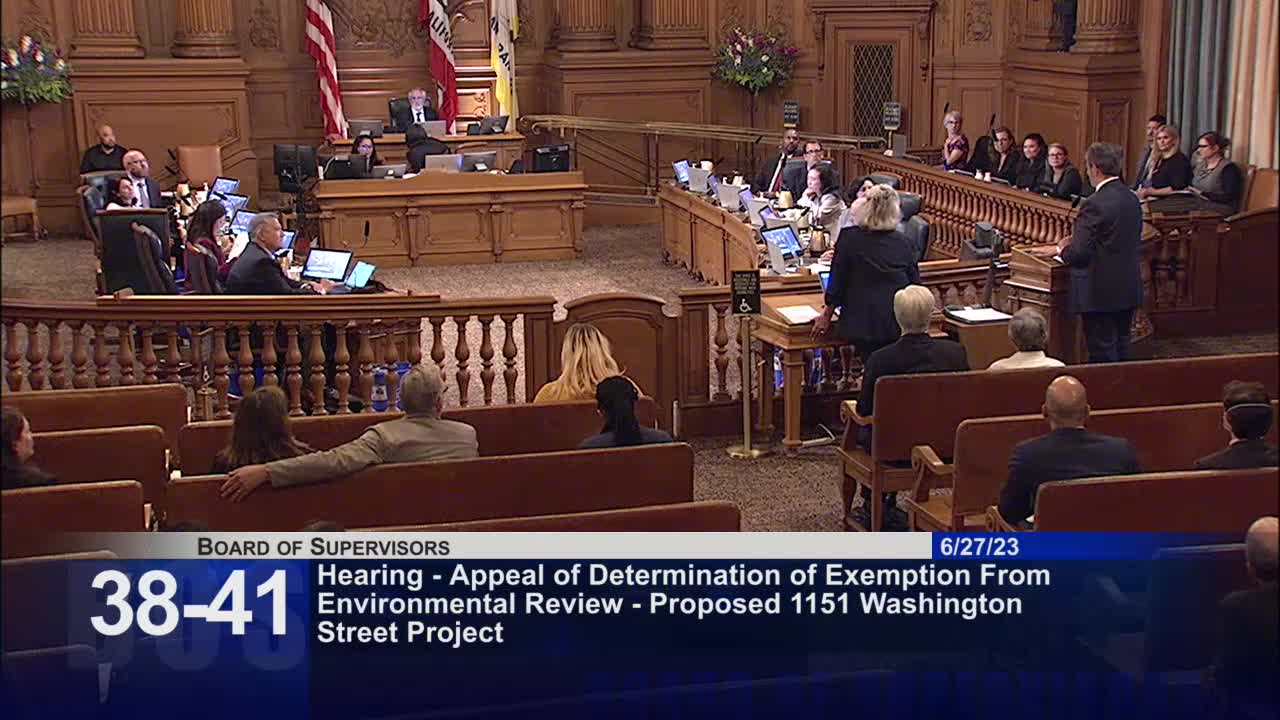
The San Francisco Board of Supervisors voted on June 27 to require additional written findings and further review after neighbors appealed the Planning Department’s categorical CEQA exemption for a 10‑unit infill project at 1151 Washington Street.
The San Francisco Board of Supervisors voted on June 27 to require additional written findings and further review after neighbors and local groups appealed the Planning Department’s Class 32 categorical exemption for a proposed 10‑unit development at 1151 Washington Street.
Appellants argued the project poses two unexamined risks: soil contamination that could release toxic chemicals during excavation and a design that would cast new, extensive shadows over the nearby Betty Ann Ong Recreation Center play areas. "The play yards are almost entirely engulfed in shadow," appellant attorney Scott Emblidge told the board, summarizing shadow modeling his group commissioned.
Why it matters: The site is adjacent to one of the few outdoor play spaces serving Chinatown and Upper Nob Hill. Appellants and neighborhood groups said the combination of proximity, topography and the project’s massing makes the impacts unusually severe and asked the board to require an Environmental Impact Report.
What the board heard: Appellants showed shadow analyses and cited soil sampling that detected hexavalent chromium and PCE. "Hexavalent chromium ... is a very toxic chemical. It only exists at 11 sites in the entire city of San Francisco," said attorney Richard Drury, who represented the Upper Chinatown Neighborhood Association. Appellants’ experts said the proposed excavation and construction could require mitigation beyond routine controls.
Planning and health department response: Lisa Gibson, the Planning Department’s environmental review officer, told supervisors the project met the criteria for a Class 32 infill exemption and said the city’s MAHER (Mandatory Alternative and Health Evaluation and Remediation) program and Department of Public Health remediation requirements are the established legal framework for sites with undocumented fill or soil contamination. Bill Chen of the Department of Public Health said the MAHER review requires site investigation, construction‑phase controls and remediation tailored to contaminants, and that routine protections (dust suppression, health and safety plans, PPE for workers and vapor‑intrusion controls where needed) are standard.
Board action: After public testimony and department presentations, the board voted to table the motion that would have affirmed the Planning Department’s categorical exemption and instead approved motions directing preparation of written findings and further procedural steps. The motion passed on a recorded vote 7‑4.
What’s next: The board’s action remands the matter for additional findings and follow‑up review; it does not by itself disapprove the project. Appellants said they want an EIR to evaluate shadow mitigation options, excavation safeguards and any additional mitigations beyond MAHER protocols. The Planning Department and Public Health signaled they would continue to oversee MAHER compliance and any site‑specific mitigation requirements.
Community context: Speakers from Chinatown tenant groups and the Chinatown Community Development Center emphasized the recreation center’s importance to low‑income seniors, families and children who lack other nearby outdoor spaces. The appellants asked the board to prioritize those users’ access to sunlight and to require deeper study of soil and air risks that excavation could pose during construction.
Board comments and reasoning: Several supervisors said they were weighing the city’s practice of applying MAHER and Chapter 31 guidance against community concerns about unusual circumstances. The board’s majority said additional findings and review were warranted before the exemption could stand; dissenting supervisors cautioned against adding novel CEQA requirements for routine infill projects.
The full record and next administrative steps are to be prepared by city departments and returned to the board as directed.