Get Full Government Meeting Transcripts, Videos, & Alerts Forever!
Get email alerts on the Public Safety topic
No spam. Unsubscribe anytime.
San Francisco mayor and supervisors call for coordinated response to open‑air drug dealing after off‑site session
Summary
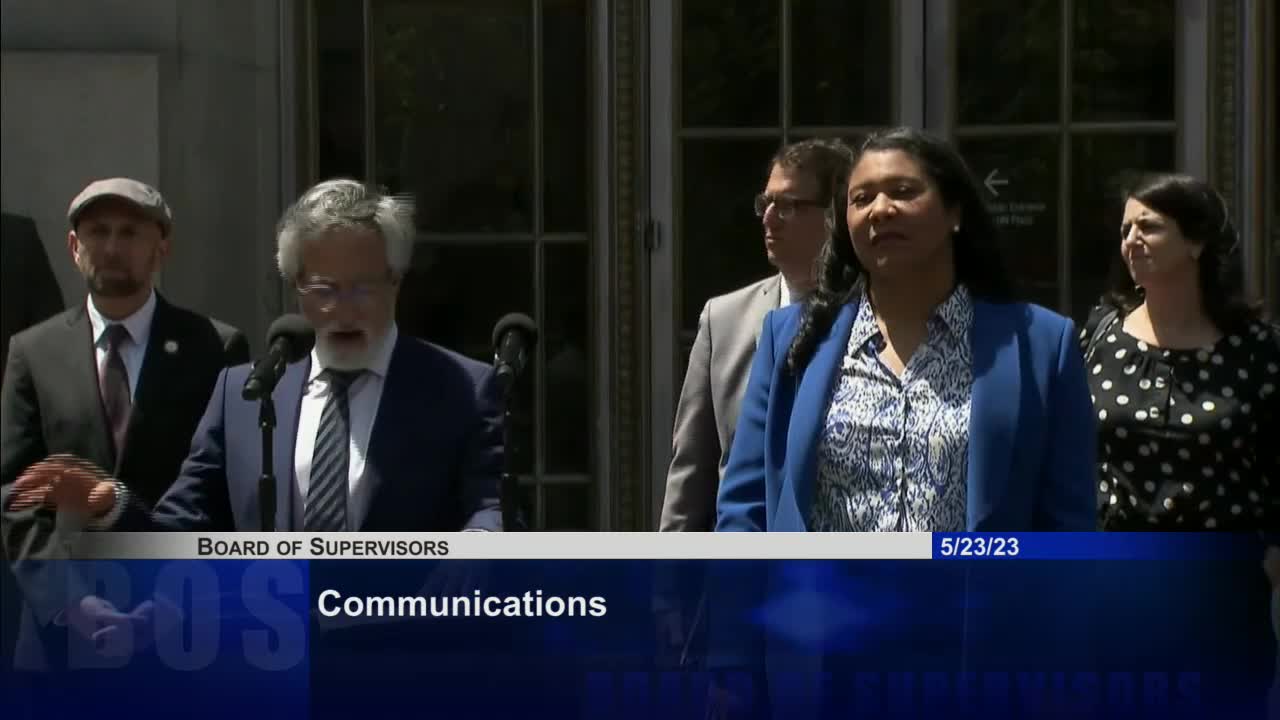
At an off‑site meeting May 23 at United Nations Plaza, Mayor London Breed told the San Francisco Board of Supervisors she supports a coordinated, multi‑agency effort to address open‑air drug dealing and a rising number of overdose deaths, and said her budget will emphasize both expanded services and holding people accountable.
At an off‑site meeting May 23 at United Nations Plaza, Mayor London Breed told the San Francisco Board of Supervisors she supports a coordinated, multi‑agency effort to address open‑air drug dealing and a rising number of overdose deaths, and said her budget will emphasize both expanded services and holding people accountable. President Aaron Peskin asked whether the city would stand up an emergency operations center to coordinate daily responses by police, the district attorney, sheriff, state partners and health and social services and to target open‑air markets within 90 days.
Mayor London Breed said the city has increased treatment capacity and other supports but still faces staffing and coordination limits. "We lead with services. We lead with support and my budget this year will truly reflect that, but that doesn't mean that in the meantime anything goes," Mayor Breed said, adding that the city has invested $75,000,000 per year in Department of Public Health substance use services and manages an approximately $600,000,000 annual behavioral health budget.
Peskin pressed the mayor for a centralized, day‑to‑day operation like the emergency operations centers used during major incidents, asking specifically whether the mayor would "stand up an emergency operation center that will coordinate all of the many agencies and departments" and direct them to shut down public open‑air drug dealing in the next 90 days. Breed said the city's Department of Emergency Management is coordinating multiple departments and that the city is working with state partners, including the California Highway Patrol and the National Guard, and with federal agencies. She urged collaboration with the board while noting the city faces long‑term staffing shortages in law enforcement and other agencies.
Breed also described several ongoing public health and enforcement efforts: expanding street crisis response teams, adding 400 treatment beds to the city's existing roughly 2,200, and increasing local law enforcement deployments that she said have resulted in a reported "over 150% increase in the amount of fentanyl seized over the same period last year." She emphasized limits on what she could disclose about investigative tactics and said the district attorney is "committed to following through with prosecution."
Board members repeatedly framed the problem as one of coordination as much as funding. Several supervisors urged that short‑term emergency coordination be combined with long‑term investments in treatment and housing. Supervisor Aaron Peskin said weekly or daily, co‑located decision meetings could enable faster, real‑time action, similar to the city's COVID‑era operations center.
Mayor Breed asked the board to support her public safety budget "without any of the traditional reductions we see during the budget process" and to back state legislation to change laws the city cites as constraining enforcement options. She said the city is attempting to balance intensive outreach and treatment with enforcement when behavior is disruptive to residents and businesses: "When we offer shelter, when we offer housing, and when we offer behavioral health support... and those offers are declined, that doesn't mean a free license to terrorize a community," Breed said.
The board did not take a formal vote on a single, board‑wide emergency operation center during the session. The mayor invited supervisors to join ongoing coordination efforts and to work with her office on the budget and operational details. The discussion ended with the board adjourning the off‑site portion of the meeting and reconvening in chambers to continue the record and other business.
Why it matters: Supervisors and the mayor framed the situation as both a public health and public safety crisis that requires daily operational coordination among local, state and federal partners, additional bed capacity and treatment, and enforcement tools that county and state law allow. The mayor’s request that the board support her public safety budget and state‑level legislative changes signals the city intends to couple immediate operational actions with requests for legal and fiscal changes that could affect policing, prosecutions and program funding.
What to watch next: The mayor said new details would appear in her upcoming budget. Supervisors and the mayor indicated they will continue negotiations on what form a sustained coordination mechanism should take and which agencies must participate.