Get Full Government Meeting Transcripts, Videos, & Alerts Forever!
Get email alerts on the Reparations topic
No spam. Unsubscribe anytime.
Board receives reparations advisory committee report and Dreamkeeper Initiative update after hours of testimony
Summary
The San Francisco Board of Supervisors convened a committee of the whole on March 14 to receive an update from the Human Rights Commission and the African American Reparations Advisory Committee (ARAC) on the draft San Francisco reparations plan and the city—s Dreamkeeper Initiative.
The San Francisco Board of Supervisors convened a committee of the whole on March 14 to receive an update from the Human Rights Commission and the African American Reparations Advisory Committee (ARAC) on the draft San Francisco reparations plan and the city—s Dreamkeeper Initiative.
The hearing, introduced by Supervisor Shamann Walton, included a presentation from Human Rights Commission Director Cheryl Davis and Dreamkeeper Initiative Director Dr. Syeda Lea Toutufu Burch and a report from ARAC chair Eric McDonough and vice chair Tanisha Hollins. After the presentations the board heard extended public comment and later adopted a resolution formally receiving the ARAC—s draft plan.
The Dreamkeeper Initiative update said the city—s $60 million annual investment has funded programs across arts and culture, economic mobility, workforce development, homeownership assistance and health and wellness. Director Dr. Syeda Lea Toutufu Burch told the board the initiative has supported hundreds of artists and community events, launched businesses and storefronts, and helped dozens of families purchase homes: "We last year were able to welcome home 22 families who have successfully purchased their homes," she said. The Dreamkeeper director said grantees reported hiring hundreds of Black educators and childcare providers and that the Initiative has funded over $2.7 million in startup capital for entrepreneurs.
Human Rights Commission Director Cheryl Davis urged the board to understand the Dreamkeeper funding as an investment distinct from reparations: "That is not reparations," Davis said, emphasizing that the $60 million program is a "point-in-time" investment while the ARAC—s work aims at tailored redress. ARAC chair Eric McDonough said the committee—s draft report contains 111 recommendations across economic empowerment, education, health and policy reform and urged the board to treat the recommendations as a package to be refined and funded.
Supervisors on the dais broadly expressed support for the process and for advancing the recommendations. Supervisor Walton said the next step will include follow-up actions: he said he will ask the board this budget season to consider either a de-appropriation or supplemental funding to create an Office of Reparations or otherwise resource the work needed to implement selected recommendations and to continue ARAC—s work until the final report is issued in mid-2023.
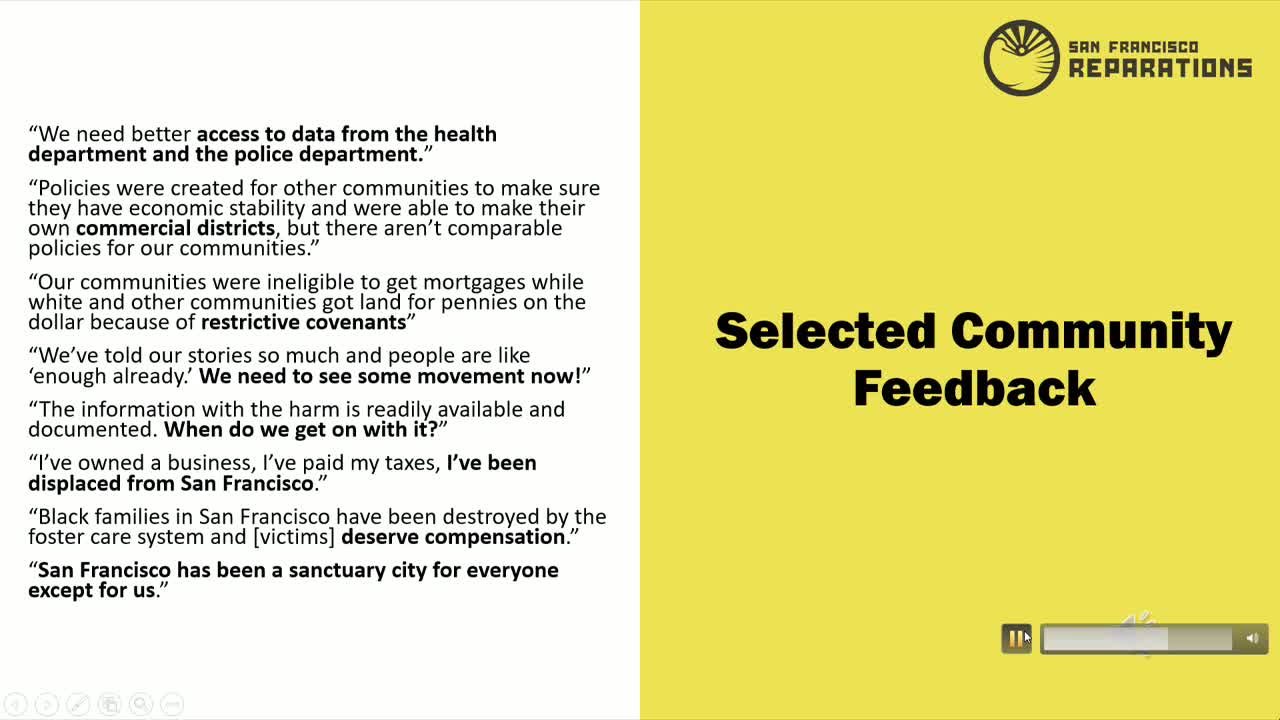
Public comment on the item was extensive, with residents, community leaders and nonprofit directors testifying in support of both the Dreamkeeper Initiative and the ARAC recommendations; speakers recounted personal and family histories of discrimination, urged swift funding, and described Dreamkeeper-funded programs—impacts on education, housing and services.
Action and next steps: the board adopted a resolution receiving the ARAC—s draft San Francisco reparations plan (item 19). Supervisors asked ARAC to continue monthly public meetings and asked city departments for additional briefings. Walton and other members signaled an intent to pursue budget action this cycle to fund office capacity and begin implementation steps. The ARAC—s final report remains due mid-year 2023.
Why this matters: The hearing gathered a substantial body of qualitative and quantitative community input and recorded the draft committee recommendations into the official record. The board—s decision to receive the draft and the subsequent conversation about budget authority and an implementation office make this a turning point in translating the advisory committee—s proposals into policy and spending choices that could materially affect housing, business, health and education outcomes for San Francisco—s Black residents.
Ending: The committee will continue the process: the ARAC will finalize its report in the months ahead and the board flagged the current budget season as the first opportunity to resource implementation.