Get Full Government Meeting Transcripts, Videos, & Alerts Forever!
Get email alerts on the Housing Zoning topic
No spam. Unsubscribe anytime.
Board falls one vote short of overriding mayor’s fourplex veto; ordinance remains vetoed
Summary
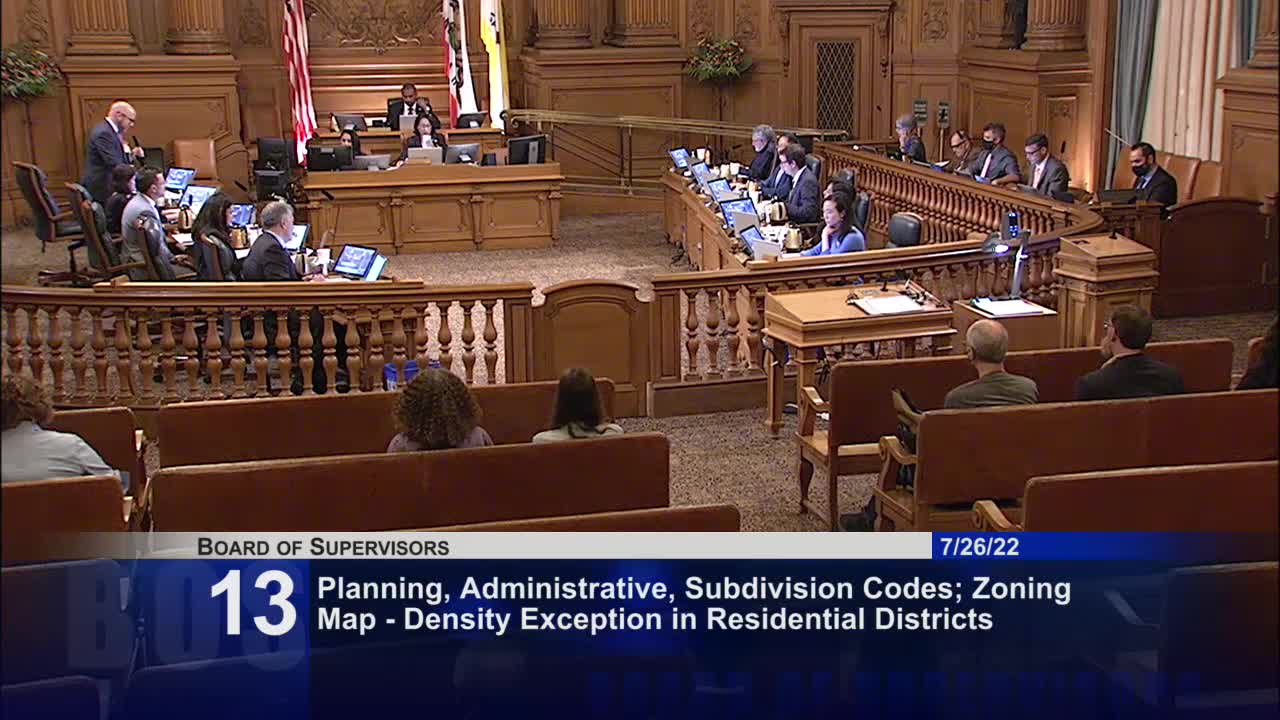
After hours of debate, the Board of Supervisors voted 7–4 on a motion to override Mayor London Breed’s veto of the fourplex ordinance; eight votes were required for an override, so the mayor’s veto stood.
The San Francisco Board of Supervisors voted 7–4 on July 26 on whether to override Mayor London Breed’s veto of the fourplex ordinance, a package of planning‑code changes that would permit small multi‑family buildings and eliminate RH1 single‑family zoning in many areas. Because state law and local rules require an eight‑vote supermajority to override a mayoral veto, the vote fell short and the mayor’s veto remained in effect.
What the ordinance would have done: Sponsors and backers framed the measure as an incremental, pro‑housing step to permit small multi‑family buildings and allow units created under the program to be sold as condominiums. Supporters said the change would open opportunities for homeowners to add units, expand “missing middle” housing, and help meet the city’s RHNA (Regional Housing Needs Allocation) targets. Opponents warned it could accelerate displacement and change neighborhood character.
Key arguments in the meeting: Supervisor Mandelmann, the ordinance author, called the measure “modest and incremental” and said it advanced pro‑housing options while preserving some protections. "Mayor Breed's veto does not make sense to me, except as politics," Mandelmann said. Supporters including Supervisors Melgar and Peskin defended the compromise and noted that the Planning Department and Planning Commission had recommended many of the ordinance’s provisions.
Opponents, including Supervisor Dorsey and Supervisor Safai, said they could not support the measure in its current form and favored relying on state tools such as SB9 or pursuing other local approaches. Dorsey said SB9 could facilitate small‑scale development. Safai and others said the package did not include adequate protections or feasible paths for lower‑income homeowners to use the program.
Vote and legal threshold: The roll call recorded seven ayes and four noes (Stephanie, Walton, Dorsey and Safai). Because the override required eight votes, the mayor’s veto was sustained and the ordinance did not become law.
What happens next: Sponsors indicated plans to continue the discussion and refile legislation; several supervisors called for further work on affordability, demolition controls, tenant protections and monitoring. The debate also prompted calls for the board to develop clearer engagement with the mayor’s office on land‑use proposals.
Speakers (selected): • Supervisor Mandelmann (author/lead speaker in debate): argued the ordinance was a foundation for denser housing. • Supervisor Melgar (co‑sponsor/supporter): endorsed the compromise as progress toward RHNA goals. • Supervisor Dorsey (opposed): said he would sustain the mayor’s veto and suggested state law (SB9) could be relied upon.
Authorities referenced in debate: SB9 (California state law), RHNA housing targets, HOME‑SF (previous local density bonus program). The mayor’s veto was the proximate administrative action; the board’s vote was on whether to override that veto.
Proper names: Mayor London Breed, the San Francisco Planning Department, Planning Commission, HOME‑SF, SB9.
Actions — formal outcome: Motion to override the mayor’s veto on item 13 failed to meet the eight‑vote threshold; Mayor Breed’s veto of the fourplex ordinance remained in effect. Recorded vote: 7 ayes, 4 noes; override threshold: 8.
Clarifying details: The ordinance author said RH1 zoning would be eliminated by the board’s original version if the veto had been overridden; opponents said the measure raised concerns about feasibility for lower‑income homeowners; sponsors emphasized an annual reporting requirement to be added for monitoring units created.
Context: The vote followed months of hearings in Land Use and other committee sessions and high public interest. Supervisors framed the debate around tradeoffs between facilitating home‑owner‑led additions and concerns about displacement and rent/tenant protections.