Get Full Government Meeting Transcripts, Videos, & Alerts Forever!
Board continues India Basin EIR appeal to Oct. 16 after weeks of testimony on air quality and contamination
Summary
The Board of Supervisors agreed to keep the administrative record open and continue public comment to Oct. 16 so the public and agencies can review newly proposed air‑quality mitigation language after appellants raised concerns about hazardous materials, language access and public notice for the India Basin mixed‑use project.
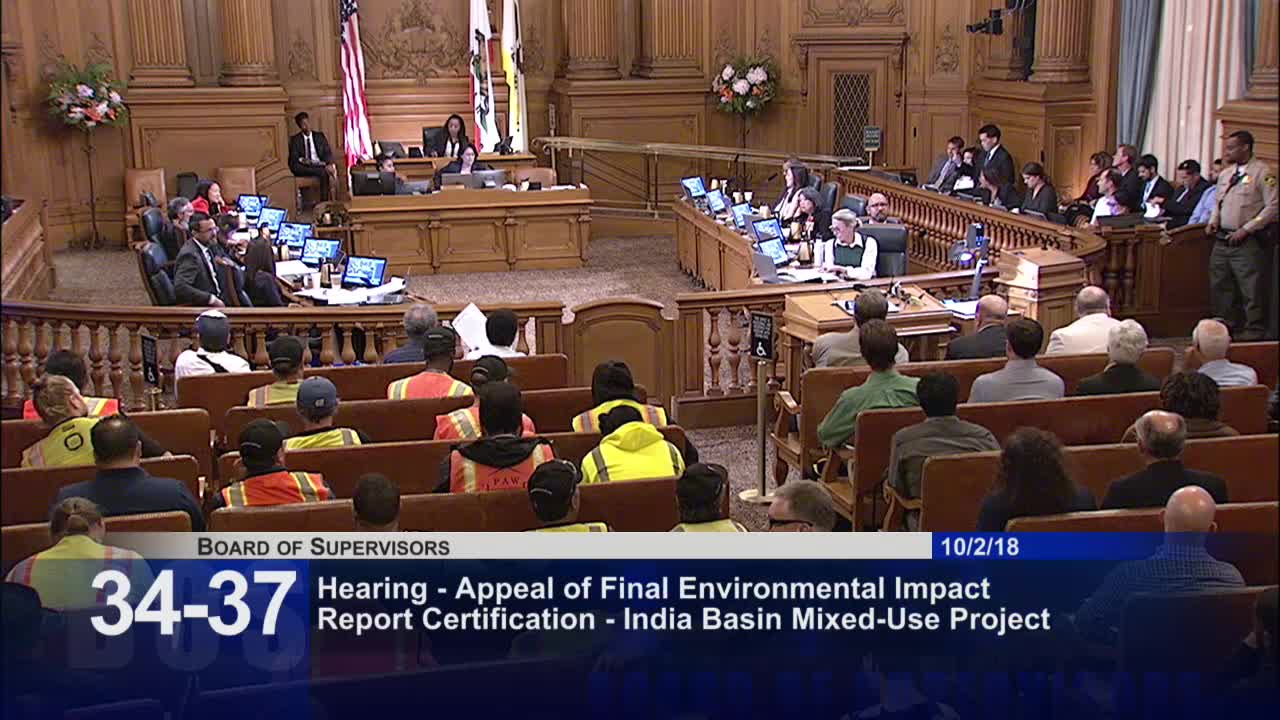
The San Francisco Board of Supervisors voted on Oct. 2 to continue its appeal hearing on the India Basin Final Environmental Impact Report (EIR) to Oct. 16, saying it will reopen public comment limited to air‑quality mitigation measures the Bay Area Air Quality Management District (BAAQMD) suggested days before the hearing.
The appeal was filed by Archimedes Bania (the operator of a communal bath at 748 Innis Avenue) and Greenaction for Health and Environmental Justice. Appellants argued the EIR did not adequately account for an existing business at 748 Innis, possible contaminated fill on the site and language‑access failures in the project's public notices. Planning staff said the EIR includes environmental testing and mitigation measures and that recently proposed clarifications to air‑quality mitigation do not change the EIR's adequacy.
Why it matters: The 28‑acre India Basin project, led by private developer BUILD, proposes about 1,575 housing units, roughly 200,000 square feet of commercial space and a large new shoreline park. Backers say it will create jobs, housing and a publicly maintained park without public subsidy; opponents say the site’s industrial history and proximity to the Hunters Point Naval Shipyard require more testing and stricter mitigation to protect health in a neighborhood that has elevated respiratory and cancer rates.
Planning staff presentation and city response Michael Lee, the Planning Department’s EIR coordinator, told the board the department had evaluated the appeals and that the EIR is “adequate, accurate, and complete” under CEQA. He said the EIR documents on‑site testing and includes appendices with more than 4,000 pages of hazardous‑materials data, and that the EIR contains mitigation measures and a contingency plan to address unanticipated contaminants during construction.
“Planning department staff have evaluated the existing mitigation measures and determined that mitigation measures MAQ1A and MAQ1C could be amended to require use of renewable diesel, which would further reduce the project’s air‑quality impacts,” Michael Lee said, describing language the department circulated at the hearing.
Appellants’ concerns Archimedes Bania owner Mikhail Brodsky told the supervisors the project as proposed would “box in” his facility, eliminate sunlight and sever panoramic views that his customers value, and that changes to building heights in a narrow corridor would affect some three dozen units and the business’s rooftop amenity. He asked the board to require design changes to preserve sightlines and daylight.
Marie Harrison of Greenaction urged the board to rescind certification of the EIR. “The EIR concluded that the proposed project would generate emissions that could expose sensitive receptors to substantial pollutant concentrations and that the project’s air‑quality impacts would be significant and unavoidable even with mitigation,” Harrison said, pointing to the EIR’s own responses to comments. She and other appellants also argued that notices were not translated into Tagalog and other languages for a community with large limited‑English populations, limiting meaningful public participation.
Developer and community proponents Lou Vasquez, president of BUILD, said the project has been under development for years and includes about 25 percent subsidized housing, an 11‑acre shoreline park the developer will build and fund, and roughly $250 million in community benefits. He described the EIR as conservative in its assumptions and said BUILD proposes contingency plans, radiological screening and a health‑and‑safety officer to stop work if unexpected contaminants are found.
BAAQMD input and the timing issue Representatives from the Bay Area Air Quality Management District told the board they had recommended several additional and more stringent mitigation measures to reduce particulate matter exposure and diesel particulate emissions — including investigating tier‑4 engines for certain heavy equipment, using renewable or biodiesel fuels for non‑tier‑4 equipment, and exploring electrified loading docks and cleaner delivery vehicles. Planning staff and the air district discussed adding renewable diesel language to MAQ measures the morning of the hearing; the city provided the revised language to the board and public at the meeting.
Supervisor reactions and decision to continue the hearing Several supervisors, including Supervisor Aaron Peskin, described receiving the revised mitigation language for the first time in the hearing and expressed concern about public review. Supervisor Peskin called the late submission “tantamount to document dumping.” The deputy city attorney advised the board that the change to mitigation language did not alter the CEQA determination before the board and that the board could, at its discretion, continue the hearing to allow targeted public comment on the new mitigation language.
By roll call the board voted to continue the appeal hearing and to reopen public comment limited to air‑quality impacts and mitigation on Oct. 16, 2018. The motion to continue was made and the roll call returned 10 ayes (Supervisor Stephanie was excused for that vote). The board directed planning staff to work with BAAQMD and community groups in the coming two weeks and to make the revised mitigation language available for public review.
What’s next The board’s Oct. 16 session will be limited to additional public comment and discussion of air‑quality mitigation language and related measures recommended by BAAQMD and community groups; the board will then decide whether to affirm certification of the EIR. If the board affirms the EIR, later votes on related general plan and zoning approvals will follow as part of the project entitlements.
Speakers (first reference with role/title) - Michael Lee, Planning Department EIR coordinator (Planning Department) - Marie Harrison, representative, Greenaction for Health and Environmental Justice (advocacy group) - Mikhail Brodsky, owner/operator, Archimedes Bania (business owner) - Lou Vasquez, president, BUILD (project sponsor/developer) - Lisonbee Kirk, senior environmental planner, Bay Area Clean Air Foundation / BACMED (regional air quality stakeholder) - Lisa Gibson, environmental review officer (Planning Department) - Jessica Range, planning staff (Planning Department)
Authorities - statute: California Environmental Quality Act (CEQA),…
Already have an account? Log in
Subscribe to keep reading
Unlock the rest of this article — and every article on Citizen Portal.
- Unlimited articles
- AI-powered breakdowns of topics, speakers, decisions, and budgets
- Instant alerts when your location has a new meeting
- Follow topics and more locations
- 1,000 AI Insights / month, plus AI Chat