Get Full Government Meeting Transcripts, Videos, & Alerts Forever!
Get email alerts on the Housing Zoning topic
No spam. Unsubscribe anytime.
Supervisors approve first reading of rezoning to allow small multiunit housing; 6-4 vote after months of debate
Summary
The San Francisco Board of Supervisors voted 6-4 on June 28 to pass on first reading an ordinance rezoning most RH1 areas to permit small multiplexes — up to four units per lot (six on corner lots) — with new units required to enter into regulatory agreements making them subject to the city Residential Rent Stabilization Ordinance.
The San Francisco Board of Supervisors voted 6-4 on June 28 to pass on first reading an ordinance that rezones most RH1 (single-family) residential districts to a new RH2-D classification and establishes a citywide density exception allowing up to four dwelling units per lot and up to six on corner lots, subject to specified conditions and rent-control protections.
The ordinance, authored by Supervisor Rafael Mandelman, includes an amendment added at the meeting requiring project sponsors that use the new density exception to enter into regulatory agreements making the new units subject to the San Francisco Residential Rent Stabilization and Arbitration Ordinance (Chapter 37 of the Administrative Code) as a condition of approval.
The measure drew a lengthy public and board debate about whether the local approach would promote housing production or undercut recently enacted state rules. Supporters framed the ordinance as an incremental, locally tailored step to increase "missing middle" housing in low-density neighborhoods. "We crafted legislation that is a halfway point between . . . different opinions," Mandelman said during the hearing, adding that the measure "is a change for our city, but one that I feel we must embrace."
Opponents said the local law risks conflict with state law and could slow housing creation. Supervisor Ahsha Safai said she would "not be supporting this legislation today, because I think it's an attempt to thwart our state bill," referring to SB 9, the state law that streamlines small-lot splits and duplexes. Supervisor Matt Dorsey, who also voted no, said after considering advocates and experts he believed the ordinance "would place San Francisco beyond the reach of state law" and could jeopardize housing production.
Supporters pointed to the added amendment as a key protection for tenants. The amendment, adopted by unanimous voice/roll call prior to the final vote, added language that project sponsors "shall enter into a regulatory agreement with the city, subjecting the new units created pursuant to the exception to the San Francisco Residential Rent Stabilization and Arbitration Ordinance, Chapter 37 of the Administrative Code, as a condition of approval of the density exception." Sponsor Mandelman and other supporters said that requirement would ensure market-rate units created under the exception would become covered by rent-stabilization rules.
After debate and the amendment vote, the board approved the ordinance on first reading by a 6-4 roll-call vote. The supervisors recorded as voting yes were Preston, Ronen, Mandelman, Mar, Melgar and Peskin; supervisors Safai, "Stephanie" (recorded in the transcript as "Stephanie"), President Walton and Dorsey voted no. The ordinance passed on first reading and will return to the board for a required second reading before final adoption.
Why it matters: The ordinance would change zoning across many low-density neighborhoods and create a local pathway to build what supporters call "missing middle" housing while making new units subject to the city rent stabilization framework. Opponents warn it could conflict with SB 9 (state law) and that added local requirements could reduce builders' interest. The debate highlights a central tension facing many California cities: how to respond to a state push to increase housing production while protecting local tenant protections and neighborhood character.
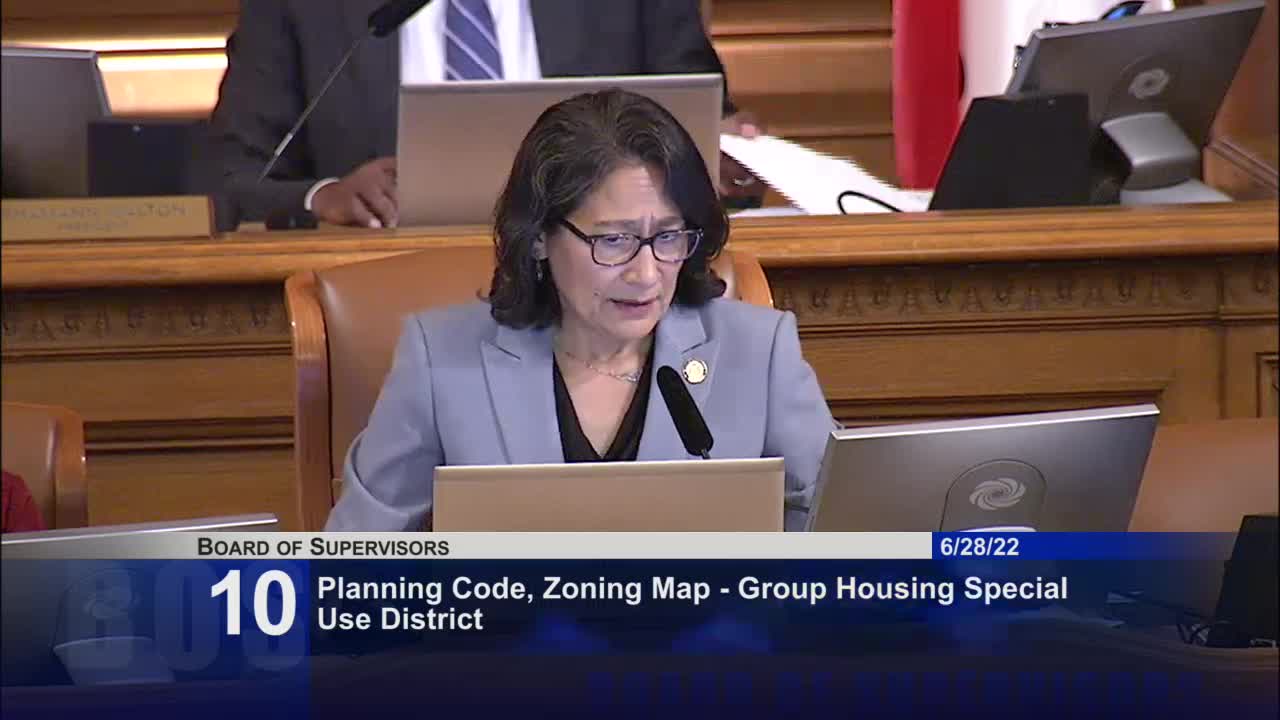
Votes at a glance (select items from June 28 meeting): - Item 11 (rezoning / density exception): Ordinance passed on first reading, 6-4 (yes: Preston, Ronen, Mandelman, Mar, Melgar, Peskin; no: Safai, "Stephanie", Walton, Dorsey). Amendment requiring regulatory agreements passed unanimously prior to final vote. - Items 6 & 7 (Department of Public Health grants to Positive Resource Center and Baker Places, Inc.): Ordinances appropriating approximately $2,000,000 and $1,200,000 respectively for one-year grants; passed finally, unanimous vote recorded as 10 ayes. - Items 8 & 9 (interim city budget and salary ordinance for FY 2022-23 and FY 2023-24): Ordinances passed (final vote reported as 9 ayes, 1 no — Supervisor Preston voted no). - Item 10 (planning code: group housing special use district): Passed on first reading, unanimous. - Items 12 & 13 (MOUs / labor contracts, including SEIU Local 1021): Adopted, unanimous.
Next steps: The rezone and density-exception ordinance cleared first reading and will return to the board for a second reading and final action. If it becomes law, the planning department and other city agencies will write implementing details and regulatory-agreement templates required by the ordinance; opponents and supporters said additional amendments and implementing programs could follow.