Get Full Government Meeting Transcripts, Videos, & Alerts Forever!
Get email alerts on the Public Health topic
No spam. Unsubscribe anytime.
After 90-day action, Board sends Tenderloin overdose emergency follow-up to committee amid questions on metrics and policing
Summary
The San Francisco Board of Supervisors on Tuesday voted unanimously to refer the mayor's Tenderloin overdose emergency and its follow-up actions to a committee after a three-hour multi-department briefing that produced new hiring and service numbers but left supervisors pressing for clearer outcome metrics and policing plans.
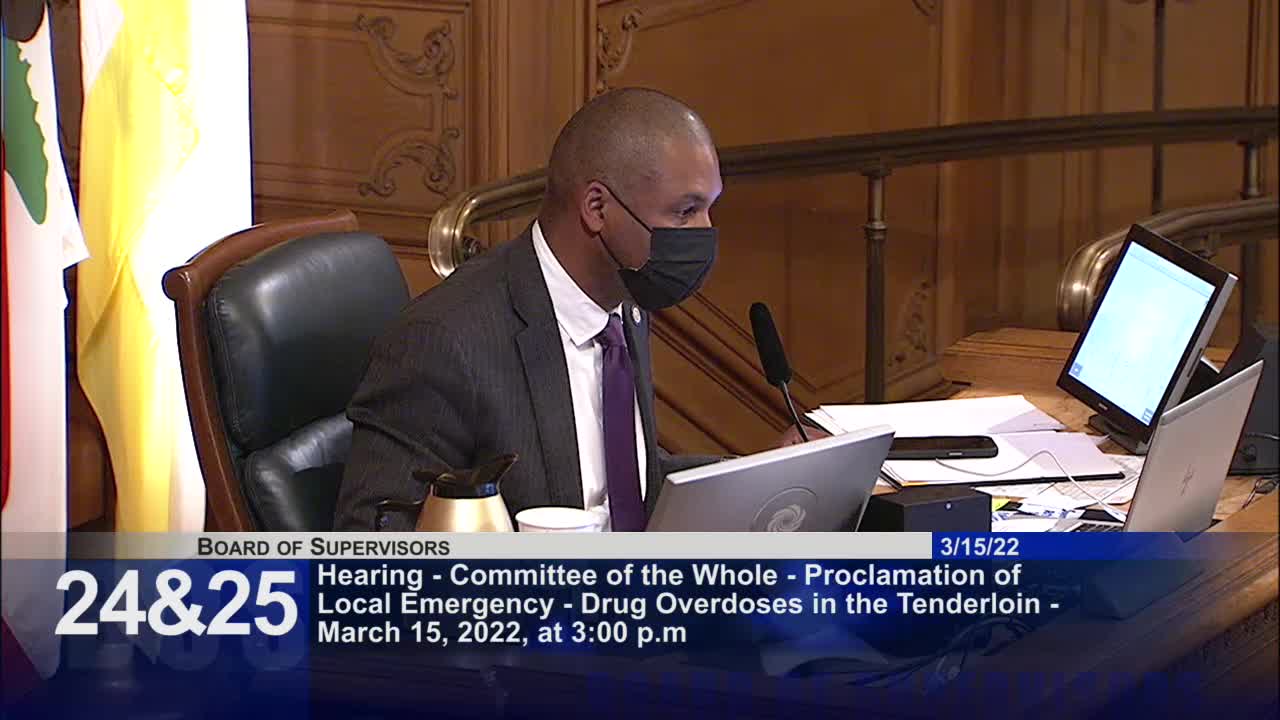
The San Francisco Board of Supervisors on Tuesday voted unanimously to send the matter of the mayor's December proclamation of a local emergency addressing a spike in drug overdoses in the Tenderloin to the board's Public Safety committee for follow-up.
The referral came after a three-hour hearing that mixed public testimony, cross-department briefings and repeated questions from supervisors about whether the emergency declaration produced measurable public-health benefits. City officials described new services, shelter placements and daily joint field operations aimed at reducing overdoses and improving safety; several board members said they still lacked detailed, timely outcome metrics and asked for clearer plans about policing and displacement.
"This emergency has focused attention and resources on a neighborhood that has been in crisis for years," Supervisor Aaron Peskin said. "But as we finish the 90 days for which the declaration authorized accelerated hiring and operations, the next step must be measurable results and sustained resources."
What the city reported
San Francisco's Department of Emergency Management (DEM) said it led an interagency response that stood up the Tenderloin Linkage Center on Jan. 18 and coordinated daily joint field operations (JFOs) that combined outreach, cleanup and enforcement. DEM Director Mary Ellen Carroll told the board the initiative prioritized both "helping" services and safety measures and was designed so the two would be "unified and mutually supportive."
Department of Public Health (DPH) behavioral-health staff reported more than 15,000 total visits to the Linkage Center across eight weeks, about 3,000 referrals to a range of health and human services, roughly 35 on-site overdose reversals and about 40-60 showers a day. DPH said it had accelerated hiring of behavioral-health clinicians, community health workers and other positions funded under the emergency.
The Department of Homelessness and Supportive Housing (HSH) said outreach teams had made roughly 2,000 direct outreach contacts in the Tenderloin and that about 345 people had been placed into shelter through the coordinated effort; 154 people had been assessed for housing and 56 had already moved into permanent housing, HSH said.
The probation department reported reentry placements and said, since mid-January, it placed about 65 justice-involved individuals into transitional housing with a high rate of continued engagement in services.
San Francisco Police Department Captain Chris Canning and a metro-division commander described enforcement and narcotics work that had produced arrests and large narcotics seizures; SFPD said the city had seen increased quantities of fentanyl recoveries and that new deployments this week added officers to the Tenderloin for stepped-up visibility and enforcement.
Board questions and concerns
Supervisors repeatedly pressed agencies for direct outcome metrics: Has the initiative reduced fatal overdoses in the Tenderloin? Are nonfatal overdoses and calls for medical aid decreasing? Carroll said the Office of the Chief Medical Examiner's (OCME) data lags but that DPH is working with the controller's office to publish a public-facing dashboard with overdose and service linkage metrics. Supervisors sought earlier access to EMS overdose-reversal data, placement figures and evidence the JFOs were reducing open-air dealing without displacing problems to other neighborhoods.
Supervisor Matt Haney said, "I'm concerned that the declaration is ending even though the crisis remains." Supervisor Connie Chan and others asked how the city would sustain gains after the emergency period and whether extra police presence would be sustained or funded through redeployment.
Captain Canning said recent deployments added roughly 20 officers to the Tenderloin station across watches and that coordination with undercover narcotics teams and joint field operations would continue. The mayor's office said the additional personnel were from existing budgets and reassignments rather than a new appropriation.
Public testimony and community priority
Public comment included neighbors, service providers and advocacy groups. Several speakers praised the Linkage Center for saving lives and connecting people to services; others urged faster, clearer connections to residential treatment beds and criticized the scale of street-level open-air dealing.
Advocates for supervised-consumption services said the Linkage Center demonstrated demand for a supervised site and argued those services reduce overdose deaths and public drug use. Neighborhood businesses and residents asked for more consistent street cleaning and daytime security.
Board action and next steps
After questioning and public comment, the board voted unanimously to refer item 25 (the motion regarding concurrence with the mayor's emergency proclamation) to the Public Safety and Neighborhood Services committee for continued review and oversight. The committee will hold more detailed follow-up hearings, gather the promised metrics and review policing and enforcement plans, agency hiring status and the Linkage Center's operational plans, including proposed hours, sober-room options and strategies to prevent displacement of people from the Tenderloin into neighboring districts.
Ending
Supervisor Peskin said the city must treat the overdose crisis as a sustained emergency regardless of the legal status of the proclamation and that the committee process is a chance to drill down on results and accountability. "We will need evidence of measurable progress," he said, "and a durable plan for neighborhoods when the accelerated-resourcing window closes."