Get Full Government Meeting Transcripts, Videos, & Alerts Forever!
Get email alerts on the Elections Funding topic
No spam. Unsubscribe anytime.
Board approves $8.7 million for elections; $3.25 million for school district remains contested after lengthy debate
Summary
The San Francisco Board of Supervisors approved an $8.7 million supplemental appropriation to the Department of Elections on first reading but hours of procedural votes and disagreement left the separate $3.25 million portion earmarked to cover school-district election costs disputed and subject to further procedural and legal review.
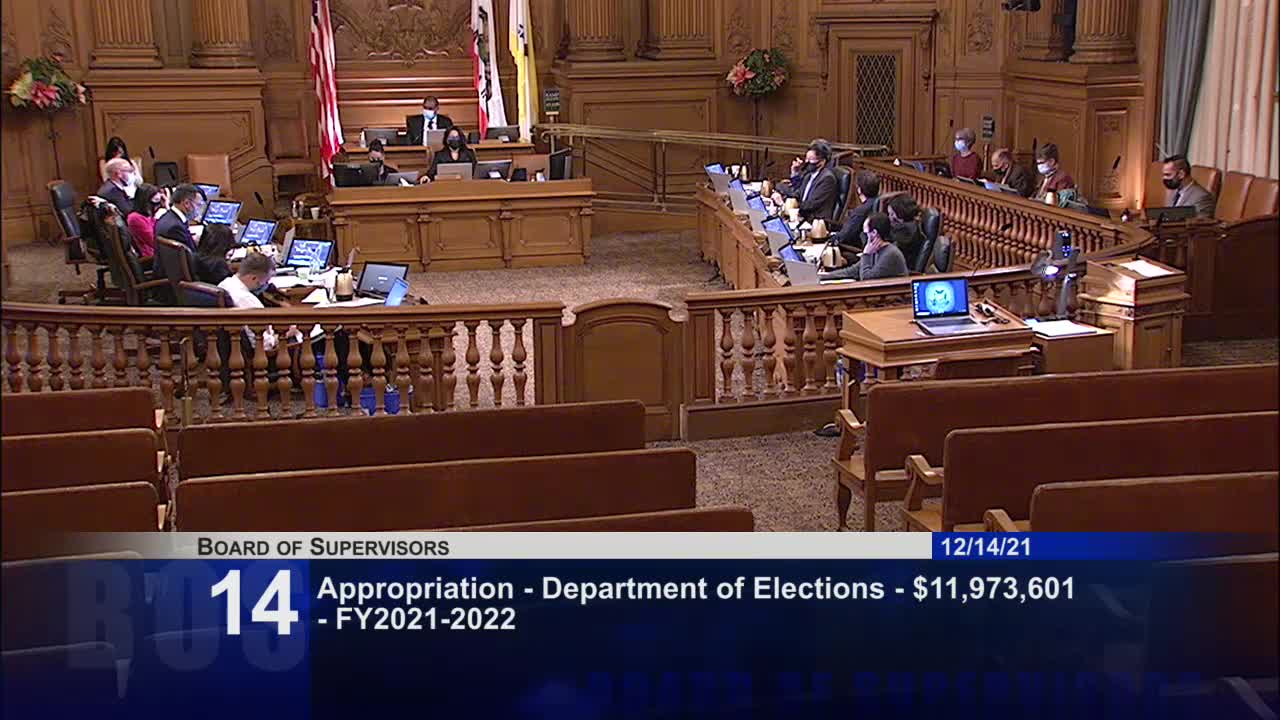
The San Francisco Board of Supervisors approved on first reading an $8,700,000 supplemental appropriation on Dec. 14 to provide the Department of Elections authority to spend additional funds to prepare for extraordinary elections in early 2022. The board split the larger $11.95 million package after extended debate over whether $3.25 million of the total should be used to cover the San Francisco Unified School District’s share of recall-election costs.
The $8.7 million item, described by Controller Ben Rosenfield and the mayor’s budget team as necessary to give the elections office time to hire contractors and ramp up operations, passed on a separate vote that the board later recorded as unanimous. The remaining $3,250,000 — which the mayor framed as covering part of the school district’s bill for special elections scheduled for February — was the subject of repeated motions to divide, continue and rescind, and drew the most disagreement among supervisors.
Why it matters: Elections departments need time and appropriation authority to enter contracts and hire seasonal staff before a ballot. At the same time, several supervisors argued it is poor policy for the city to subsidize a recall election that the school district would otherwise pay for, while others said the school district faces an urgent fiscal crisis and could not absorb the cost without cutting classroom services.
What the board said and did: Controller Ben Rosenfield told the board the elections department’s existing appropriation authority was tight and that the department would face difficulties obligating contracts and hiring without additional authority. Ashley Grafenberger, the mayor’s budget director, said the department needed time to ramp up for the February election and that some of its budget had been spent preparing for the September special election. Director of Elections John Arndt confirmed the department's budget had already partially been drawn down preparing for earlier recalls.
Supervisor Aaron Peskin led efforts to divide the package, saying members should see the appropriation details separate from the policy choice about funding a recall. Several supervisors, including Supervisor Roni Ronan and Supervisor Shamann Walton, split along policy lines: Ronan, Mirna Melgar and others argued the school district needed help because of a deep budget shortfall; Peskin, Supervisor Dean Preston and Supervisor Walton warned against using city funds for recall costs and urged broader review of supplemental appropriations. At several points the board voted, rescinded and re-voted while asking the controller to parse which line items would legally require a two-thirds (eight-member) threshold under Charter 9.113.
After procedural maneuvers, the board approved the $8.7 million appropriation on first reading. The separate $3.25 million item drew extended debate; in one recorded vote the board approved it on first reading by a 7-4 margin (ayes: Ronan, Chan, Haney, Mandelmann, Melgar, Safaïe, Stephanie; nos: Peskin, Preston, Walton, Mar), but the board and the controller noted that portions of the supplemental may legally require an eight-vote supermajority and asked the controller’s office to specify which line items are subject to the higher threshold.
Next steps and legal questions: The controller told the board he could provide a line-by-line analysis in the days after the meeting to identify which portions require a two-thirds vote because the charter treats certain restored or new appropriations differently. Several supervisors asked to continue or clarify the school-district portion to the first meeting in January so the controller could provide a definitive threshold analysis.
Ending: The board’s votes set the elections office on a path to begin contracting and staffing for early 2022 elections, but left open the political and legal dispute over whether the city should absorb school-district recall costs and whether the appropriation will require additional votes or technical adjustments when the controller completes his analysis.