Get Full Government Meeting Transcripts, Videos, & Alerts Forever!
Get email alerts on the Public Safety topic
No spam. Unsubscribe anytime.
Board approves ordinance allowing sheriff deputies to provide supplemental services to retail and commercial establishments with oversight and 90‑day reporting
Summary
The San Francisco Board of Supervisors on Dec. 7 passed an ordinance permitting voluntary overtime deployment of sheriff's deputies to provide supplemental services for retail and commercial establishments under a new Chapter 10A framework, with mandated oversight, a 60‑day initial routing through SFPD and a required 90‑day implementation report.
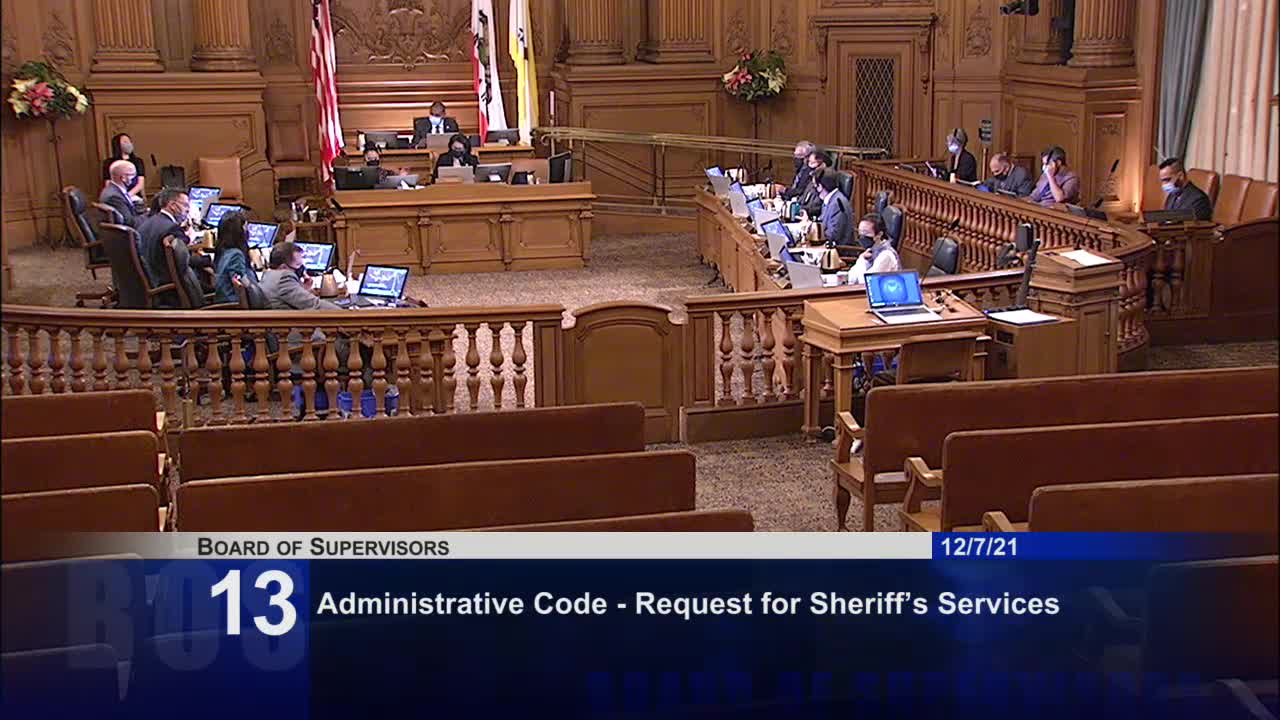
The San Francisco Board of Supervisors on Dec. 7 passed an ordinance (Item 13) allowing the sheriff to provide supplemental law‑enforcement services to retail and commercial establishments under a new Chapter 10A framework, with restrictions, oversight and a required implementation plan to return to the Board within 90 days.
The ordinance, introduced and explained by Supervisor Safaei, passed first reading after a 7‑3 roll call (ayes: Peskin, Safaei, Stephanie, Chan, Haney, Mandelmann, Mar; noes: Preston, Ronan, Walton). Supervisor Safaei said the measure is intended to expand the pool of available officers who can be hired for overtime details at retail and commercial establishments amid concerns about organized retail theft and staffing demand from private entities.
Supporters said the ordinance includes guardrails: an initial administrative flow that routes requests through the police department for the first 60 days, a required written staffing plan for any approved details, and a requirement that the sheriff, in consultation with the chief of police, develop and transmit to the board a written plan describing how the sheriff will implement and administer the program within 90 days of the ordinance's effective date. The ordinance also requires a memorandum of understanding (MOU) between the sheriff and the chief of police addressing operations such as arrests, bookings and transportation; the temporary 60‑day routing expires once the MOU is executed.
Opponents — including Supervisors Preston and Ronan — raised legal and operational objections during debate. Preston cited state attorney general opinions and warned that state law allows contracting for “special events or occurrences” and does not authorize continuous private security arrangements using sworn officers. He argued the city risks legal exposure if the program is used to staff stores on an ongoing basis. Ronan and others pressed whether using deputized staff on overtime for private details could interfere with the sheriff's capacity to staff courtrooms and jail operations, where the department already reports staffing shortages.
Sheriff Paul Miyamoto testified that participation by deputies would be voluntary overtime and that the department would not be required to deploy deputies if volunteer sign‑ups did not meet demand. He said involuntary overtime (holding on‑duty staff over) is governed by collective bargaining and that the 10A sign‑up is intended for off‑duty voluntary overtime; he told supervisors the department would meet its core obligations and would seek help recruiting and retaining staff to address persistent shortages.
Deputy City Attorney Ann Pearson said the ordinance was drafted to conform to state law authorizing local governments to enter into contracts to provide supplemental law enforcement services "to preserve the peace at special events or occurrences that happen on an occasional basis" and that the sheriff would need to develop administrative guidance to distinguish occasional events from uses beyond the statute.
The ordinance requires submittal of an implementation plan within 90 days that will cover staffing, training, use‑of‑force and booking procedures. It also limits initial operations to retail and commercial establishments and allows the sheriff and chief of police to prioritize requests consistent with departmental needs and public safety.
Supervisor Safaei said the measure is not intended to resurrect “days of over‑incarceration” and emphasized the program’s stated alternatives for people with addiction issues and other supportive services, while Preston and Ronan said the board should not risk reducing the department’s capacity to meet court obligations and constitutional speedy‑trial concerns.
The item passed first reading by a vote of 7 to 3 and will return with the required implementation materials and MOU developments described in the ordinance.