Get Full Government Meeting Transcripts, Videos, & Alerts Forever!
Get email alerts on the Transit Funding topic
No spam. Unsubscribe anytime.
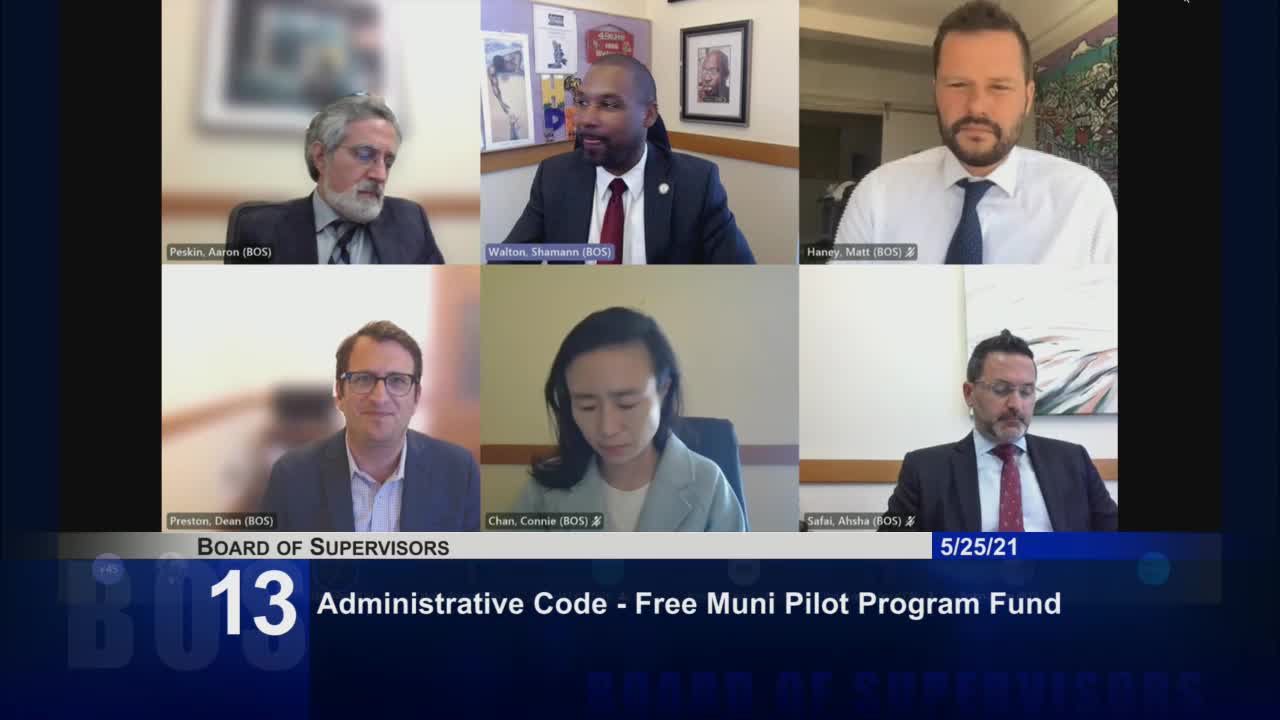
Board approves three-month "Free Muni" pilot despite split vote
Summary
After hours of debate, the Board of Supervisors approved a two-part ordinance and supplemental appropriation to fund a three-month fare-free pilot for Muni starting July 1, 2021. Supporters said the $12.5 million plan will help riders and spur recovery; opponents said service levels and operator shortages should be fixed first.
San Francisco’s Board of Supervisors voted on May 25 to approve a three‑month pilot that will make Muni rides free from July 1 through Sept. 30, 2021, funding the effort with a $12,500,000 supplemental appropriation. The measures were approved on first reading by a 7–4 vote.
Proponents said the pilot would put money back in households’ pockets, encourage people to return to public transit and help the city meet climate and traffic‑reduction goals. “We need to be expanding Muni ridership,” said Supervisor Matt D. Preston, the measure’s lead sponsor, arguing that many riders are low‑income and would save substantially from the pilot. “This is a welcome back to Muni,” he said.
Opponents focused on service reliability and operator availability. Supervisor Myrna Melgar said many routes in her District 7 were not running at pre‑pandemic levels and that without restored service free fares would not help riders in transit deserts. “I cannot in good faith support the supplemental while my constituents are in a transit desert,” she said. Supervisor Ahsha Safaí and others also cited an operator shortage and questioned whether SFMTA would accept and spend the funds as the ordinance requires.
Sponsors and committee testimony said the pilot was timed to coincide with the planned lifting of COVID capacity limitations on transit around mid‑June, which supporters said would briefly lower the cost of a trial. Preston said the city’s one‑time federal stimulus funding and projected budget surplus made the pilot financially feasible now, and he emphasized that a long‑term free‑transit policy would require a dedicated revenue source and more planning.
The board’s roll call on the two related items (an ordinance creating a special fund and a $12.5 million appropriation) produced 7 ayes and 4 noes. The four supervisors voting no were Safaí, Supervisor Shamann Walton (noting service and budgetary concerns), Mandelmann and Melgar. The measure passed on first reading and will return in the regular process for second reading and final passage.
The vote does not itself change SFMTA operational schedules; the pilot funds are contingent on the SFMTA accepting the supplemental appropriation and implementing the pilot as spelled out in the adopted ordinances.
Supporters and opponents said they expect more detailed discussions with SFMTA and community stakeholders before the program begins in July. The board also heard repeated requests for further data collection during the pilot so the city can measure effects on ridership, congestion and equity.
A vote tally taken by the clerk recorded 7 ayes and 4 noes with supervisors Safaí, Stephanie, Mandelmann and Melgar voting no.