Get Full Government Meeting Transcripts, Videos, & Alerts Forever!
Get email alerts on the Land Use Historic Preservation topic
No spam. Unsubscribe anytime.
Board reverses planning department on Green Street project, sends case back for fuller environmental review
Summary
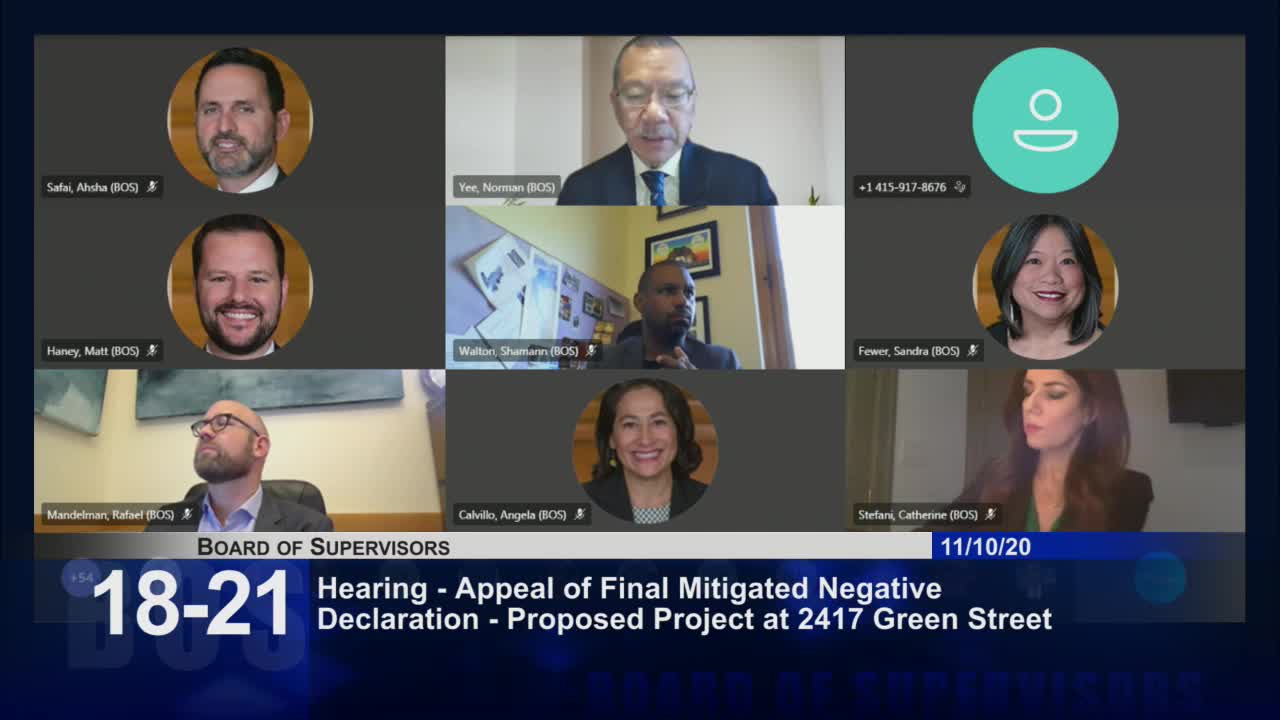
After testimony from neighbors and experts that a proposed excavation threatened the adjacent historic Ernest Coxhead house, the Board of Supervisors voted unanimously Nov. 10 to overturn the Planning Department's final mitigated negative declaration for 2417 Green Street and sent the project back for further environmental review.
The Board of Supervisors on Nov. 10 voted unanimously to reverse the Planning Department’s determination that a proposed remodel and rear addition at 2417 Green Street would not require an environmental impact report (EIR), directing the department to prepare findings and pursue additional environmental review.
The action follows months of neighborhood debate over a three‑story addition and partial excavation next door to a landmarked Ernest Coxhead house at 2421 Green Street. Appellant Philip Kaufman and his attorney Richard Drury told the board the proposed project could threaten the hilltop house’s fragile brick foundation and historic light well and said the Planning Department’s mitigated negative declaration relied on a single, deferred mitigation approach that would be inadequate.
“We have presented expert evidence from four prominent experts who concluded that the proposed project presents an existential threat to the Coxhead House,” attorney Richard Drury said, summarizing structural, architectural‑history and geotechnical analyses. Planning staff, who prepared the mitigated negative declaration (MND), maintained the document included a mitigation measure requiring coordination and monitoring to prevent adverse impacts and argued DBI’s building‑permit review would provide further protections.
Nut graf: The board’s vote to overturn the MND came after neighbors, preservationists and technical consultants described possible structural risks, contamination concerns on a city “Maher” hazardous‑site map, and slope‑stability questions. The Board concluded the record supported further environmental review to define binding mitigation rather than rely on a process measure.
What the board decided
Supervisor Molly‑Ann Stephanie moved to conditionally reverse the Planning Department’s final mitigated negative declaration for the project and to direct the department to prepare findings describing why an EIR is required. After public testimony — including architectural historian Bridget Maley and a structural engineer — the board approved the motion 11‑0.
Appellant’s concerns
Appellant counsel highlighted several technical points: the project site appears on multiple city slope‑hazard maps, the Maher hazardous‑materials layer shows the parcel near a historical tank site and the MND’s mitigation requirement called only for the developer to coordinate with staff “if unacceptable earth movement occurs,” which the appellant’s attorney characterized as too late to prevent irreversible harm. Appellant experts testified the excavation could undermine the adjacent brick foundation and lead to partial collapse on the steep hillside.
Planning and sponsor responses
Planning staff responded that the department coordinated early with the Department of Building Inspection, added a mitigation and monitoring requirement to the MND, and that DBI plan review and permit conditions would address technical construction concerns. The project sponsor, developer Chris Durkin, said he had reduced the scope of excavation and engaged geotechnical and vibration engineers; he also pledged to use less invasive demolition methods and to keep key foundations separated.
Ending: Board action and next steps
By approving the motions to reverse the MND and to direct preparation of findings (items 20 and 21 on the agenda) while tabling the motion to affirm the MND (item 19), the Board effectively required the Planning Department to revisit the environmental review. The board voted 11‑0. The decision means that the project cannot move forward under the existing mitigated negative declaration; the Planning Department must now prepare further analyses and findings that address the board’s concerns.